

Alliance Report
March 27, 2026
Issue 26/5
The leading voice of nonprofits on postal issues for over 45 years.
Copyright 2025: Alliance of Nonprofit Mailers—All rights reserved.
The Alliance of Nonprofit Mailers is a 501 (c)(4) nonprofit organization established by nonprofits for nonprofits.
Congressional Subcommittee Holds Hearing on USPS Finances
The House Committee on Oversight and Government Reform on March 17, 2026, held a hearing, “Oversight of the U.S. Postal Service: The Financial Future Under Postmaster General Steiner”, with the Postmaster General and David Marroni, Director, Physical Infrastructure, U.S. Government Accountability Office, as witnesses. The House Committee is chaired by Rep. James Comer (R-KY) and ranking member Robert Garcia (D-CA). The hearing was convened by the Subcommittee on Government Operations, which is chaired by Pete Sessions (R-TX) and ranking minority member Kweisi Mfume (D-MD).
Committee on Oversight and Government Reform Chairman Comer asked Postmaster General Steiner about a recent news article citing that the USPS is unnecessarily spending billions on the USPS Ship program after the USPS Office of Inspector General (OIG) had already recommended ending the program because the private sector already offers similar programs. Steiner responded that the USPS “wants to give customers the best experience, and generally dealing directly with customers does that,” and said that the USPS has not made a final decision on the issue yet.
Rep. Comer then focused on asking Steiner what cost-cutting measures the USPS has put in place since Congress gave it money to stabilize its financial condition five years ago. He noted that 80 percent of the USPS costs are still labor and asked why the USPS is not looking at a hiring freeze like other government agencies. Steiner recapped savings from the USPS network transformation, although he acknowledged that to date the savings are short of the plan. On the topic of labor, he said that carriers are necessary to deliver the mail, and that the USPS is focusing on what he said are two ways it can reduce its labor costs – reducing use of overtime, and changing the employee mix to include more less expensive pre-career employees.
Chairman Comer also criticized the USPS insourcing vs. outsourcing, stating that it is “hard for him to believe that the USPS can operate cheaper than private sector companies that have done these things for years.” Steiner responded that the only thing the USPS has really insourced in the past few years is transportation, largely because some contract carriers were not reliable and may not show up, whereas USPS employees can move immediately. The Postmaster General said so far, the USPS has saved about $44 million from this change.
Rep. Mfume in his opening remarks said that “putting the USPS back on secure financial footing is key,” noting that the Postmaster General had met with the Subcommittee leadership last year to share plans on stabilizing the USPS’ finances, but “since then, the USPS has continued to lose money at an alarming rate while performance has continued to suffer.” “We cannot allow this to continue happening,” Rep. Mfume said, “the USPS needs to cut costs and increase revenue.” He said the Subcommittee appreciates the Postmaster General’s efforts to do so, acknowledging “it’s not an easy matter, it’s a juggling act.”
In his written testimony submitted for the hearing, Postmaster General David Steiner said “I am not sure that the American public is aware that the Postal Service is at a critical juncture.” “I know that I wasn’t aware of the extent of it before I took on this role,” he said, “but at our current run rate and if we continue to pay our required obligations in the same manner as we have done in recent years, then we will be out of cash in less than 12 months.” “So,” Steiner told the Subcommittee, “less than a year from now the Postal Service will be unable to deliver the mail if we maintain the status quo.”
Steiner said that reasons for the current financial crisis include a drastic reduction in the use of mail, being regulated like a monopoly, and a variety of legislative “anchors” that “weigh down” the agency. The Postmaster General said that its regulator (the Postal Regulatory Commission or PRC) “ensures that we won’t make money or break even – out of fear of a non-existent mail monopoly.” “The regulator puts pricing restrictions on us,” he said, “requires we give ‘work share’ dollars back to our customers, and places a number of other unreasonable burdens on us that cost us billions of dollars every year.” “Moreover,” Steiner said, “they recently enacted an order that, among other things, limits us to one price increase per year for our mailing services, a change that by their own math will cost us more than $700 million in lost revenue over five years.”
The legislative “anchors” outlined by the Postmaster General included being “required to pay a disproportionately high share of Civil Service Retirement System (CSRS) benefits for employees that worked for both the Post Office Department, prior to our creation as an independent entity in 1971, and subsequently for the Postal Service;” a $15 billion limit on its borrowing authority (which Steiner said should be raised to $30-40 billion); allowing the USPS to invest its retirement funds in other than Treasury notes; not being able to manage its own workers’ compensation claims; and more.
The Postmaster General told Congress “we are mandated by law to deliver to every address—more than 170 million of them—six days a week.” “While this is our statutory obligation as a public service entity,” he acknowledged, “it is also our financial burden.” “This leads to 71 percent of our delivery routes being financially underwater,” he said, “[a]nd fifty-eight percent of our Post Offices do not cover the cost of their operations.” “Each day of delivery costs billions of dollars every year,” Steiner said, noting that “[t]he simple financial solution would be to cut the number of days of delivery, and Post Office locations, which I don’t believe is anybody’s preference.” “But if we are expected to deliver six days per week, absent the volume or pricing authority to justify or afford it, some source of funding beyond postal revenue needs to pay for it,” he said.
“So, all those costly inequities amass to an incredibly burdensome anchor that plagues our financial trajectory, and we should have a discussion about all of them,” the Postmaster General said. “But in the short term,” he noted, “in order to ensure our survival beyond next year, we need to increase our borrowing capacity so that we don’t run out of cash.” “The failure to do this could lead to the end of the Postal Service as we know it now,” he emphasized.
Steiner later in his testimony detailed how the Postal Service is doing “everything humanly possible to work through restrictions and financial handcuffs to deliver mail and packages that are so depended upon by the American public.” The Postmaster General said “there are only three things that any company can do to improve financial performance— sell more products, raise prices, or cut costs.” He said the USPS is looking at all three, noting the USPS has recently expanded its portfolio of package products through its last mile delivery initiative.
“On the pricing side,” the Postmaster General testified, “we need to look for higher prices on both our package and mail products.” He noted that “at 78 cents, the U.S. First-Class Stamp is the lowest-priced in the industrialized world.” “Compare it to France, at almost $3, and England at $2.50,” he said, noting that “the longest distance that letters have to travel in those countries is about 600 miles—smaller than the state of Texas.” “We deliver from the tip of Puerto Rico to the tip of Alaska for 78 cents,” he said, noting “[t]hat’s a distance of 5,000 miles.” “So, we sell the stamp at less than half the cost to travel over eight times farther,” he said.
“If we were to change the stamp price to 90 to 95 cents,” Steiner testified, “which is still less than half of the cost of most foreign posts, that would largely solve our controllable loss.” “And the stamp price would still be the lowest in the industrialized world by a lot,” he said.
On reducing costs, Steiner said the USPS in the last few years has undertaken an “unprecedented transformation of our network and operating practices to reduce costs.” “We know that our initial execution of these changes should have been much better,” he acknowledged, “and that we have not yet achieved the entirety of the savings that we initially projected.” “But that cannot detract from the fact that our network is dramatically improved,” he said, “and that we are seeing significant benefits from the changes, both in terms of improved service reliability and more cost-effective operations.” “These benefits will only grow as we continue to roll out and refine our network,” he said, “add more volume to the same network, and leverage the opportunities presented by those changes to operate as efficiently as possible.” The Postmaster General also said the USPS is continuing to look for ways to further reduce its costs.
“If you want the same level of services that we have today—six-day-a-week delivery and 33,000 plus post offices,” the Postmaster General told the Subcommittee, “we can do that, and we are glad to do that.” “But someone has to pay for it, and the only options are postal ratepayers or taxpayers,” he said. “If we want to have a discussion about reducing the level of service to both meet the needs of the American public but also make the Postal Service self-sustaining, we are glad to have that discussion,” Steiner said. “But there is one thing we can’t do,” he stressed, “and that is maintain the status quo.”
Marroni’s written testimony consisted of the recently published report by the GAO, Urgent Action Needed to Fix Unsustainable Business Model and Improve Service Performance. He acknowledged during the hearing that the USPS has taken actions, but “not enough.” “The USPS’ expenses are growing at a faster rate,” he told the Subcommittee, “which is not sustainable.” “Something has to change,” Marroni said, noting that “the USPS needs to take additional actions within its own authority to improve its financial condition,” as well as develop long-term financial projections to help communicate its progress to Congress.
Marroni said it is “highly unlikely” that the USPS can fix its poor financial condition entirely on its own, stating that “Congress needs to act – it may take short term measures to ensure the Postal Service doesn’t run out of cash, but there is also a need for measures to ensure long term viability.” He stressed that within the next five years, the USPS will be responsible for another $6 billion per year in retiree health benefits costs. “Congress needs to decide the level of postal services the nation needs and how to fund it,” he said. “USPS has been struggling financially for years, it is now reaching a crisis point,” Marroni told the Subcommittee. “We need to fix the USPS’ business model for the long term,” he said, “and difficult choices are ahead, but they need to be made now.”
The Subcommittee asked the Postmaster General for a break down of where its revenue comes from and a break down of its costs, as well as more information on the USPS’ legislative asks and different financial scenarios based on each potential change. Subcommittee Chairman Rep. Sessions at the conclusion of the hearing said that although he finds Postmaster General Steiner “refreshing and honest,” that “decisions still must be made that are in the best interests of all the people who want, need and expect a good postal service for a good price with sound service.” He noted that when the Subcommittee leadership met with the Postmaster General before he said the Subcommittee does not want to see the USPS raise the price of a stamp. “The buck stops here now,” he said. “We are going to do this together, but we will do this,” he told the Postmaster General and Subcommittee members. Sessions said the Subcommittee needs to “dig in further” on the USPS financials but needs to do it rapidly and get to the real issues.
A recording of the hearing, along with the written testimony submitted by both witnesses, is available at: https://oversight.house.gov/hearing/oversight-of-the-u-s-postal-service-the-financial-future-under-postmaster-general-steiner/
Alliance Submits Statement to Congressional Subcommittee
Shortly after the conclusion of the March 17, 2026, Congressional hearing on the state of the USPS’ finances, the Alliance of Nonprofit Mailers submitted a statement for the record to provide the perspective of nonprofit organizations on the USPS finances and some of the testimony at the hearing (see above).
“Our members are largely captive users of the Postal Service’s monopoly,” the Alliance told the Congressional Subcommittee, “in that direct mail tends to be their best avenue for raising funds, distributing publications, building membership, and communicating with members, donors, constituents, and lawmakers.” “Nonprofit organizations mail 11 percent of all market-dominant mail volume and purchase significant volumes of First-Class Mail, Marketing Mail, and Periodicals Mail to support their charitable purposes,” it noted.
In addition to sharing the impacts that excessive USPS postage increases have had on nonprofit organizations, the Alliance included some additional information in response to some questions and comments that came up during the hearing. “We are hopeful that a solution to the USPS’ financial issues can be developed that does not depend on additional price gauging of captive mailers like nonprofit organizations,” the Alliance said.
The subcommittee during the hearing had asked about where the USPS’ revenue comes from. “In the USPS’ Fiscal Year 2025,” the Alliance said, “58.1% of the USPS’ total revenue came from mail (Market Dominant products) vs. packages (Competitive Services products).” “Within the monopoly mail side of the USPS’ charter,,” it noted, “in FY2025 only 14.7% of its Market Dominant revenue came from consumers (First-Class Mail Single Piece letters and cards).” “The vast majority of the USPS’ Market Dominant revenue (85.3%) came from businesses and nonprofit organizations paying postage to send mail,” the Alliance stressed. “We note this fact,” it said, “because it helps put into perspective comments that attempt to minimize the impact of price increases by pointing only to impacts on consumers.” “While it may be true that increasing the price of a stamp to $1.00 might not be significant for most consumers,” the Alliance told the Subcommittee, “it would be hugely significant for businesses and nonprofit organizations that rely on using the mail.”
The Alliance stressed that the frequency and magnitude of USPS postage price increases above CPI over the past five years have accelerated mail volume declines. “Since the Postal Service was granted and has aggressively used rate authority above CPI,” it said, “starting in 2021, nonprofit mail volumes (Nonprofit Periodicals and Nonprofit Marketing Mail) have declined by an average of 3.5% annually from FY 2021 to 2025.” “Over the prior 15 years (which included extraordinary events like the Great Recession and pandemic),” the Alliance noted, “nonprofit mail volumes declined at a slower pace — by an average of 1.7% annually.” “The annual rate of decline in the last five years has more than doubled,” it summarized, “even in the absence of recession and COVID-19.”
In its statement, the Alliance recapped impacts from the high price increases that were recently reported by nonprofit organizations in letters and declarations in the Postal Regulatory Commission’s 5-year rate system review proceeding [these comments have been recapped in the last 2 issues of the Alliance Report].
The Alliance also included in its statement, information about the value of nonprofit organizations to the United States and to the USPS. “According to the National Council of Nonprofits,” it said, “’charitable nonprofits feed, heal, shelter, educate, nurture, and inspire people of every age, gender, race, and socioeconomic status, from coast to coast, border to border, and beyond.’” “Nonprofit organizations benefit the U.S. economy, with over 1.8 million recognized 501(c) organizations in the U.S. employing over 13 million people, representing 9.9% of all private sector employment,” the Alliance said, noting that “[a]s of 2022, nonprofit employment equaled that from the manufacturing industry segment in the U.S., and was second only to the retail and food industries.”
“For FY 2025, $2.12 billion of the Postal Service’s revenue came from nonprofit mailpieces, which represented over 11% of total market-dominant mail volume,” the Alliance told the Subcommittee, noting “[t]hat doesn’t include the mail in other categories that is generated as a result of a direct mail donation or subscription response.” “Most nonprofit mailpieces that are successful in bringing in charitable donations result in more mailpieces being sent at higher commercial rates,” it said, noting that “[s]ubscriptions generate First-Class Mail pieces for bill payment and Business Reply Mail (BRM) pieces, and charitable donations are returned via First-Class Mail or Business Reply Mail pieces.”
The Alliance told the Subcommittee that the USPS can’t price its way to financial stability, “as can be seen by the testaments from multiple nonprofit organizations, and similar conditions for commercial mailers.” “Higher prices lead to faster erosion of the USPS’ mail volumes,” it said, “which is a serious concern for the long-term health of the system.” “We believe that a multi-pronged approach is needed to put the Postal Service back on solid financial footing,” the Alliance said.
“The USPS needs to reduce its costs and improve its efficiency,” it stressed. “In just the last five years (FY2021 through FY2025),” the Alliance noted, “the USPS Office of Inspector General (OIG) identified a total of $7.8 billion in USPS ‘questioned costs,’ ‘revenue impacts,’ and ‘funds put to better use,’ many of which would accrue annually once implemented so that the total savings would be even higher over time.” “The USPS could start there in looking for opportunities to reduce costs,” it said, “and although we welcome the reported recent formation of a USPS team to explore cost cutting opportunities, we believe such an effort should have been ongoing since the USPS first began to experience significant financial losses.” “Instead,” the Alliance stated, “the USPS’ answer seems to always be to continually raise prices on captive Market Dominant mail.”
“While an annual two percent reduction in costs (as referred to in the EIG Study recently submitted to the PRC, which said such cost reduction would see the USPS to break even status by 2030) may not be ‘easy,’ as the Postmaster General said at the hearing,” the Alliance noted, “it is a fairly standard target in the private sector.”
The Alliance thanked the Subcommittee for its efforts in holding the hearing and the work it says will follow. “We support the Subcommittee’s efforts to find solutions to the USPS’ financial condition that do not include continually raising prices for captive mailers, which accelerates mail volume declines,” it said. “Such solutions should include more aggressive cost-cutting focus by the USPS as well as legislative changes such as the USPS has requested Congress consider,” the Alliance said.
President Nominates Three for USPS Board of Governor Vacancies
The President on March 2, 2026, nominated three individuals to fill vacancies on the USPS Board of Governors. The below three join former nominee Anthony Lomangino, chairman and founder of Southern Waste Systems, who was nominated previously and renominated in the current Congress.
- Jeffrey Brodsky, Florida, to serve term ending Dec. 8, 2029, vacated by former governor William Zollars. Brodsky is co-founder and managing director of Quest Turnaround Advisors, a management firm that provides advice, intramanagement or liquidation of companies facing financial crisis. https://qtadvisors.com/phone/jeffrey-a.-brodsky.html
- William Gallo, of Florida, to serve a term ending Dec. 8, 2030, vacated by former Governor Anton Hajjar. Gallo is CEO of Emergency Medical Solutions, and he is described as an experienced entrepreneur with a track record of starting and growing profitable entities. https://www.linkedin.com/in/william-c-gallo/
- Robert Steffens, Texas, to serve a term ending Dec. 8, 2032, vacated by former Governor Robert Duncan. Steffens has had a lengthy career in financial planning and business operations in the entertainment industry at Marvel Entertainment. https://www.linkedin.com/in/rob-steffens-5490a34/
The nominations will next be taken up in the Senate for confirmation hearings. Government Executive subsequently published an article noting the nominees and reactions from some stakeholders.
The Latest on USPS’ Rate Authority for a July 2026 Price Increase, Based on Updated CPI
The Bureau of Labor Statistics on March 11, 2026, released the February 2026 CPI, which increased by 2.4 percent from February 2025 and increased by 0.3 percent from January 2026 (seasonally adjusted).
The CPI price cap authority for a July 2026 market dominant postage rate adjustment is now 2.613 percent. This reflects not only the release of the February 2026 CPI, but also the Postal Regulatory Commission’s (PRC) new method for addressing the missing October 2025 CPI. See table below for the total July 2026 rate authority. The USPS is expected to file its proposed price changes for July at the PRC before April 10, 2026 (when the March CPI is released).

USPS February Financial Results
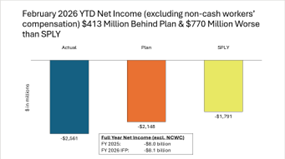
The USPS on March 24, 2026, filed its preliminary financials for February 2026 with the Postal Regulatory Commission (PRC). For February 2026 year-to-date, the USPS net income (excluding non-cash workers’ compensation) was $413 million less than its Plan and $770 million worse than the same period last year (SPLY). Volume year-to-date continues to be below SPLY, largely due to last year’s election mail volumes. Revenue year-to-date is similar to last year, as can be seen below.


USPS Files for Limited Price Change
The USPS on March 25, 2026, filed a request with the Postal Regulatory Commission (PRC) for a “time-limited price change to better align its costs of transportation with the market.” “This temporary price adjustment will provide needed flexibility for the Postal Service by helping to ensure that the actual costs of doing business are covered, as required by Congress,” the USPS said in its announcement. This marks the first time the USPS has essentially requested a fuel surcharge for its Competitive Services parcel products.
The USPS is proposing the limited time price increase for Priority Mail Express, Priority Mail, USPS Ground Advantage, and Parcel Select. No price changes are being made to Special Services or International competitive products. “The new prices will take effect on April 26, 2026, and will roll back to approved levels on January 17, 2027,” the USPS said. “At that time,” it said, “the Postal Service can determine if a different long-term approach is needed.” The USPS is proposing an 8% increase across the board.
“While this price increase is a time-limited adjustment,” the USPS said, “it will provide a necessary bridge to a permanent mechanism to reflect market conditions in prices for competitive products that can support the Postal Service’s ability to achieve the universal service obligation in a more financially sustainable manner going forward.”
“Transportation costs have been increasing,” the USPS said, “and our competitors have reacted with a number of surcharges.” “We have steadfastly avoided surcharges and this charge is less than one-third of what our competitors charge for fuel alone, so even with this change, the Postal Service continues to offer great value in shipping with some of the lowest rates in the industrialized world,” it said.
“The time-limited price change is consistent with industry practices and will support the Postal Service’s ability to continue achieving its public service mission — providing a nationwide, integrated network for the delivery of mail and packages at least six days a week — in a cost-effective and financially sustainable manner over the long term,” the USPS said, “just as the U.S. Congress has intended.”
PRC Issues Annual Compliance Determination (ACD)
The Postal Regulatory Commission (PRC) today issued its Annual Compliance Determination (ACD) report, “a comprehensive evaluation of whether the Postal Service complied with price caps for Market Dominant products, cost attribution requirements, and service performance standards.” A summary of the Commission’s overall findings is captured in the ACD’s Executive Summary. The ACD outlines the Commission’s detailed findings, recommendations for improvement, and directives requiring the Postal Service to take specific corrective actions where necessary. Highlights from the ACD include:
Market Dominant Rate and Fee Compliance. The PRC determined that “all FY 2025 rates complied with applicable rate authority provisions and that all workshare discounts were compliant when introduced based on the most recent avoided cost data.” The USPS will be required to bring any discounts that are not in compliance with applicable regulations based on the new FY2026 avoided costs into compliance in the next price change.
Market Dominant Non-Compensatory Classes and Products. The PRC found that the USPS “incurred $711.6 million in losses from non-compensatory classes and products in FY 2025.” It found that “Periodicals was the only non-compensatory class, and both products within that class were non-compensatory, while Alaska Bypass Service (Package Services class) and USPS Marketing Mail Flats (USPS Marketing Mail class) were also non-compensatory.” The PRC directed the USPS to adjust prices for these products (an additional 2% price increase) in the next price change.
Competitive Products. The PRC found that “total revenues for Competitive products were not subsidized by Market Dominant products during FY 2025, thereby satisfying 39 U.S.C. § 3633(a)(1).” The PRC also found that “collectively, Competitive products satisfied the appropriate share requirement of 39 U.S.C. § 3633(a)(3).” “However,” it noted, “revenues for 18 Competitive products did not cover attributable costs and, therefore, did not comply with 39 U.S.C. § 3633(a)(2).” “Revenues for 5 Competitive domestic contracts included in Non-Published Rates (NPR) products, and 6 Competitive international sub-products or components, did not cover their attributable costs,” the PRC found, “even though the product covered its attributable costs.”
Nonpostal Products and Services. The PRC found that “Market Dominant and Competitive legacy nonpostal products complied with the applicable requirements of 39 U.S.C. chapter 37 and that Competitive legacy nonpostal products satisfied the cost coverage requirement of 39 U.S.C. § 3633(a)(2) in FY 2025.” “As it relates to the Postal Service’s interagency agreements (IAAs),” the PRC found that the USPS’ “IAAs provided a net contribution to the Postal Service in compliance with 39 U.S.C. § 3704 during FY 2025.”
Service Performance. The PRC found that “20 out of 27 Market Dominant products/categories failed to meet their FY 2025 service performance targets and directs the Postal Service to take corrective action to achieve compliance in FY 2026.” “This occurred,” the PRC said, “despite the Postal Service lowering its targets for 19 products/categories in FY 2025.” “The remaining seven products met their targets,” it found.
The PRC said its analysis “also confirms that changes to the service performance measurement system, particularly the Sunday/Holiday exclusion, produce a meaningful but uneven increase in reported service performance scores, as much as 2.1 percentage points for some products’ annual on-time performance.” The PRC directed the USPS to “improve service performance results to achieve the applicable on-time percent target level for all non-compliant products in FY 2026.” The PRC said it has “developed specific directives that are designed to provide increased transparency for the public about the government-owned postal operator’s ongoing efforts to restore service performance for those products in FY 2026.” “These directives include continued Postal Service reporting of specific information developed from its internal metrics within 90 days of the issuance of this ACD and as part of the Postal Service’s FY 2026 ACR,” it said.
Flats. The PRC found that “overall cost coverage for flats products improved in FY 2025, with 5 out of 8 flats products covering their costs and unit revenue rising across all 8 flat categories.” “However,” it said, “unit costs for non-compensatory flats increased significantly, and service performance continued to decline for most categories.” “Persistent operational challenges, such as bundle breakage rates, in addition to increased purchased transportation costs and delivery costs contributed to these results,” it said, and provided “several recommendations for the Postal Service to collect, improve, and analyze data on specific flats initiatives.”
Later this spring, the PRC will release a separate, expanded report on the Postal Service’s Financial Results and 10-K Statement for 2025. “In addition,” the PRC noted in its press release, “the Commission will also issue a supplemental report on the Postal Service’s FY 2025 Annual Performance Report and FY 2026 Performance Plan.”
Highlights from the Mailers Technical Advisory Committee (MTAC) Meetings
Below are some highlights from the meetings held earlier this week of the Mailers Technical Advisory Committee (MTAC). If anyone would like additional information on any of the below, email kathy@nonprofitmailers.org.
Postmaster General Remarks to MTAC. Postmaster General Steiner kicked off the MTAC meetings with remarks and a Q&A period with MTAC members and guests. He noted that the USPS had a good peak season that brought it “within shouting distance of where we need to be.” He said that USPS performance during peak shows that it can do a much better job of operating its network, but that the USPS still needs to learn how best to operate the new network. He said one thing the USPS does not yet have in place is end-to-end visibility of where every package is as it moves through the network. “If we can get that in place,” he said, “we will be able to solve many problems.” He said the USPS will be devoting a lot towards that goal in the coming months.
Steiner talked about the many stakeholders involved with the USPS, including employees and their representatives, the many mailing industry associations that comprise MTAC, Congress, and the millions of U.S. citizens that send and receive mail. “We are the only ones that have to look at all those constituencies and how to balance their needs,” he said, “and it is a monumental task.” Steiner said everyone will need to chip in to save the USPS considering its “dire” financial situation.
He said that Congress understood when it created the Postal Service back in 1971 that it would ask the USPS to do things that don’t make money. “Hence,” he said, “Congress allocated funds to cover those things,” through a Public Service Law established back in 1971 that required Congress to contribute annual appropriations to the USPS to fund the universal service obligation. In actuality, the USPS has not requested the annual appropriation in over 40 years. In response to the question of why, Steiner said, “I asked the same question when I came here,” and it seems that for many years when volumes were strong and increasing, the USPS did not request the appropriation, then it just became routine not to request it. “You are all businesses,” he said to the MTAC group, “if you found out you were making a billions of dollars mistake…wouldn’t you do something?” “We will have to send a bill to Congress,” he said.
Steiner echoed some of his recent testimony before the Congressional Subcommittee on Government Operations (see above article), that the USPS can do whatever Congress and the American people want, but someone has to fund it. He said in the short term, increasing the USPS’ debt limit would prevent it from the impending liquidity crisis. For the long term, he said if the USPS has to “work in a universe where we have all these constraints and no funding,” then the USPS would have to figure that out. He noted the USPS has hired a restructuring firm to help identify self-help options for the USPS, and he said they are looking at “everything.” He said “nothing is off the table, you can’t have sacred cows when the ship is going down.”
MTAC Recognizes Sharon Owens. Sharon Owens, USPS Vice President of Costing & Pricing was recognized by MTAC for her many contributions and work with the mailing industry over the years. Owens will be retiring from the USPS in May.
July Price Increase. The USPS shared its current forecast for the July 2026 price increase (see below), noting that the impacts from discounts, promotion incentives and the growth incentive will not significantly impact the July price changes:
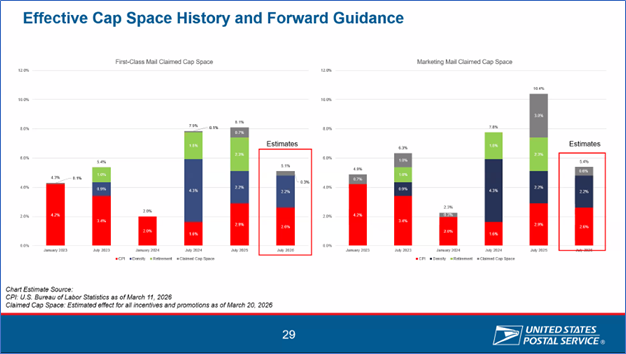
In addition to the price changes for July, the USPS will be implementing structural changes. Structural changes already approved by the Postal Regulatory Commission (PRC) in the last price change proceeding include: elimination of the ADC destination entry and presort discounts; increase in Marketing Mail maximum weight and addition of Heavy Printed Matter category; aligning “Mixed” price nomenclature; and simplification of Periodicals price structure. Also planned is a change that does not require PRC approval, allowing First-Class mail letters and cards to have a combined 500-piece minimum (vs. separate 500 piece minimums today).
Additional structural changes the USPS plans to propose include the two new promotions (see article below); elimination of Marketing Mail flats bundles in tubs; a Package Quality Noncompliance Fee; the new Heavy Printed Matter rate structure; changes to the Bound Printed Matter (BPM) pricing structure (change to BPM carrier route bundles) and BPM nonstandard parcel bundling (eliminate bundles in sacks); and a new National Change of Address (NCOA) structural addition. Information on these changes can be found in the proposed Domestic Mail Manual (DMM) updates to take effect July 12, 2026, shown on Postal Explorer (https://pe.usps.com/DMMIMMUpdates/Index).
USPS Initiative on Reimagining Mail. In an effort to better retain and grow mail volumes, the USPS has embarked on a “Reimagining Mail” initiative. The USPS said data shows that direct mail still works and has a good ROI, but the percentage of advertising spend on mail vs. other media has been declining. The USPS wants to generate ideas on how to bend that curve back more towards mail and is soliciting ideas from industry groups with “everything on the table.” The initiative will look at how to improve perceptions of mail and its value, educating new generations on using mail, improvement or new products, how and where mail is entered to optimize the new USPS’ network, simplification of processes and requirements – making it easier to use the USPS’ products and services, changes to pricing strategies, new promotions or other solutions, partnerships, and more.
USPS MTE Update. The USPS gave a brief update on availability of Mail Transport Equipment (MTE), noting that there recently have been issues with availability of EMM trays and flat tubs. The USPS has made additional orders of MTE and said it expects to see improvements in availability in the next few weeks.
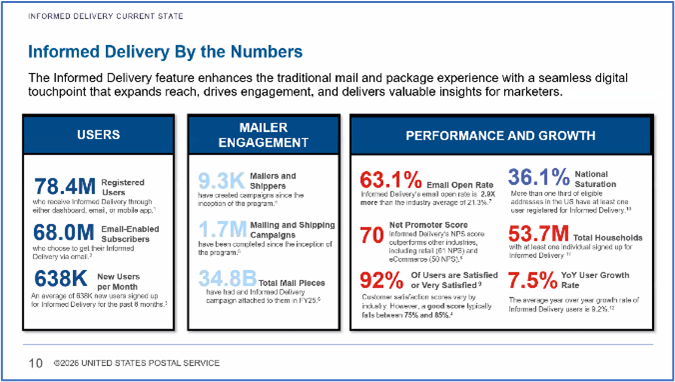
Informed Delivery Update. The USPS gave an update on its Informed Delivery program (see slide right), noting that campaigns continue to increase. The USPS surveys users every six months or so to obtain feedback on issues, enhancements, etc. It is proposing enhancements to the mailer portal and other tools, focusing on helping small/medium mailers.
USPS Proposes Eliminating PMOD for Parcels. The USPS on March 19, 2026, published in the Federal Register proposed changes eliminating its Priority Mail Open and Distribute (PMOD) service for packages effective January 17, 2027. The proposed changes to not impact use of PMOD for letters or flats. The USPS said at the MTAC meeting that only about six companies will be impacted.
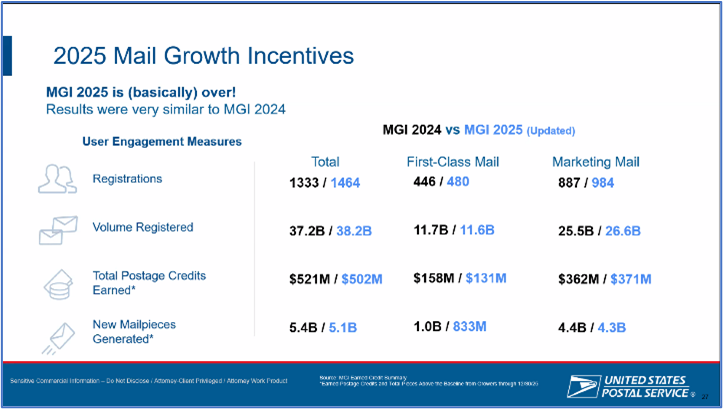
Mail Growth Incentive Program. The USPS shared a comparison of participation in the Mail Growth Incentive program from 2024 to 2025 (see slide to right), as well as info on the 2026 program. The registration period for the 2026 program began in March 2026 and ends May 30, 2026. Those who participated in the 2025 program should be automatically enrolled by the USPS’ system. The USPS said it has approved about 400 participants so far, is in discussions with about 80 and is waiting for information from customers for about 1100. There are no significant changes in the program for 2026 compared to 2025.
USPS to Propose Two New Promotions for 2027
The USPS at this week’s meeting of the Mailers Technical Advisory Committee (MTAC) shared preliminary information about two new promotions it plans to propose (pending approval) for 2027. More information will be included when the USPS files its price change proposal in April to take effect in July.
The two new promotions include “Direct Mail Discovery” for Marketing Mail (including nonprofit Marketing Mail) to incentivize new mailers to try mail for the first time; and the “Impact Messaging” promotion which will be for First-Class Mail and Marketing Mail (including nonprofit Marketing Mail) to get customers to take action with high impact messaging demonstrating the power of mail.
The USPS also plans to propose continuation of the Integrated Technology; Tactile, Sensory and Interactive; First-Class Mail Advertising (enhanced to include inserts); and Informed Delivery Add-On and Sustainability Add-On. The existing Catalog Incentive will be ending and replaced with the prior check-box catalog incentive.
Into the Postal Weeds…
For those who live in the “postal weeds,” and are looking for news on mail entry, preparation, discounts, incentives, and more, this column in the Alliance Report will be right up your alley! We won’t go all the way into the weeds…but we will offer up highlights on useful resources and mailing standard changes.
- USPS FAST Appointment Update. Effective March 29, 2026, a system update will modify how FAST appointment no-shows are processed. A FAST appointment will be considered a no-show six (6) hours after the scheduled appointment time, a change from the current 24-hour timeframe. If the associated load has not arrived at the assigned facility within six hours of the appointment time, the appointment will be canceled in the system and a new FAST appointment will be required. As a reminder, a no-show is defined as a load that has not arrived at the assigned facility for the scheduled appointment. FAST appointments may be amended up to one (1) hour prior to the scheduled appointment time. For questions, please contact the FAST Help Desk at FAST@USPS.GOV.
Alliance April Webinar for members & sponsors only – Register Now!
Our 2nd webinar for 2026 will be held in April and will be for Alliance nonprofit members and sponsor members only. This next webinar will focus on the details of the USPS’ July 2026 price change, update on regulatory proceedings and news from the March meeting of the Mailers Technical Advisory Committee (MTAC).
The webinar will be held on Friday, April 17, 2026, from 1-2 EST. This webinar will be open to current members and sponsors only. Registration is open at https://zoom.us/meeting/register/W6PTrjgzQXKTzFQHO0omdQ.
The Alliance is planning to hold more webinars in 2026, some will be restricted to Alliance members only, others will be open to all. If there are specific topics or speakers your organization is interested in having a webinar on, email me at kathy@nonprofitmailers.org.

Leave a Reply