

Alliance Report
December 22, 2025
Issue 25/12
The leading voice of nonprofits on postal issues for over 45 years.
Copyright 2025: Alliance of Nonprofit Mailers—All rights reserved.
The Alliance of Nonprofit Mailers is a 501 (c)(4) nonprofit organization established by nonprofits for nonprofits.
USPS Petitions PRC for Changes in Rate System
The USPS on December 22, 2025, filed two petitions at the Postal Regulatory Commission (PRC), “to adjust the system for regulating market dominant rates.” The USPS said to address its ongoing systemic problems where it continues “to face multibillion dollar losses every year under the current system, despite our comprehensive efforts to correct the systemic imbalance between our annual revenues and costs,” it has filed the petitions to provide it additional flexibility to price Mail and Services and to improve its precarious cash position [see below article]. “Both approaches are intended to provide more time for the Postal Service to continue cutting costs, implement new strategies to increase revenue, and pursue other means of narrowing our losses,” it said.
Rate Authority. The first USPS petition asks the PRC to replace the price cap system with a “regulatory monitoring approach, under which the Postal Service’s Governors would be given the authority and flexibility to establish the parameters that will govern the path of rates over a 5-year regulatory review period.” The USPS said as part of this proposal, it is committing to providing “forward guidance to specify: the estimated filing and implementation dates for future rate adjustments, the price ‘ceiling’ for the entire course of the five-year regulatory review period based on the established parameters, and mail and service class-level guidance for the first rate adjustment.”
“The regulatory monitoring approach is the best way to properly balance and achieve the statutory objectives, including assuring the Postal Service’s financial stability,” it said, “by giving the Postal Service the pricing tools we need to adapt to changing conditions while retaining a robust oversight role for the PRC.”
The USPS said that if the PRC decides the statutory objectives in law cannot be balanced without a price cap system, it proposes a “rate reset,” in the form of additional pricing authority to give the USPS “a meaningful opportunity to close the gap between our costs and our revenues.” “Using a very conservative methodology,” it said, “we estimate this would require at least 22% of additional pricing authority to be provided as a bank to be used, as the Governors deem appropriate, over the course of the regulatory review period.”
The USPS proposes under either approach “a first-year rate adjustment at the mail and service class-level, assuming the first rate adjustment under the system would be implemented on January 17, 2027.” “Market Dominant prices would rise by roughly 7.4% on average, and price increases would not exceed the following by class: 8% for First-Class Mail; 6% for Marketing Mail; 12% for Periodicals; 10% for Package Services; and 8% for Special Services.”
The USPS said that this approach “is intended to provide more time for the Postal Service to pursue other means of narrowing our losses.” “We believe it is prudent to be cautious in the first year, while we pursue other strategies to achieve financial stability before determining whether it is necessary to implement higher magnitude price increases,” it said.
Liquidity. The USPS said its second petition “seeks near-term relief for our precarious cash position, to allow us to continue serving the American people while the PRC considers our larger reform petition.” “As background,” it said, “Congress has required the Postal Service to make certain payments for future retirees’ pension and health benefits.” “For years,” it noted, “the Postal Service has had to make the difficult choice to forgo these future benefits payments in order to conserve scarce cash and continue serving the American public.”
In 2020, the USPS noted, the PRC provided additional pricing authority aimed at covering a portion of these future benefits payments. “As a condition of that authority, however, the PRC mandated that we commit a certain amount of revenue to those future benefits payments and away from our ability to serve the American people,” it said, noting that the USPS has complied with the PRC’s requirement to date. “Given our current liquidity position, and the need for more unrestricted cash,” the USPS said, “we are requesting that the PRC eliminate the payment conditions that it imposed.”
The USPS concluded its announcement by saying that “[a]lthough both redesigning the ratemaking system and improving our liquidity position are necessary, they are not the only elements required for us to achieve financial stability.” “The Postal Service remains committed to our self-help efforts to reduce costs, and to explore new, innovative strategies to grow revenue.” “The Postal Service also is pursuing rational statutory and administrative reforms to create a more sustainable framework for the Postal Service,” it noted.
Postmaster General Says USPS May Run Out of Money as Soon as Early 2027
In addition to discussing the USPS’ new bid solicitation process for accessing last mile delivery [see below article], Postmaster General David Steiner said in an interview with Reuters that the USPS could run out of cash as soon as early 2027. “We certainly have a precarious cash position,” Steiner was quoted as saying, adding “[y]ou know, within probably 12 to 24 months, we are out of cash.”
In the same week, the Government Accountability Office (GAO) issued a report that action is needed to fix the USPS’ “unsustainable business model,” [see below article]. In the GAO’s report, it notes that the USPS says it could run out of cash as early as 2026 if it made all its required payments towards its unfunded liabilities in full.
Déjà vu All Over Again? Yes, the USPS has been here before. In September 2010, following significant volume losses from the Great Recession, then Postmaster General Jack Potter told the press that the USPS was “perilously close to running out of cash in October or November,” after posting a loss of $8.5 billion in FY2009. In the subsequent years, the USPS borrowed from the U.S. Treasury up to its $15 billion limit, defaulted on its required retiree health benefits prefunding and other required payments, increased revenue through an exigent surcharge, instituted a capital spending freeze, postponed infrastructure maintenance and decreased funding for research and development.
In April 2020, the USPS warned it could run out of cash by October due to projected huge revenue drops from pandemic-related business slowdowns. Congress responded by providing the USPS with $10 billion in the Coronavirus Aid, Relief, and Economic Security (CARES) Act as well as an additional $3 billion appropriation from the Inflation Reduction Act to buy zero-emission delivery vehicles and related infrastructure.
Unlike the above two periods when the USPS was running out of cash, however, there has not been a recession or pandemic contributor leading up to the USPS’ financial condition today. In the past four years, the USPS has expended funds to complete the $40 billion capital investments outlined in the Delivering for America (DFA) plan to modernize its aging facilities, equipment and transportation fleet.
According to a recent white paper on the “Financial History of the U.S. Postal Service,” by the USPS Office of Inspector General (OIG), from FY 2021 through FY 2024, the Postal Service spent $10.9 billion in capital expenditures, which decreased its liquidity from $24.3 billion to $19.5 billion at the end of FY2024. “[T]hese capital expenditures represent a significant increase from prior years, in some cases doubling the amounts spent,” the OIG noted.
In addition, the OIG white paper noted that the post-pandemic rise in inflation “increased the Postal Service’s compensation and benefits expense from $48.7 billion in FY 2020 to $54.1 billion in FY 2024, which is paid biweekly to its employees and OPM.” “Overall, Postal Service operating costs increased from $82.2 billion in FY 2020 to $89.5 billion in FY 2024,” it reported. The USPS posted a net loss of $9.1 billion for FY2025, and is forecasting for a net loss of $8.1 billion for FY2026.
GAO Says Action Needed to Fix USPS’ Unsustainable Business Model
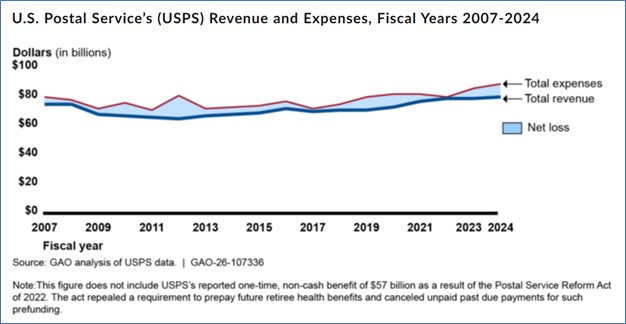
The Government Accountability Office (GAO) on December 16, 2025, issued a report: “U.S. Postal Service: Action Needed to Fix Unsustainable Business Model.” The GAO noted that Congress created USPS to be financially self-sufficient, but the “USPS has lost billions since 2007 as people use mail less and costs increase.” It noted that the USPS has been on the GAO’s High Risk list since 2009 due to its financial viability issues.
The GAO said that the USPS “has tried to improve financially by raising prices and making operational changes,” and noted that “Congress also passed legislation to reduce some of USPS’s expenses.” But it concluded “[m]ore must be done.” The GAO said that the USPS needs to project how “changes like transporting more mail on trucks, may affect its future revenue, expenses, and more,” because the USPS and Congress “need these projections to determine what other steps to take.”
The GAO noted that the USPS in 2021 had introduced its Delivering for America (DFA) 10-year strategy designed to improve its poor financial condition while fulfilling its statutory mandates, and that the USPS has taken many actions since then to try to increase revenue and reduce expenses — such as increasing prices and redesigning its transportation network and processing operations. The USPS also asked the federal government to take action as part of the DFA strategy. The GAO noted that “Congress partially fulfilled this request via the Postal Service Reform Act of 2022,” which “canceled $57 billion of USPS’s missed payments, among other things.” But the USPS’ financial condition remains poor, the GAO said.
The GAO said that while the USPS has increased revenue, total expenses continue to outpace total revenue leading to further losses (see below figure).
The GAO noted that in addition, the “USPS’s unfunded liabilities and debt have steadily increased since fiscal year 2022.” It said that the “USPS projects that if it made all its required payments toward its unfunded liabilities in full, it would run out of cash as early as fiscal year 2026.” “USPS updated its strategic plan in 2024,” the GAO noted, “but this plan did not include financial projections showing how near-term results from the updated plan’s actions could increase revenue or reduce expenses.” “Without financial projections,” it concluded, “USPS does not have targets to show progress or to effectively communicate how its actions will restore USPS’s financial sustainability.”
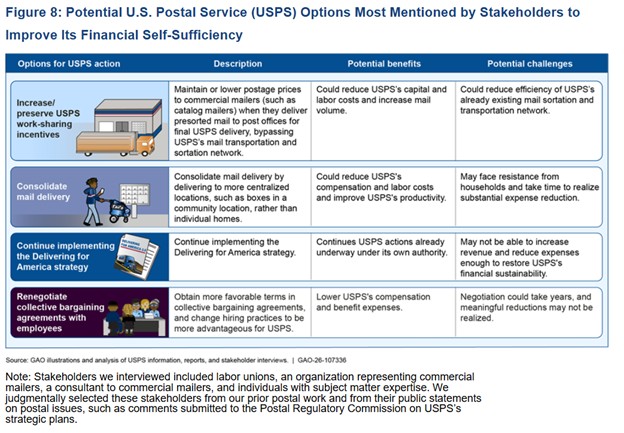
The GAO said that while the USPS and Congress “have a wide range of options to improve USPS’s financial condition,” USPS actions alone “will likely not be enough for it to become financially self-sufficient.” It noted it had previously recommended that Congress consider various options, and although “Congress has taken some action, key issues remain unresolved,” such as “identifying a sustainable path for postal retiree health benefits and determining the level of postal service required, and the extent to which USPS should be financially self-sufficient.”
The report outlines potential options the USPS could take on its own as well as those that would need Congressional action. (see below figures)

The GAO recommended that “the Postmaster General should develop publicly available financial projections of revenue and expenses,” but the “USPS disagreed with the recommendation.” The USPS said that “publishing long-term projections does not promote trust with stakeholders.” It noted that “long-term projections are inherently uncertain,” and stated that “such projections can contribute to a misperception of the success of different initiatives.” It noted that “when it did not meet the long-term projections published in its Delivering for America plan in 2021, certain stakeholders opposed the plan, citing USPS’s unmet projections.”
The GAO argued that “without long-term financial projections, USPS cannot fully communicate its progress toward financial sustainability, and Congress cannot measure USPS’s progress against its planned goals.”
The GAO also reiterated “that Congress should fully address the level of postal service the nation requires, the extent to which USPS should be self-sustaining, and a sustainable financial path for retiree health benefits.” The GAO report was submitted to the Congressional chairs of the House and Senate Committees that oversee the U.S. Postal Service.
USPS Announces Bid Solicitation for Access to Last-Mile Delivery Network
The USPS on December 17, 2025, issued an announcement that it plans to “open up entry to its valuable last mile delivery network,” noting that “[s]hippers large and small, will be able to access the more than 18,000 USPS Delivery Destination Units (DDUs) nationwide via a solicitation process that will begin accepting bids in late January or early February 2026.”
“Shippers who wish to access the DDU network will have the ability to propose a combination of volume, pricing and tender times at each location, with deliveries for successful bidders being made by USPS that same day or the next day, at the customer’s preference,” the USPS said in its announcement. It noted that prior to establishing a dedicated bid solicitation platform, the USPS “will engage shippers to discuss the procedure, gauge interest in participation, and fine-tune the bidding process based on feedback to provide the most effective platform.” The USPS said it would provide more details in the coming months, and that it “expects to formalize accepted bids for this direct-to-customer capability for its Parcel Select product through a negotiated service agreement contract, or NSA.” It said it “expects to notify winning bidders in the second calendar quarter, and service under those NSAs would begin in the third calendar quarter of 2026.”
“We want to allow customers to custom-build their last mile solution,” said Postmaster General David Steiner. “We want to make the service as convenient, cost-effective and efficient as possible,” he noted, adding that the USPS has “achieved impeccable service performance scores for our last mile, which reflects the simple, quick-turn processing that occurs at a local DDU.”
In a Reuters article published following the USPS’ announcement, which also included remarks from an interview with Postmaster General Steiner, the topic of the USPS’ ongoing contract negotiations with Amazon came up. “We are currently in negotiations to extend that contract,” the PMG is quoted as saying, “I told them that we were going to go out to the market, that we had to test the market.” “There’s only one thing I am absolutely certain of — if we continue to do things the way we’re doing it today, we’re dead in about a year, and so I have got to go out and test the market on this price to find out if it’s a fair price,” the PMG said.
Reuters noted that the “USPS is currently selling about 1.7 billion units of capacity from its last-mile distribution, but has capacity for 3.5 to 4 billion and currently generates $5.5 billion to $6 billion in annual revenue from those deliveries.” Reportedly, the USPS is seeing significant interest from a wide range of companies.
“We had to do something dramatic and fast. We do not have the luxury of time,” Steiner said. He added USPS fate is tied to Amazon and vice versa and said Americans get Amazon packages delivered by the Postal Service 1.7 billion times a year. “There is absolutely no doubt that without the U.S. Postal Service Amazon wouldn’t be what it is today … We would love to continue that relationship. We just want to make sure we continue at a fair price,” Steiner said.
INVEST Act Passes House; Headed to Senate Next – Could Significantly Impact Mail Volumes
The House of Representatives last week passed a bill that includes a provision to allow electronic delivery to become the default for providing certain regulatory documents to investors that today are required to be sent hardcopy via USPS. H.R. 3383, the INVEST ACT, is a larger bill designed to “empower entrepreneurs and small businesses, and provide Americans with the opportunity to more freely invest,” but Section 205 of the bill directs the Securities and Exchange Commission to finalize a rule, within a year of enactment, permitting investment companies to switch to electronic-only delivery for financial information that is legally required to be sent to clients in hardcopy form.
While customers would be able to opt to continue to receive paper documents, those mechanisms are not always easy for consumers to find, understand, or select. According to an article by FreightWaves, “[p]roponents said modernizing disclosure requirements makes the financial system more efficient, reduces waste and is more secure from theft than physical mail.” The Investment Company Institute said in a news release,
“Electronic delivery provides a more widely accessible, cost-effective, and speedy means of conveying and receiving information than paper delivery. Using electronic delivery to communicate with investors also creates opportunities for the industry to provide dynamic, real-time information rather than static data, making it easier for consumers to find information at the level of detail they prefer.”
“Mass marketers and print-industry suppliers oppose the measure,” the article notes, “saying it threatens jobs and revenue in the direct mail sector, as well as for the U.S. Postal Service.” “Many older Americans are less comfortable with technology and may prefer paper documents because they have trouble navigating digital platforms,” and the opt-out process for paper delivery may add complexity for seniors, Mackay Mitchell Envelope company said in a LinkedIn post. “E-delivery isn’t a practical solution for households in rural areas without reliable high-speed Internet,” it added.
The measure, which has yet to be considered by the Senate, would also have a significant detrimental impact on the U.S. Postal Service in terms of decreased revenue and volume at a time it can ill afford such a loss, the Alliance said in sharing the information. “For nonprofit mailers, anything that further weakens the Postal Service’s ability to provide an affordable means to communicate with donors, members, and other Americans could have a severe impact,” it said.
In a letter posted on LinkedIn and sent to Postal Customer Councils (PCCs) in a call to action, noted that paper communications remain one of the most secure channels. Requiring digital document transmission increases exposure to cyberattacks, identity theft, and data breaches. “Digital disclosure does not equal comprehension. Paper ensures critical financial information is actually seen, read, and retained — not buried in inboxes or spam folders. Digital-only systems fail during outages, disasters, or cyber events. Paper provides a necessary backup that keeps information moving when systems go down,” the letter said.
Alliance members should let their Senators know the significant negative impact on mail volumes and the USPS that could come from Section 205 of the bill.
Updated Projections for July 2026 Price Change Based on Latest CPI Data
Last week the Bureau of Labor Statistics released the November 2025 CPI, which increased by 2.7 percent from November 2024 (seasonally adjusted).
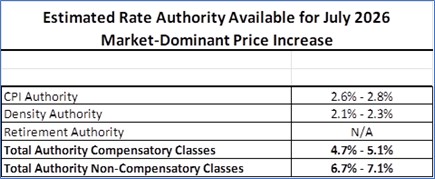
Due to the government shutdown, the BLS has not and will not publish an October 2025 CPI. SLS Consulting prepared the below updated projections for the USPS’ rate authority for a July 2026 price change. For purposes of their calculation, they assume that the October CPI is halfway between the September and November CPI figures. While the exact method used to address the missing October 2025 CPI is unlikely to significantly affect estimated price cap authority, SLS said it expects the PRC will need to initiate a rulemaking to determine how to officially calculate CPI price cap authority with the October CPI unavailable.
Based upon the above assumption regarding the October 2025 CPI, SLS estimates the current CPI price cap authority to be approximately 2 percent. See table below for the estimated July 2026 rate authority at the time of a rate filing.
PRC Approves USPS’ Proposed January 2026 Price Changes for Competitive Services
The Postal Regulatory Commission (PRC) on December 19, 2025, issued an order approving the Postal Service’s proposed rate and classification changes for Competitive Services products as proposed, effective January 18, 2026. The changes will raise prices approximately 6.6 percent for Priority Mail service, 5.1 percent for Priority Mail Express service, 7.8 percent for USPS Ground Advantage and 6.0 percent for Parcel Select.
The Many Reasons to Love Nonprofit Mail
Check out the Nov/Dec issue of Mailing Systems Technology Magazine, particularly the Alliance article on pages 24-25, “The Many Reasons to Love Nonprofit Mail.”
https://issuu.com/rbpublishing/docs/mailing_systems_technology_november-december_2025
Flanagan Recognized with Megan Brennan Award
The Women in Logistics and Delivery Services (WILDS) has announce that Rose Flanagan, Manager of Postal Strategies & Logistics at Data-Mail, has been selected as the 2025 recipient of the Megan J. Brennan Award of Excellence. Upon hearing the news, Rose shared that she was both honored and humbled to be chosen. She added, “I was fortunate enough to have worked with PMG Brennan. She truly cared about both her customers and her employees. Teaming with her was a pleasure. I never envisioned being honored with an award in her name.”
“Industry and USPS leadership recognize the name Rose Flanagan. She is one of the strongest leaders who consistently steps up and shares her time and knowledge with others,” said Wanda Senne, DHL. “The mailing, shipping, and logistics industry is better because of Rose’s continued efforts as a speaker, mentor, and champion working toward a stronger system.” Those who know Rose appreciate her lifelong dedication to strengthening the industry for every participant in the ecosystem. She has chaired PostCom, served on MTAC leadership, and led User Groups, among numerous other leadership roles. Her exceptional people skills enable her to drive consensus and develop win–win solutions. She serves as a trusted advocate and translator for mail owners, the Postal Service, software developers, and logistics companies.
“The Megan J. Brennan Award for Excellence was established to honor individuals who embody the leadership traits Brennan exemplified during her tenure as the 74th Postmaster General—and the first, and to date only, woman to hold that position,” said WILDS Vice Chair Paula Stoskopf. “I’m excited to see this tradition continue with our fifth recipient. Rose truly reflects the spirit and intent of this recognition.” The award is anticipated to be presented at a March 26 luncheon event.
WILDS is a nonprofit organization dedicated to promoting women’s leadership in the postal, delivery, and logistics industries and to addressing the challenges women and minorities often face within these fields. For more information, visit www.shedelivers.org.
Into the Postal Weeds…
For those who live in the “postal weeds,” and are looking for news on mail entry, preparation, discounts, incentives, and more, this new column in the Alliance Report will be right up your alley! We won’t go all the way into the weeds…but we will offer up highlights on useful resources and mailing standard changes going forward.
- DMM Revision: Products Mailable at Nonprofit USPS Marketing Mail Prices. Effective January 18, 2026, the Postal Service™ will revise Domestic Mail Manual (DMM®), section 703.1.6.11, to reflect a change in the price for low-cost items. “Under section 703.1.6.11, which includes standards based on U.S. statutory restrictions, three types of products or items are mailable at Nonprofit USPS Marketing Mail® A low-cost item (as defined in the U.S. Internal Revenue Code) is one of those products. Each year, the Internal Revenue Service determines the allowed value of a low-cost item and adjusts it for cost of living. For 2026, the allowed value of a low-cost item is $13.90 or less (compared to $13.60 or less in 2025). The value of a low-cost item is the item’s cost to the authorized nonprofit organization mailing the item or on whose behalf the item is mailed.” [Source: USPS Postal Bulletin 22690, published 11-27-2025]
- ISAL to be Terminated by USPS. The USPS published a final rule in the Federal Register that effective January 18, 2026, it will terminate its International Surface Airlift (ISAL) service. Some nonprofit organizations currently utilize the ISAL service as a way to send mail to other countries, and will need to explore alternatives offered by the USPS or other international carriers.
- Updated Business Acceptance Solutions & Major Mailer Support Directory posted by USPS.
Alliance Educational Webinar 1/22/26 – Register Now!
The Alliance will be kicking off our new webinar series in 2026 with a great primer, “Nonprofit Postage Rates – Past, Present and Future,” where we will talk about the evolution of the laws and policies governing nonprofit rates in the past and those that apply today, as well as what to expect in the July 2026 USPS price change.
The webinar will be held on Thursday, Jan. 22, 2026, from 11-12 EST. This first webinar will be open to all, so please share the information within your organization and with your nonprofit peers. Registration is open at https://zoom.us/meeting/register/zvXk8r-ESSqgMdI-7bPgCw.
Rose Flanagan, Manager of Postal Strategies & Logistics at Data-Mail, has been selected as the 2025 recipient of the Megan J. Brennan Award of Excellence. Upon hearing the news, Rose shared that she was both honored and humbled to be chosen. She added, “I was fortunate enough to have worked with PMG Brennan. She truly cared about both her customers and her employees. Teaming with her was a pleasure. I never envisioned being honored with an award in her name.”
“Industry and USPS leadership recognize the name Rose Flanagan. She is one of the strongest leaders who consistently steps up and shares her time and knowledge with others,” said Wanda Senne, DHL. “The mailing, shipping, and logistics industry is better because of Rose’s continued efforts as a speaker, mentor, and champion working toward a stronger system.” Those who know Rose appreciate her lifelong dedication to strengthening the industry for every participant in the ecosystem. She has chaired PostCom, served on MTAC leadership, and led User Groups, among numerous other leadership roles. Her exceptional people skills enable her to drive consensus and develop win–win solutions. She serves as a trusted advocate and translator for mail owners, the Postal Service, software developers, and logistics companies.
“The Megan J. Brennan Award for Excellence was established to honor individuals who embody the leadership traits Brennan exemplified during her tenure as the 74th Postmaster General—and the first, and to date only, woman to hold that position,” said WILDS Vice Chair Paula Stoskopf. “I’m excited to see this tradition continue with our fifth recipient. Rose truly reflects the spirit and intent of this recognition.” The award is anticipated to be presented at a March 26 luncheon event.
WILDS is a nonprofit organization dedicated to promoting women’s leadership in the postal, delivery, and logistics industries and to addressing the challenges women and minorities often face within these fields. For more information, visit www.shedelivers.org.
Into the Postal Weeds…
For those who live in the “postal weeds,” and are looking for news on mail entry, preparation, discounts, incentives, and more, this new column in the Alliance Report will be right up your alley! We won’t go all the way into the weeds…but we will offer up highlights on useful resources and mailing standard changes going forward.
- DMM Revision: Products Mailable at Nonprofit USPS Marketing Mail Prices. Effective January 18, 2026, the Postal Service™ will revise Domestic Mail Manual (DMM®), section 703.1.6.11, to reflect a change in the price for low-cost items. “Under section 703.1.6.11, which includes standards based on U.S. statutory restrictions, three types of products or items are mailable at Nonprofit USPS Marketing Mail® A low-cost item (as defined in the U.S. Internal Revenue Code) is one of those products. Each year, the Internal Revenue Service determines the allowed value of a low-cost item and adjusts it for cost of living. For 2026, the allowed value of a low-cost item is $13.90 or less (compared to $13.60 or less in 2025). The value of a low-cost item is the item’s cost to the authorized nonprofit organization mailing the item or on whose behalf the item is mailed.” [Source: USPS Postal Bulletin 22690, published 11-27-2025]
- ISAL to be Terminated by USPS. The USPS published a final rule in the Federal Register that effective January 18, 2026, it will terminate its International Surface Airlift (ISAL) service. Some nonprofit organizations currently utilize the ISAL service as a way to send mail to other countries, and will need to explore alternatives offered by the USPS or other international carriers.
- Updated Business Acceptance Solutions & Major Mailer Support Directory posted by USPS.
Alliance Educational Webinar 1/22/26 – Register Now!
The Alliance will be kicking off our new webinar series in 2026 with a great primer, “Nonprofit Postage Rates – Past, Present and Future,” where we will talk about the evolution of the laws and policies governing nonprofit rates in the past and those that apply today, as well as what to expect in the July 2026 USPS price change.
The webinar will be held on Thursday, Jan. 22, 2026, from 11-12 EST. This first webinar will be open to all, so please share the information within your organization and with your nonprofit peers. Registration is open at https://zoom.us/meeting/register/zvXk8r-ESSqgMdI-7bPgCw.
The Alliance is planning to hold more webinars in 2026, some will be restricted to Alliance members only, others will be open to all. If there are specific topics or speakers your organization is interested in having a webinar on, email me at kathy@nonprofitmailers.org.
The Alliance is planning to hold more webinars in 2026, some will be restricted to Alliance members only, others will be open to all. If there are specific topics or speakers your organization is interested in having a webinar on, email me at kathy@nonprofitmailers.org.

Leave a Reply