

Alliance Report
February 13, 2026
Issue 26/3
The leading voice of nonprofits on postal issues for over 45 years.
Copyright 2025: Alliance of Nonprofit Mailers—All rights reserved.
The Alliance of Nonprofit Mailers is a 501 (c)(4) nonprofit organization established by nonprofits for nonprofits.
USPS Quarter 1 FY2026 Financial Results
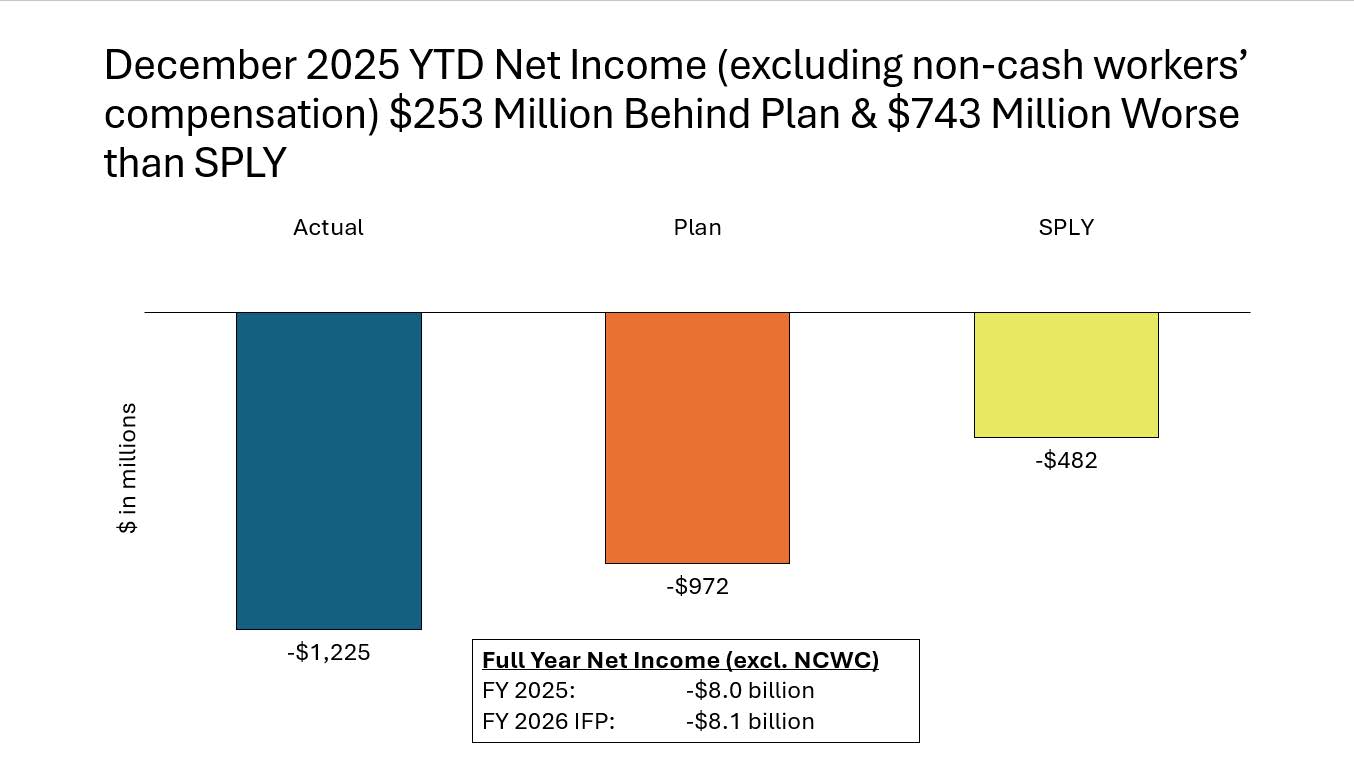
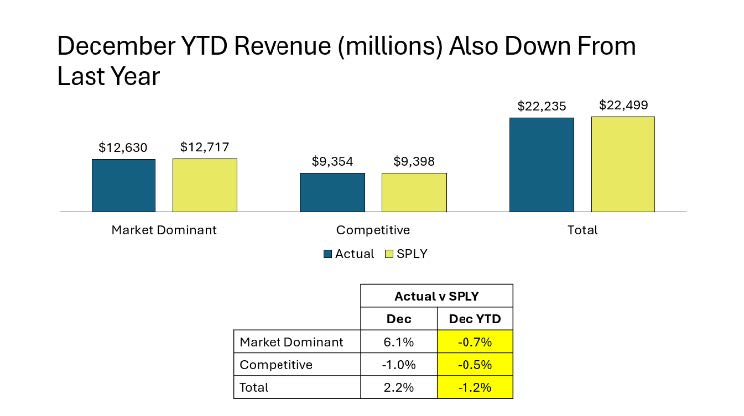
The USPS at its Feb. 5, 2026, meeting of its Board of Governors, shared financial results for Quarter 1 of FY2026 (Oct. 1, 2025 through Dec. 31, 2025). The USPS’ net loss increased by nearly $1.4 billion in the quarter, compared to the same period last year. The net loss totaled nearly $1.3 billion compared to a net income of $144 million for the same quarter last year. Controllable income was $350 million, down $618 million from the same quarter last year, and operating revenue was $22.2 billion, a 1.2 percent decrease compared to the same quarter last year.
The USPS attributed the significant increase in net loss to “an increase in workers’ compensation expense of $634 million, operating revenue decrease of $264 million, an increase in retiree health benefits expense of $175 million, higher other operating expenses of $169 million, and higher transportation expenses of $43 million.”
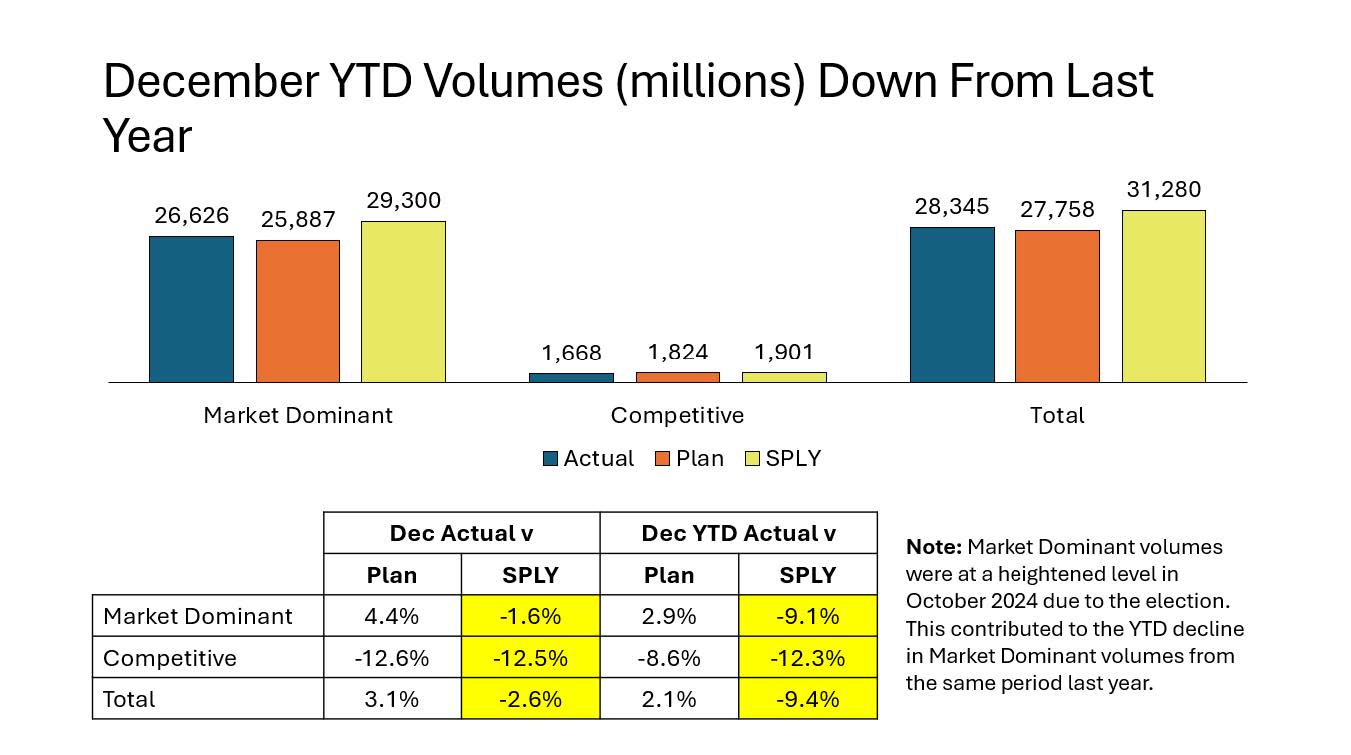
The USPS attributed revenue declines largely to declining volumes in First-Class Mail, Shipping and Packages, and Marketing Mail. Shipping and Packages revenue decreased $23 million or 0.2 percent, on a volume decline of 243 million pieces, or 12.1 percent, compared to the same quarter last year. Marketing Mail revenue decreased $126 million, or 2.7 percent, on a volume decline of 1.8 billion pieces, or 10.9 percent, compared to the same quarter last year.
“While we are pleased that the holiday quarter was quite strong with regard to service improvement as measured by our on-time delivery scores and other important service performance metrics, we continue to face difficult systemic financial and business model headwinds,” said Postmaster General David Steiner. “To right our financial ship, we are aggressively pursuing growth strategies – which include creating new opportunities for businesses to leverage our vast last-mile delivery network – and driving greater efficiencies throughout our operations. We are convinced that these efforts, if combined with needed regulatory, administrative, and legislative changes, can meet the needs of the American public and return the Postal Service to long-term financial stability and strength.”
The USPS noted in its press release that it continues to pursue administrative and legislative reforms to “remedy outdated and unwarranted financial and regulatory burdens that negatively impact our liquidity as we continue to strive to serve our customers in a fiscally responsible manner.” USPS noted that legislative reforms include “changes in retiree pension benefit funding rules for the Civil Service Retirement System (CSRS) benefits, diversification of pension asset investments, raising the statutory debt ceiling, and workers’ compensation administration reform.”
The USPS also noted that it has recently petitioned the Postal Regulatory Commission (PRC) for changes that include modification of the Market Dominant ratemaking system “through the elimination of the price cap and adoption of a regulatory monitoring ratemaking system in order to achieve the objectives of forging a sustainable path; alternatively, if the price cap is maintained, re-baselining the rates to ensure they are compensable while also maintaining adjustment factors to ensure that the system is flexible enough to deal with external circumstances that may arise; and repeal of the minimum remittance payment associated with retiree pension benefit amortization payments required by our regulator with regard to our retirement-based rate authority.” [See below for more information.]
Nonprofits Start to Weigh In, Opposing USPS’ Proposed Rate System Changes
Nonprofit organizations have already started to weigh in, opposing the USPS’ proposed rate system changes, though comments are not due until March 2 (so you still have time to submit a letter!).
The USPS in December 2025 submitted its proposal for changing the rate system as part of the PRC’s review of changes and invitation for stakeholders to submit additional proposals. Proposals for changes to the rate system are due by Feb. 17, and comments on any of the proposals – including the USPS’ proposals – are due by March 2, 2026. The Alliance will be submitting both a proposal as well as comments on the USPS’ and potentially other proposals.
The USPS’ proposes to eliminate the CPI cap altogether, as well as changes to the regulatory process involved when the USPS changes prices. The USPS shared at the last meeting of the Mailers Technical Advisory Committee (MTAC) that if the PRC approves its proposed changes, it likely would move to a January 2027 price change as the first of the 5-years of changes. [The USPS could do this and remain in compliance with the PRC’s recent order limiting the USPS to one price change each Fiscal Year because the July price change would be in FY2026 and a January 2027 price change would be in FY2027.]
The USPS proposes a “regulatory monitoring approach” that would include expanded forward guidance on price and structural changes. The CPI price cap would be eliminated and there would be no automatic pre-implementation review by the regulator. The USPS has said one of the benefits of its proposal is the forward guidance mailers would have on price change dates and amounts well in advance of their effective date. It should be noted, however, that the USPS’ proposal leaves open the USPS’ ability to change the prices implemented from what it communicates earlier in the process.
The USPS said in its regulatory monitoring proposal that if the PRC did not accept it, the USPS’ alternative proposal would be a financial rebalancing (reset) of prices that would include 23% additional rate authority over the next 5 years (in addition to the Density and Non-Compensatory additional rate authorities) to get the USPS to breakeven level.
Earlier this week, nonprofit organizations began submitting comments to the PRC on the USPS’ proposed changes, which focus on eliminating the CPI price cap.
The Dollywood Foundation told the PRC, that “repeated double-digit postal increases,” have required it to raise costs for local and state partners, “slowing enrollment in many states and local communities.” “When local programs and state governments cannot absorb added increases,” it explained, “fewer children enroll, and fewer books reach homes during the most crucial period of early brain and language development.” “The impacts of missing this opportunity are lasting and can limit a child’s literacy achievement for the rest of their life,” it said, noting that “[m]aintaining an affordable, predictable rate structure is essential to sustaining our service to children and their families.” The Dolly Foundation urged the PRC “to retain the CPI price cap and reject approaches that permit sudden, outsized increases that would reduce access to books and undermine the public value of reliable, affordable mail.”
Mercy Home for Boys & Girls, a therapeutic home for kids and young adults in Chicago, ages 11-24, who’ve suffered the trauma of abuse, neglect and neighborhood violence, told the PRC that “[d]irect mail appeals are the backbone of most well-established nonprofits, and Mercy Home is no exception to that rule. “Direct mail fundraising drives Mercy Home’s immediate revenue needs, but it also provides for future income via planned gifts and other deferred gift opportunities, it said. Mercy continued,
“In order to reduce postage expense over the last 5 years, we’ve moved many high value donor packages from outgoing first-class categories to nonprofit postage categories and eliminated live first-class stamps from reply envelopes, but this usually has a negative effect on response and, ultimately, reduces our spend with USPS. Mercy Home’s postage costs now comprise 62% of total direct mail expenses vs 56% in FY21, and our cost to acquire a new direct mail-sourced donor has increased 56%. The proposed postal rate plan is unsustainable for nonprofits. Organizations like Mercy Home will be forced to cut back on mailings, which will impact our ability to raise funds and will, ultimately, reduce the number of children and families we can help.”
Alliance sponsor member Daniller+Company told the PRC that it “works with 40–50 nonprofit organizations each year, supporting strategic fundraising, donor communications, campaign planning, and the production of multichannel direct response programs.” “Direct mail remains a critical fundraising channel across our client base—particularly for donor acquisition, renewals, upgrades, and special appeals—because it reliably reaches audiences who may not respond to digital-only outreach and provides a durable, tangible message tied to a mission,” Daniller said. It told the PRC that many of its nonprofit clients use USPS products including Marketing Mail and, in some cases, Periodicals. “Many of these organizations dedicate a significant portion of their annual development budgets to USPS postage,” it said. “Direct mail is not simply a communication tactic—it is a primary revenue engine and a key tool that sustains charitable missions.” Daniller contined,
“Since 2021, the magnitude and frequency of USPS postage rate increases have had a material impact on nonprofit fundraising strategy and results. Across multiple organizations we serve, these sustained increases have forced difficult operational decisions, including:
- Reducing mail volume (fewer pieces mailed per campaign)
- Narrowing audience selections (including reducing prospect outreach)
- Reducing the number of fundraising campaigns mailed annually
- Cutting back on stewardship and cultivation mail that strengthens retention
- Moving budget away from program delivery to cover increased postage costs
In practical terms, postage volatility and compounding increases shrink the margin available for mission delivery. For direct response fundraising, even modest increases to per-piece costs can alter the economics of a campaign—reducing net revenue and limiting an organization’s ability to reinvest in donor growth. Of course, what the Postal Service is proposing can hardly be called “modest” – it would subject nonprofit organizations to even larger rate increases than the already-sizable ones faced over the past five years.”
Texas Electric Cooperatives “publishes Texas Co-op Power magazine for the benefit of our not-for-profit member electric cooperatives. The publication provides energy efficiency, outage management, and weather and electrical safety information to inform its 1 .6 million subscribers.” It told the PRC “The series of rate changes over the last 4 years has increased the cost of mailing the magazine by almost 35%.” “The July 2025 increase, which was promoted as an 8% increase, actually increased our rates 20%-primarily due to changes that drastically increased the rates for some work-sharing levels,” it said.
“To manage the financial hit of the rate increases,” Texas Electric Cooperatives told the PRC, “we’ve had to make some difficult decisions over the past few years-including dropping from 40 to 36 pages and lowering the basis weight of the paper that we print on. Other than cutting mail volume to fewer issues per year, there are few remaining changes we could make that would result in savings significant enough to counteract continued aggressive rate increases.”
Today in Mississippi, a joint publication from twenty rural, not-for-profit electric cooperatives in Mississippi with a circulation of over 450,000, that shares information related to the electric power industry and the safe, efficient use of electricity, told the PRC that “[t]he postage rates for Today in Mississippi have increased enormously over the past few years.” “Mississippi co-ops have experienced a 43% postage increase in just three years,” it said, noting that “there was not a substantial increase in circulation over this three-year period.” It continued,
“The July 2025 USPS rate increase, that was originally communicated to be 9% to 9.5% for periodicals, was much higher, and quite frankly, staggering. The increase in density and saturation for postal charges had a significant impact on Today in Mississippi and its postal rates. For Mississippi, the actual increases, based on circulation by electric cooperative area, ranged from 14.85% to 28.83%. The average USPS postal rate increase for Mississippi’s rural electric cooperatives was 20.87%, more than double the communicated, and therefore, budgeted rate. In response to these exorbitant increases, many of the systems cut back their mailing lists, and one electric cooperative reduced their monthly circulation from 12 months to six months per year. Another cooperative reduced their mailing list by 4,500 members per month.”
The Alliance urges members and sponsors to add their voice to this critical proceeding before the PRC which will determine postage rates for the next 5 years. Anyone needing assistance in developing or filing a letter should contact the Alliance at kathy@nonprofitmailers.org.
Latest Forecast for July 2026 Price Increase Based on CPI Data
This morning, the Bureau of Labor Statistics (BLS) released the January 2026 CPI, which increased by 2.4 percent from January 2025 and increased by 0.2 percent from December 2025 (seasonally adjusted).
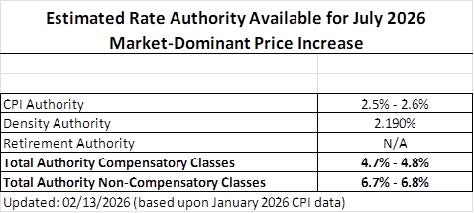
Due to the government shutdown, BLS will not publish an October 2025 CPI. The below calculation (prepared by SLS Consulting) uses the method the Postal Regulatory Commission (PRC) has used to estimate rate authority in the absence of an October 2025 CPI. Using this method, the current CPI rate authority is 2.361 percent.
See table below for the estimated July 2026 rate authority at the expected time of a rate filing.
Brookings Institute Study on Value of USPS Network for Rural Small Businesses
Brookings Institute has published a study on the value of the USPS network for rural small businesses. Brookings reported that “rural counties with better access to post offices have higher levels of small business activity.” “This relationship persists after accounting for broadband access and local economic conditions,” it said, noting that “[t]he strongest links appear in service and trade sectors that are likely to rely on routine, physical access to postal services.” “Postal policy debates often overlook these economic spillovers of the postal network in rural areas,” the study noted.
USPS Office of Inspector General (OIG) Issues Latest Report on DFA Progress
The USPS Office of Inspector General on January 30, 2026, published its latest report on the USPS’ progress with its Delivering For America (DFA) plan.
“Overall,” the OIG reported, “our analysis of progress toward key initiatives shows mixed results.” “While the Postal Service (USPS) has made meaningful investments in infrastructure, fleet modernization, and pricing reforms,” it noted, “service performance has been inconsistent, and financial outcomes have fallen short of break-even targets.” “As the Postal Service’s transformation is ongoing,” the OIG said, “our oversight will continue to focus on whether these efforts deliver measurable improvements in reliability, customer experience, and fiscal health that would ensure the Postal Service remains a vital, self-sustaining part of the nation’s infrastructure.”
The OIG in its update details service performance issues stemming from the USPS’ network modernization under DFA. It also reviewed USPS transportation costs – a key area of cost reduction included in the DFA. It also looked at the USPS’ financial performance, since the DFA plan includes significant cost reductions and revenue growth.
“Four years into its 10-year DFA plan,” the OIG concluded, “the Postal Service continues to face challenges with reliable service, network reconfiguration, financial sustainability, and rising personnel costs.” “While the Postal Service has reduced transportation costs and raised revenue through price increases and legislative reforms have yielded benefits,” it noted, “persistent service performance issues, cost overruns, and delayed implementation of key initiatives continue to challenge outcomes.” “As the Postal Service moves quickly toward the halfway mark in plan implementation, stakeholders will be looking for assurances that its further implementation will result in critical financial sustainability for the future,” it summarized.
Into the Postal Weeds…
For those who live in the “postal weeds,” and are looking for news on mail entry, preparation, discounts, incentives, and more, this column in the Alliance Report will be right up your alley! We won’t go all the way into the weeds…but we will offer up highlights on useful resources and mailing standard changes.
- Mailer ID (MID) Validation for Payments API. On Monday, February 9, 2026, the USPS will implement a security enhancement for the Payments API. This update will enable validation of Label Owner MID and Manifest MID roles to ensure they are authorized or registered to the associated API User. Only authorized or registered MIDs may be used to generate a Payment Auth Token. Unauthorized or unregistered MIDs will be rejected. This change aligns with USPS policy and is designed to enhance the security and integrity of payment transactions. Please go to Email Us | Web Tools | Inquiry for assistance if needed. Monthly release notes documentation can be accessed on PostalPro: https://postalpro.usps.com/usps-apis-releases.
Alliance April Webinar for members & sponsors only – Register Now!
Our 2nd webinar for 2026 will be held in April and will be for Alliance nonprofit members and sponsor members only. This next webinar will focus on the details of the USPS’ July 2026 price change, update on regulatory proceedings and news from the March meeting of the Mailers Technical Advisory Committee (MTAC).
The webinar will be held on Friday, April 17, 2026, from 1-2 EST. This webinar will be open to current members and sponsors only. Registration is open at https://zoom.us/meeting/register/W6PTrjgzQXKTzFQHO0omdQ
The Alliance is planning to hold more webinars in 2026, some will be restricted to Alliance members only, others will be open to all. If there are specific topics or speakers your organization is interested in having a webinar on, email me at kathy@nonprofitmailers.org.

Leave a Reply