

Alliance Report
January 20, 2026
Issue 26/2
The leading voice of nonprofits on postal issues for over 45 years.
Copyright 2025: Alliance of Nonprofit Mailers—All rights reserved.
The Alliance of Nonprofit Mailers is a 501 (c)(4) nonprofit organization established by nonprofits for nonprofits.
Postmaster General on USPS Focus Areas
Postmaster General David Steiner spoke to the mailing industry at last week’s meeting of the Mailers Technical Advisory Committee (MTAC). He gave an update on the USPS’ peak season performance, commented on the recent furor over postmarking, then talked about the three focus areas the USPS is prioritizing – cost-cutting, new revenue from selling last mile delivery capacity and pricing.
Peak Season. Steiner said that the USPS had a very successful peak season, with service “up 2-6% at every level,” driven by the USPS not only adding package capacity but learning how to use that capacity. He said the USPS’ network is completely different than it was five years ago, 2 years ago or even last year. “We’re not done yet,” the Postmaster General said, “but have come a long way.” He said now the USPS needs to carry over this improved performance beyond peak. Steiner said next year the USPS’ performance will be even better, and that the improvement allows the USPS to complete in the market as well as have the ability to speak with Congress and ask for a “bit more help.”
Postmarking Press. The PMG said another thing “top of the mind” at USPS are the recent press articles popping around the country about “changes” to the postmark. He said the USPS did not make any change in the postmark but issued a statement with clarification. He said that those needing their mail to be postmarked the day of entry can still go inside a post office and have the clerk postmark the piece. “If you need that, go in and get it,” he said, but he noted that for those post offices where the USPS’ Regional Transportation Optimization (RTO) has been implemented, there will be an additional day before the mail gets to the processing center. Steiner said a lot of the recent press articles have mischaracterized what changed, but “if there was only one message the American public got and that was to mail ballots early, that is a win for us.”
USPS Finances. The Postmaster General moved on to talk about the USPS’ financial condition, stating that the USPS “will be out of cash in early 2027, less than 14 months from now,” if it stays on its current trajectory. He said his job is to change the trajectory and there is no luxury of time, so it needs to happen fast. Steiner said there are three areas the USPS is focusing on. First, the USPS needs to look at its entire cost structure, nothing is sacrosanct, he said, in terms of looking for cost reductions. He characterized the Delivering for America (DFA) plan as “first and foremost, a way to pull costs out,” and said that while the USPS has done a good job, there is no way it could do so fast enough to get the cash it needs to not face a liquidity crisis in 2027. “We can’t save our way to prosperity, we need time, and we don’t have that luxury,” he said.
“We have one asset that we can monetize fast,” the Postmaster General said, noting that there are lots of assets the USPS could monetize, but not quickly. “Our last mile capability is the single asset we can monetize fast,” he said. “We can grow other revenue, but it takes a long time to find new customers, convince them to use us, onboard them, etc.,” he said, “but the last mile we can.” Steiner said that today the USPS is only monetizing about half its last mile capacity and at a very low price. “If we can sell more at a higher rate,” he said, “we can solve our short term cash problem.” He said the concept is not a reverse auction, the USPS is trying to develop a tailored solution for customers that want to use its last mile. The USPS will consider bids on entry at DDUs, S&DCs and LPCs, for price, volume and specific time periods, and will design a network that works best, going to those customers with the higher bids and negotiating NSAs. The concept launches next week, Steiner said, with potential customers coming in for a meeting to learn more about submitting bids in a new portal the USPS will unveil. Steiner said the USPS hopes to negotiate contracts in the 2nd quarter with implementation by the end of the 2nd quarter. [See article later in this issue for more information]
The third thing the USPS can do, Steiner said, is to use maximum pricing authority. He noted that the USPS filed two petitions with the PRC with the USPS’ view on rate authority. “There is a reason I put this third,” he said, “we don’t want to use pricing, we’d like to have the ability to not use price and see what it could do to volume.” “I believe there is some ability to not take price, increase volume and be good for the USPS, Steiner said, “but the problem is that I don’t have the time for that option.” “When we are losing money and going to be out of cash, we can’t say we won’t raise prices,” he said. “It is a last resort, but if we have to use it, we have to use it,” he told the MTAC attendees. “Our mandate is to be a self-sustaining organization,” he said.
The Postmaster General said that is how he looks at the next 14 months – pull out costs, see what the last mile strategy brings, improve service to drive growth, and round it out with pricing. “I know it is a hard message,” he said.
Steiner said the other thing the USPS needs help with are the things the USPS can’t control that impact its financial situation, which “everyone agrees should go away.” Referring to its legislative asks, the Postmaster General said the USPS is going to push for these things and it is confident it will see some positive things over the next few months.
When asked what his number one ask to Congress would be, Steiner said to raise the USPS’ borrowing limit from $15 billion to $30-35 billion, which would solve the immediate cash problems and give the USPS time for its strategies to work. When asked what would happen if the USPS runs out of cash, Steiner said “I don’t want to be the CEO that goes to Congress to say we are closing doors; I am not having conversations with anyone about alternatives.” He said the USPS has asked the PRC to unrestrict the current payment requirements into the USPS’ retirement account to give the USPS more time.
USPS’ Outlines “Benefits” of its Rate System Proposal
The USPS at last week’s MTAC meeting, outlined what it characterized as “benefits” of the rate system changes it proposed in one of the two petitions it filed with the Postal Regulatory Commission (PRC) in December for consideration.
The USPS’ proposes going back to an annual January price change, which means that if its proposal were to be adopted by the PRC, it would begin with a January 2027 price change. [The USPS could do this and remain in compliance with the PRC’s recent order limiting the USPS to one price change each Fiscal Year because the July price change would be in FY2026 and a January 2027 price change would be in FY2027.]
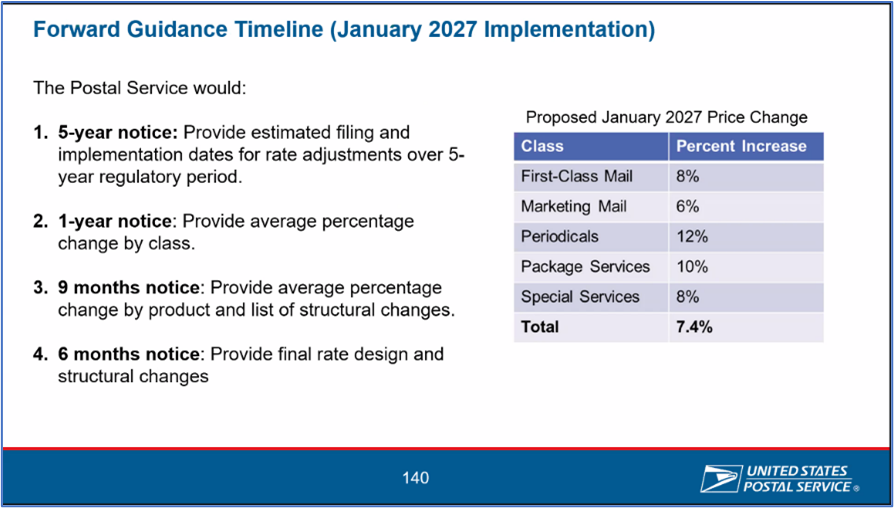
The USPS proposes a “regulatory monitoring approach” that would include expanded forward guidance on price and structural changes. The CPI price cap would be eliminated and there would be no pre-implementation review by the regulator. The USPS shared the below slide with its thoughts on a January 2027 price change, were its proposal to be adopted by the PRC. The USPS said one of the benefits of its proposal is the forward guidance mailers would have on price change dates and amounts well in advance of their effective date. It should be noted, however, that the USPS’ proposal leaves open the USPS’ ability to change the prices implemented from what it communicates earlier in the process.
The USPS said in its regulatory monitoring proposal that if the PRC did not accept it, the USPS’ alternative proposal would be a financial rebalancing (reset) of prices that would include 22% additional rate authority to get the USPS to breakeven levels.
The PRC has invited other stakeholders to submit comments on the USPS’ proposed rate system changes, as well as any other rate system change proposals by other stakeholders, by March 2, 2026.
USPS’ Revised Future Price Change Forecast
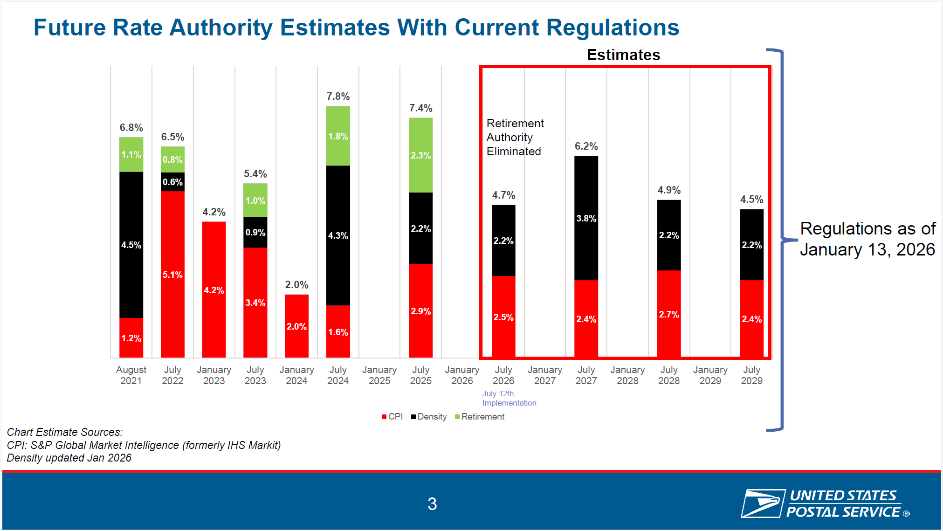
The USPS has shared the below price change forecast which takes into account the decision by the Postal Regulatory Commission (PRC) issued earlier this week limiting the USPS to one price change per Fiscal Year [note that our Alliance Alert sent out last week incorrectly stated it was one price change per calendar year]. The below chart shows the current USPS forecast for price changes for the next 4 years given the new PRC rule.
A few things to note – there is an additional 2% that will be added to “underwater” categories, which are identified each year in the USPS’ Annual Compliance Report (ACR) and then reviewed and ruled on by the PRC in its Annual Compliance Determination (ACD), which is published around the end of March. For a July 2026 price change, the additional 2% rate authority for underwater categories would apply to Periodicals, Marketing Mail flats, and Alaska Bypass.
There are also two more months of CPI data to take into account, so the below could change based on that data before the USPS files its request with the PRC in April.
Lastly, for the years beyond 2026, the below forecast does not take into account any changes the PRC might implement to the USPS rate system. For example, the “regulatory monitoring approach” proposed by the USPS could result in a January 2027 price change because it would be in a different USPS Fiscal Year than the July 2026 change. One approach proposed by the USPS would increase prices by 22% over 5 years.
USPS July 2026 Structural Changes
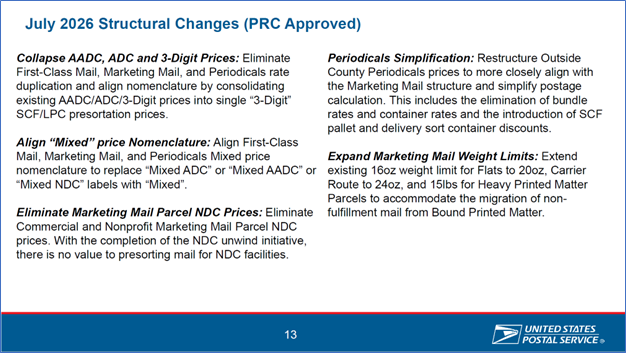
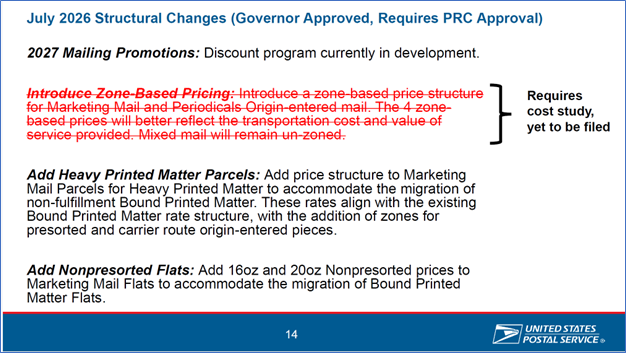
In addition to the above-referenced price change the USPS plans to implement July 12, 2026, there are also structural changes it plans to make. The USPS at this week’s meeting of the Mailers Technical Advisory Committee (MTAC) shared the below slides recapping the planned structural changes.
The first slide shows changes already approved by the Postal Regulatory Commission (PRC) and the second slide shows changes that have been approved by the USPS Board of Governors for July 2026 implementation but which still need approval from the PRC. Note that the introduction of zone-based pricing for Marketing Mail and Periodicals origin-entered mail will not be introduced in July 2026 as the USPS had previously planned since the PRC has ruled the USPS needs to file a cost study to support its proposed changes.
The USPS on Jan. 13, 2026, published its Release Notes for the July 2026 price change, which include more information on the USPS planned changes.
USPS Talks About “Reimagining Mail”
Postmaster General Steiner at last week’s MTAC meeting said that as he travels the country visiting postal facilities as well as mailers, he is amazed at the level of enthusiasm from the mailing industry and ideas to grow mail. “We can’t do it on our own,” he told the MTAC audience, and announced that the USPS will be “reimagining mail.” USPS Chief Customer and Marketing Officer Steve Monteith shared more details later in the meeting, noting that the USPS and industry are talking about how to reimagine mail, create a buzz around mail, and grow and maintain the relevance of mail.
To kick off the project, the USPS is looking to modernize its mail portfolio, focusing on areas such as omnichannel marketing, AI, Adobe tools to create mail more simply, how to grow and compete more effectively in the marketplace. How to improve entry, transportation, efficiency to benefit both the USPS and the industry will be explored, all the way from DDU entry by mailers to origin entry and everything in between. In response to the question of whether the USPS will be more open to testing new creative designs, Monteith said yes (but USPS later clarified that pieces qualifying for automation prices must still meet automation requirements). The USPS will be meeting with industry associations to gain input and work collaboratively, and said it will provide an update on the initiative at the March MTAC meeting.
USPS’ Last-Mile Delivery Network Plan
The USPS at last week’s MTAC meeting shared more details on the plan the Postmaster General referred to as a quick way to monetize one of the USPS’ greatest assets – it’s last mile delivery network. Chief Customer & Marketing Officer Steve Monteith told the MTAC group that the USPS has designed the concept to unlock untapped capability in the USPS’ delivery network where it thinks there is $3.5-4 billion in untapped package capacity. The delivery network will include Destination Delivery Units (DDUs) including Post Office Boxes, Sorting & Delivery Centers (S&DCs) and even Local Processing Centers (LPCs) on outgoing shipments as well as returns.
The USPS is setting up a process where shippers can bid on a combination of where they want to enter packages, volumes, and time period. He said the USPS could offer next day or same day delivery depending on time of entry. Monteith said the USPS has been engaging with customers and plans to deploy the bidding system next week, after holding an invitation-only symposium on January 21, 2026, to provide prospective customers with more details. Monteith said the USPS is still working through details, but expects to notify winning bidders during the 2nd quarter and that beginning in the third quarter (which begins April 1, 2026), winning bidders will work through the Negotiated Service Agreement (NSA) process with the USPS.
Monteith noted that participation in the program will require shippers to make FAST appointments to enter at DDUs and that there is some discussion about requiring mailers to do the same, but no decision has yet been made.
Into the Postal Weeds…
For those who live in the “postal weeds,” and are looking for news on mail entry, preparation, discounts, incentives, and more, this new column in the Alliance Report will be right up your alley! We won’t go all the way into the weeds…but we will offer up highlights on useful resources and mailing standard changes going forward.
- USPS Information on Recent EPS Incident. While mailing industry representatives were gathered at the MTAC meeting on Wed., Jan. 14th, murmurs spread around the room as many were seeing their USPS Enterprise Payment System (EPS) accounts reflecting inaccurate balances. The USPS on Jan. 15th published a notice about the incident, advising mailers that beginning Jan. 11th, there were several issues with the EPS system. The USPS said it was actively working toward resolution and hoped issues would be resolved by close of business Jan. 15th.
- Parcel Dimension Compliance. The USPS on Jan. 8, 2026, published a proposed rule in the Federal Register, with comments due by Feb. 9, 2026, that would expand current USPS requirements to include accurate parcel dimensions in a manifest.
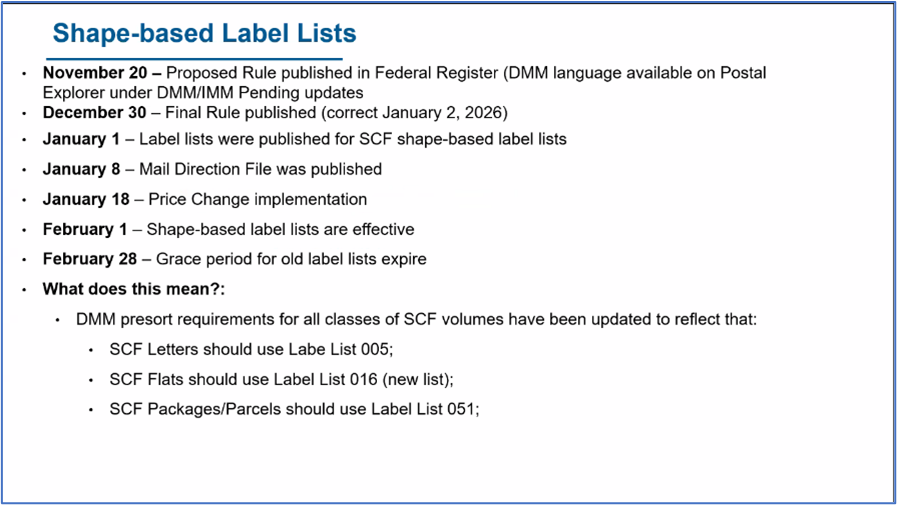
- Shape-Based Labeling List Changes. As noted in the last Alliance Report, the USPS is implementing shape-based labeling lists for SCF entry discounts, effective Feb. 1, 2026. A reference is included in the most recent Postal Bulletin, and the detailed list of shape-based DMM changes can be found here in Postal Explorer. The USPS shared the below slide at last week’s MTAC meeting with the timeline for using the new labeling lists:
- USPS Continues Work on Replacement System for Business Customer Gateway (BCG). The USPS is forming an MTAC workgroup to get industry/user feedback as it works to develop its BCG replacement system, the Business Portal. The USPS at last week’s MTAC meeting shared a slide with a timeline that showed the new portal as being available as soon as June 2026, with enhancements schedule through October 2026. The USPS said it will run the existing BCG and the Business Portal concurrently as the latter is implemented. The Business Portal will be for both shippers and mailers.
- USPS Retirement of Manifest Mailing System. Effective April 1, 2026, the USPS is retiring the Manifest Mailing System (MMS) along with the hardcopy documentation, and migrating customers to electronic documentation (eDoc), Full Service, Seamless, and eInduction, for Letters, Cards, and Flats. Options for Package customers are USPS Ship and Click-N-Ship. Mailers of Letters, Cards, and Flats can reference dat/Mail.XML Technical Specifications posted on PostalPro. Package shippers can reference Publication 199, Publication 205, and USPS Ship documentation on PostalPro.
Alliance Gears up for National Postal Forum
The Alliance will be an active participant in this year’s National Postal Forum (NPF), to be held May 3-6, 2026, in Phoenix, AZ. The Alliance submitted two educational sessions to be held at the NPF and both were approved. Our sessions will be “Direct Mail Success for Nonprofits,” and “Nonprofit Eligibility 101” (which will be co-presented with the USPS). Once the schedule is finalized, we will publish the dates and times for the sessions.
The Alliance will have a booth in the Industry Resources pavilion (Booth #1120), so stop by and see us if you are at the NPF! The Alliance will also man a table on Nonprofit in the Peer-to-Peer Roundtables session at NPF. For more information on the NPF, go to https://www.npf.org/.
National Postal Forum Appoints Dina Kessler to Board of Directors
The Alliance congratulates Dina Kessler on her appointment to the National Postal Forum (NPF) Board of Directors. Dina co-founded Kessler Creative, an Alliance sponsor member. “A seasoned entrepreneur and industry trailblazer, Dina co-founded Kessler Creative in 2007,” the NPF said in announcing the appointment. “Under her leadership, the Jacksonville-based company has grown into a multi-million-dollar direct marketing agency offering full-service creative, print, mail, and digital marketing solutions.” “Kessler Creative has earned numerous accolades for its innovative campaigns,” it said, “and has been recognized nationally by the United States Postal Service and major printing associations.”
“Dina’s deep industry involvement includes leadership roles with the Postal Customer Council Advisory Committee and the Mailers Technical Advisory Council,” the NPF said, noting that she “also serves as Industry Chair for the University of North Florida’s Marketing Advisory Council, helping shape the next generation of marketing professionals.”
Alliance Educational Webinar 1/22/26 – Register Now!
The Alliance will be kicking off our new webinar series in 2026 with a great primer, “Nonprofit Postage Rates – Past, Present and Future,” where we will talk about the evolution of the laws and policies governing nonprofit rates in the past and those that apply today, as well as what to expect in the July 2026 USPS price change.
The webinar will be held THIS WEEK on Thursday, Jan. 22, 2026, from 11-12 EST. This first webinar will be open to all, so please share the information within your organization and with your nonprofit peers. Registration is open at https://zoom.us/meeting/register/zvXk8r-ESSqgMdI-7bPgCw.
The Alliance is planning to hold more webinars in 2026, some will be restricted to Alliance members only, others will be open to all. If there are specific topics or speakers your organization is interested in having a webinar on, email me at kathy@nonprofitmailers.org.
The Alliance is planning to hold more webinars in 2026, some will be restricted to Alliance members only, others will be open to all. If there are specific topics or speakers your organization is interested in having a webinar on, email me at kathy@nonprofitmailers.org.

Leave a Reply