

Alliance Report
March 9, 2026
Issue 26/4
The leading voice of nonprofits on postal issues for over 45 years.
Copyright 2025: Alliance of Nonprofit Mailers—All rights reserved.
The Alliance of Nonprofit Mailers is a 501 (c)(4) nonprofit organization established by nonprofits for nonprofits.
A Note from Alliance Executive Director
As you will learn from this issue of the Alliance Report, there is much happening right now on the postal regulatory front. I know this is a lot of information to read and absorb, but we felt it essential to highlight all the different pieces of these regulatory proceedings so members are as up-to-date as possible because this fight is far from over.
I want to personally thank the Alliance members and other nonprofit organizations who took the time to submit letters and comments to the Postal Regulatory Commission (PRC) explaining the impact that above-CPI rate increases have had on your organizations. It is essential information for all to understand. If you were not able to submit something before the March 6, 2026, deadline, stay tuned because there may be other opportunities to do so later in this proceeding.
The ball is now with the regulator and the next step we anticipate in determining what the USPS rate system will be for the next five years will be a proposal from the PRC. While there is not an established timeline requirement for the next steps, we expect the PRC to move quickly in publishing a proposal. There will be another opportunity for comments once that happens.
It is important that the Alliance stay strong during these proceedings so that we can continue to advocate for the interests of nonprofit organizations and the postage rates they will pay for the next five years. We greatly appreciate our members’ and sponsor’s support of the Alliance! If you know of other nonprofits who are not currently Alliance members, or businesses your organization uses who are not sponsors of the Alliance, take a few minutes to tell them about the important work we are doing together and encourage them to become members/sponsors!
Kathleen Siviter
Executive Director
Industry Groups and Others Petition PRC for Changes to USPS Rate System
Stakeholders have weighed in with petitions to change the USPS rate system, in response to the Postal Regulatory Commission’s (PRC) invitation to petition for changes. Below is a brief summary of what each organization has proposed.
The Alliance of Nonprofit Mailers (ANM) proposed that the rate system return to a CPI-cap, with elimination of the current additional rate authority. The Alliance argued that the CPI-cap system was what Congress intended when it enacted the Postal Accountability and Enhancement Act (PAEA) in 2006. It noted that the CPI-cap system achieved many of the statutory objectives outlined in the law when it was in effect before, and would have done even more if not for the Great Recession and the pandemic occurring during that timeframe, as well as the requirement for the USPS to prefund retiree health benefits. Absent those conditions now, the Alliance said, the CPI-cap system could function as intended.
The Alliance said that the Modified Rate System, which has been in effect since FY2021, has accelerated volume declines from nonprofit mailers due to the magnitude of the USPS price increases. Many nonprofit organizations submitted their own comments to the PRC opposing the USPS’ proposed changes to the rate system and sharing the impact on their organization from high postage rate increases over the past 5 years.
The Alliance also stressed that the rate system must incentivize the USPS to better control its costs and improve efficiency, which is one of the statutory objectives. The CPI-cap rate system is designed to do so.
The News Media Alliance (N/MA) implored the PRC to eliminate the current Non-Compensatory additional rate authority which allows the USPS to assess an additional 2% rate authority on “underwater” mail classes or product categories. N/MA told the PRC that “Periodicals rates have risen by a compounded 62 percent since the additional pricing authorities were made available,” N/MA told the PRC, adding that “Periodicals volume has fallen as the prices have risen (and service standards and actual service declined) and is now 39 percent lower than in FY 2020.”
“In just five years,” it said, “volume has fallen from 4.01 billion pieces in FY 2020 to 2.44 billion pieces in FY 2025.” “Outside County mail, the largest product in the class, has lost 44 percent of its volume over that period.” “And the higher Periodicals rates have been accompanied by several reductions in service standards—which amounts to a de facto further rate increase— during the period the non-compensatory surcharge has been in effect.”
N/MA continued, “The higher prices and lost volume have reduced, and continue to reduce, the availability of news and information to communities around the country leading to news deserts–-particularly in rural areas where broadband Internet access remains less available. This is not in line with the Postal Service’s mission to provide the nation with reliable and affordable universal mail service.” “Since FY 2021,” N/MA told the PRC, “despite the compounded rate increases of about 62 percent, Periodicals revenue has fallen by 6 percent due to the lost volume.” “N/MA urges the Commission to repeal the non-compensatory class authority.”
The Envelope Manufacturers Association EMA) also supported a CPI-cap, and asked the PRC that any above-CPI additional rate authority granted the USPS in the future be conditioned on the achievement of specific performance metrics. EMA said the current Density additional rate authority should be eliminated, and to the extent the PRC contemplates providing any additional rate authority above CPI in the next iteration of the rate system, it should implement incentive mechanisms which should be structured as positive adjustments tied to verifiable and achievable metrics of improved pricing efficiency, improved operational efficiency, and improved service performance that meets service standards. EMA goes on to suggest incentive mechanisms based on Total Factor Productivity (TFP) improvement, workshare, and USPS achievement of service standards.
The National Postal Policy Council (NPPC) petitioned for elimination of the Density additional rate authority, but allowing the USPS to have a limited time additional rate authority up to two percent conditioned on the USPS achieving specific metrics in Total Factor Productivity (TFP), service standards, and improved workshare discount rules. NPPC said under the current rate system, the USPS has “become less efficient, less productive, and has repeatedly reduced service.” It said PAEA was intended to establish incentives for the USPS to become more efficient and reduce costs.
NPPC said the USPS does not have a revenue problem, it has a productivity problem, a cost problem and a service problem.
Keep Us Posted also urged the PRC to return the rate system to a CPI-cap system, noting that postal inflation has exceeded overall inflation and above-CPI rate hikes are triggering unnecessary volume declines. The group noted that the USPS Universal Service Obligation (USO) requires affordability, not just availability. “A CPI-based rate cap reintroduces discipline, stabilizes volume, and supports long-term financial health,” it told the PRC.
The Association for Postal Commerce (PostCom) also advocated for a return to a CPI-cap system with elimination of the Density additional rate authority and elimination of the non-compensatory (additional two percent) rate authority. PostCom noted that nearly two years ago, the PRC had provided an Advance Notice of Proposed Rulemaking where it invited parties to provide comments, including what modifications should be made to the rate system, and that the comments submitted at that time should still be part of those considered by the PRC in this proceeding.
PostCom said the last five years “have provided ample evidence that no amount of supplemental rate authority will solve the Postal Service’s financial dilemma.” It said proposals to change the rate system are not intended to restore the USPS to break-even status because other actions are needed, some of them legislative.
Quad/Graphics also petitioned the PRC for a return to a CPI-cap rate system, with limited exceptions tying future rate authority to verifiable service performance and productivity improvements with enforceable penalties for non-performance. Quad reminded the PRC of the size and scope of the mailing industry, and asked it to help make mail viable through growth incentives that reward mailers for prospecting for new customers. Quad also said the PRC should clarify and constrain the Universal Service Obligation (USO) “so that its scope aligns with USPS’s financial capacity, as well as the needs of business mailers – in particular the nation’s retailers and other marketers.”
Mailers Hub also said changes in the rate system will not, by themselves, assure financial stability for the USPS. It advocated for return to a CPI-cap system along with elimination of the current additional rate authority mechanisms (Density and Non-Compensatory). It also recommended additional rate authority to address the USPS’ debt obligations, increasing the value of worksharing, additional rate authority for cost reductions (or decreased rate authority for cost increases), linking additional rate authority incentives to productivity and service performance, with a cap on total additional rate authority that could be earned.
Next Steps. Friday, March 6, 2026, is the deadline for stakeholders to submit comments on any of the petitions filed with the PRC for changes in the rate system. Many are expected to comment in opposition to the Postal Service’s proposed changes (see below article on nonprofit organizations submitting comments to the PRC). Once the Friday deadline has passed, it will be in the hands of the Postal Regulatory Commission (PRC) to review the petitions and comments to determine what changes should be made to the rate system for the next five years. While there is not a defined timeline for its review, the Postal Service and other stakeholders have asked for prompt action.
The next part of the PRC proceeding is likely to be publication of the PRC’s proposed changes to the rate system, with another comment period for stakeholders to weigh in on specific proposals.
Nonprofits Continue to Advocate for Return to CPI Rate System; Oppose USPS’ Proposals
The Alliance recapped in its last issue of the Alliance Report letters that had been filed at the Postal Regulatory Commission (PRC) from nonprofit organizations opposing the USPS’ petition to eliminate the price cap. Since then, more nonprofits have submitted letters to the PRC advocating for a return to the CPI-cap rate system and opposing the Postal Service’s proposal to eliminate the price cap altogether or do a “rate reset” with 23% increase over 5 years. Because of the importance of this information, we recap each of those letters below.
Alliance nonprofit Board Member Guideposts, a nonprofit organization dedicated to providing hope, encouragement, and inspiration to millions of people across America, told the PRC that “[o]ver the last five years Guideposts has reduced our mail volume by over 30%.” “We have reduced the mail quantities on our direct mail promotions,” it said. “We reduced the frequency on our flagship magazine from 12 to 6 issues per year and eliminated the printing of several other magazines,” it told the PRC. “Guideposts had to reduce the number of booklets and inspirational material that we send to VA hospitals and military chaplains,” it continued. “If the CPI cap were completely removed,” the nonprofit group told the PRC, “we would need to scale back our direct mail efforts, which in turn would reduce the number of statements, renewals, and acknowledgments we send.” “This would impair our effectiveness as an organization, as many of our donors, beneficiaries, and customers continue to prefer print publications and communications,” it said.
Alliance nonprofit member, the Virginia Maryland Delaware Assn of Electric Cooperatives, which represents 16 nonprofit, member-owned electric distribution cooperatives throughout the rural tri-state area serving over 2 million people, told the PRC that “[o]ver the past five years our postage has increased 84.2% at the same time lower delivery and service standards.” “We have taken measures to offset this increase such as changing trim size, page counts, paper weight and grade, essentially reducing our quality at the expense of postage,” it said. “Postage traditionally accounted for 33% of all costs associated with the manufacturing and distribution of the magazine,” the nonprofit group told the PRC, “today postage is 54.5% of all costs.” “This is simply not sustainable,” it said.
“We must ensure all members have access to vital information that no other source can provide,” it told the PRC. “We know that the members prefer print, 87.1% from our 2025 reader survey,” it explained. “We know that those forced to provide a digital alternative due to rising postage costs have negatively impacted the cooperatives as well as the members,” it said.
Alliance nonprofit member Alabama Rural Electric Association of Cooperatives told the PRC “[t]he July 2025 postage increase affected rural electric cooperatives more than double the amount of other periodicals by 15 to 28 percent.” “In Alabama,” it said, “we experienced an increase in postage of 43 percent over July 2022.” “This has been an unfair burden on our cooperatives that are already dealing with increased operating costs, tariffs, and rising energy prices,” the nonprofit group told the PRC. “Providing a digital alternative to a print magazine isn’t a workable solution,” it said, noting that “[m]any of our members do not have access to the internet, and if they do, many find it unaffordable.”
Alliance nonprofit member Pennsylvania Rural Electric Association told the PRC that “[l]ast year’s periodical postage costs for 12 monthly issues across more than two million mailed copies of the magazine totaled nearly $612,000.” “For Penn Lines,” it said, “postage has more than doubled (60%+) over the last five years…and is now more than half of the publication’s total manufacturing and distribution budget.” “With exorbitant increases in utilities, housing, healthcare and daily living expenses, Americans, especially those who live and work in rural areas, are having to make difficult financial decisions,” the nonprofit group told the PRC. “This in turn is making it challenging to keep important communication vehicles like Penn Lines viable,” it said, noting that “[a]s a result of these financial pressures, the magazine’s staff diligently monitors page counts and advertising percentage to help keep costs down and has instituted a page-count limit.”
“[E]ven though consumer-members are paying more in postage for Penn Lines,” it explained, “timely delivery continues to be a problem and has been an issue for several years.” “We received many phone calls and emails from readers whose November and December issues arrived in their mailboxes in January, a staggering month to two months late,” the group told the PRC.
Alliance nonprofit member National Electric Cooperatives Statewide Editors Association (SEA), which “represents 32 statewide magazines that reach nearly 20 million readers every month in 42 states served by rural electric cooperatives,” told the PRC that “[c]ombined, statewide magazines are the third largest consumer publication in the United States.” “The July 2025 increase affected rural electric cooperatives more than double the amount of other periodicals by 15 to 28 percent,” the nonprofit group told the PRC, noting that “[a]s a result, circulation among our magazines has dropped by 3.6 million copies annually, an estimated 300,000 per month.” “This reduction is directly related to postage increases,” it said, “as our cooperatives continue to face the challenge of increased operating costs, tariffs and energy prices, and must make cuts to ensure electricity is kept as affordable as possible.” “It goes without saying that these cuts are hurting member engagement at a time when being informed is essential and many members will be disenfranchised,” SEA told the USPS regulator.
Alliance nonprofit member Pioneer Utility Resources, which serves more than 230 utilities, mostly in rural areas of the U.S., told the PRC “[s]ince 2021, we have seen 12 utilities drop their magazine, which represents a cumulative circulation drop of 1.84 million in the intervening period.” “In 2026 alone,” the nonprofit group told the USPS regulator, “we have already confirmed another nine utilities reducing mailing cadences or drop their magazine mailings completely, an annual circulation decline of 612,000.”
“One of our previous publications reached residents in the northernmost area of rural Alaska, Utqiagvik, for 25 years,” Pioneer said. “Budgetary constraints, driven primarily by compounding postage hikes, will prevent them from mailing the publication to their membership beginning this year,” it told the PRC, noting that “[o]ther utilities have considered turning to digital magazines as a solution to the postage increases; however, not all residents have internet access or email that would allow them to take part in digital solutions.”
Alliance nonprofit member The Elks Magazine, told the PRC that “[s]ince the 2020-2021 magazine year, our postage costs have increased 56%.” “To offset these increases,” the nonprofit group said, “we have undertaken an aggressive campaign to encourage members to cancel their print subscriptions in favor of the much cheaper to deliver digital edition.” “As a direct result of this campaign, we have successfully moved 20% of our membership to the on line magazine and are now mailing about 1.65 million fewer copies per year than we otherwise would be,” it told the PRC. “By the 2029-2030 magazine year,” it said, “we anticipate that we will be mailing roughly 52% fewer copies per year (about 4 million total copies per year) than we most likely would have had these increases never occurred.”
Alliance nonprofit member the Oklahoma Association of Electric Cooperatives, which serves 30 nonprofit electric cooperatives powering more than 1.1 million Oklahomans, many who live in consistently poverty counties, told the PRC that “[s]ince 2020, postal increases have risen by nearly 40% causing a significant hardship on budget planning and long-term sustainability of the magazine.” It explained that “[i]n 2023, staff asked the OAEC board of directors for the highest subscription rate increase in history to keep the publishing operations of this critical communications tool.” “In 2025,” it continued, “a postal increase that had been budgeted for 9.5% was instead 17.5% due to a reduction in discounts for high density and saturation – which account for about 70% of our rural mailing.”
“Cooperative magazines such as Oklahoma Living faced increases ranging from 14% to 28.5%,” the nonprofit group told the USPS regulator, “more than double the national average.” “These circumstances are not fair and are not sustainable,” it said. “Due to compounding increases, board leadership has questioned the viability of the publication and inquired about a reduction in editions as budgeting has become increasingly more difficult and burdensome,” it said.
Alliance nonprofit member the Wisconsin Electric Cooperative Association, told the PRC that “[c]irculation has dropped an estimated 600,000 annually over the past 5 years due to postage costs.” “Cooperatives also spend significant money in postage for billing statements, elections, and other urgent communications,” the nonprofit group reminded the USPS regulator. “Over the past five years our postage has increased 64.2%,” it said, “a rate that is not sustainable.” “The July 2025 increase alone was a 19-22% increase due to USPS reduction of discounts for high density, saturation mail,” it noted.
“The increase in postage has forced us to take several measures over the past five years,” the group told the PRC. “We have changed our trim size, reduced paper weight/quality, processed our mail files for HD/SAT (DSF2) and IMb, and implemented selective stitching to reduce pallets,” it explained, “[a]ll at a manufacturing cost.” “Today we are facing further changes with increased inquiries for a digital alternative,” it said, “as well as potentially reducing pages due to advertising postage penalty absorbing any margin in an already depressed market.”
Alliance nonprofit member Kentucky Living, a monthly publication of Kentucky Electric Cooperatives, an association that serves 26 member electric cooperatives across the state, told the PRC “[i]n 2025, we mailed approximately 6,416,066 individual magazines.” “This is a 13% increase in circulation volume over 2020,” it said, “[h]owever, in 2025, we paid USPS $1,508,010 to mail those magazines—an 83% increase over 2020.” “This is devastating and such an increase is unreasonable,” the nonprofit group told the USPS’ regulator.
Alliance nonprofit member NRECA (National Rural Electric Cooperatives Association), the national trade association representing nearly 900 local electric cooperatives and other rural electric utilities, told the PRC that “[e]lectric cooperatives own and maintain 2.7 million miles, or 42 percent, of the nation’s electric distribution lines and serve large expanses of the United States that are primarily residential and typically sparsely populated.” “NRECA opposes the Postal Service’s petition to remove the CPI price cap and increase its rate authority,” it said, “because it would have a significant, negative impact on America’s electric cooperatives and more broadly on rural America.”
NRECA told the PRC that “postal rate increases in recent years, including the July 2025 increase, are forcing our members to make difficult decisions about whether and to what extent to continue mail service for myriad services they utilize, most notably the cooperative magazines.” “These increases are untenable– particularly considering that all cost increases must ultimately be borne by consumer-members of the cooperatives,” it said. “These members at the end of the line should not be forced to endure slower mail service due to the RTO Initiative on top of shouldering increased postal rates imposed on their electric cooperatives,” NRECA told the PRC. “This is even more stark considering that electric cooperatives serve 92 percent of persistent poverty counties in the United States and one in four households served by electric cooperatives have an annual income below $35,000,” it said.
Alliance nonprofit member Georgia Magazine, the official publication of Georgia’s nonprofit, member-owned, rural electric cooperatives, told the PRC that it experienced an average postage rate increase of 57 percent between 2020 and 2025. “Budgeting for postal increases year-to-year has become increasingly difficult,” it said, “and these increases have been an unfair and untenable burden on our cooperatives that are already dealing with increased operating costs, tariffs and rising energy prices.”
Alliance Sponsor Moore opposed both the USPS’ proposals, noting that “[n]either the current or proposed rules hold the USPS responsible for efficiency and fiscal responsibility.” It opposed “the USPS’ desire to degrade any authority and guidance” the PRC currently has in place. It stated that “[a]bove-CPI rate increases, which the industry has seen as frequently as twice annually in conjunction with the Delivering for America Plan, are driving reductions in mail volume and mail revenue more rapidly than the USPS forecasted.” “Additionally,” Moore told the PRC, “the above CPI Increases are materializing postage rate increases far exceeding parallel supply chain categories (overall inflation, wage inflation and raw material prices such as paper) since implementation of the current rules went into effect on January 14, 2021 under PRC Order #5763.”
The Nonprofit Alliance (TNPA) – not to be confused with our association, The Alliance of Nonprofit Mailers – submitted brief comments to the PRC opposing the USPS’ proposal to eliminate the price cap and “strip the authority” of the PRC over USPS prices. TNPA told the PRC that the USPS needs to be held accountable for efficiencies and fiscal responsibility, and that above-CPI price increases have far exceeded the level of inflation. TNPA recaps information published in the Alliance newsletter on the impact the last 5 years of price increases have had on accelerating the rate of nonprofit volume decline [see Alliance Report 25-07]. TNPA provides a chart showing postage rate increases since Jan 2020 by mail class, noting that First-Class Mail rates for letters/card has risen 52%, Marketing Mail nonprofit letter rates have risen 44%, and Marketing Mail nonprofit flats rates have risen 150%.
Alliance nonprofit member Kansas Electric Cooperative, a statewide service organization for 29 not-for-profit electric cooperatives that collectively provide electric service to approximately 290,000 homes and businesses across 85 percent of the state’s landmass, told the PRC “[i]n January 2021, the postage cost to mail a 32-page issue of Kansas Country Living was 15.5 cents per piece.” “Today,” it said, “that cost has risen to 24.9 cents per piece, representing a nearly 61 percent increase in just five years.” “These increases far exceed inflation over the same time period and place an unsustainable burden on not-for-profit cooperatives and the rural consumers they serve,” the nonprofit group told the PRC. “In response to these escalating costs,” it said, “KEC has taken every reasonable step to control expenses.” It said, “[w]e reduced the magazine from 32 pages to 24 pages, significantly limiting space for educational content and advertising revenue. changed paper stock to lower printing costs.” “We also incur additional expense to ensure the publication is walk-sequence ready to improve USPS delivery efficiency,” the group told the PRC, “[but] [d]espite these efforts, cost savings have been repeatedly offset—or entirely negated—by USPS policy changes and service shortcomings.”
Alliance nonprofit member Illinois Country Living, told the PRC, “[i]n 2025, 2.3 million copies of ICL were delivered to rural Illinois.” “In 2026,” it said, “we expect to exceed 2.4 million.” “ICL, a non-profit periodical, spent approximately $383,000 in postage in 2021,” it told the PRC, noting that “[i]n 2025, ICL paid approximately $582,000.” “In comparing postage paid for our March 2021 and March 2026 issues, ICL postage per piece has increased by 64.07%,” the nonprofit group told the PRC. “[W]e believe that lifting the CPI cap and reducing oversight by the PRC will create an unpredictable and unsustainable channel of communication to co-op members and further disenfranchise rural America,” it said.
Alliance nonprofit member Colorado’s Electric Cooperative, a nonprofit group representing electric cooperatives serving 70% of the landmass of the state, told the PRC “[i]n rural Colorado, information is as essential as the electricity we provide.” “Our members rely on Colorado Country Life magazine to receive their co-op’s annual reports, official election ballots, legally required meeting notices, electric rate updates, and to learn about life-saving electrical safety tips,” it said. “Our magazine isn’t just a monthly arrival — it’s an essential and trusted tool for co-op participation,” the group noted. “Threatening its delivery means threatening the democratic heart of our cooperatives and the safety of the communities they serve,” the nonprofit group told the PRC.
“Since 2021,” it said, “our circulation decreased by roughly 11%.” “This is largely due to the consistent increases in postage costs our subscribing co-ops were experiencing,” it explained. “Despite this declining circulation, the postage we paid increased by 25%,” it told the PRC. “In addition, the cost per piece for postage from 2021 to 2026 increased 62%,” it noted. “We have been forced to mitigate rising costs by reducing our magazine page count, lowering paper quality, and paying additional freight to get closer to mailing facilities,” the group told the PRC. “We have done our part to remain efficient,” the group said, “The USPS must do the same.”
Alliance Joins with PostCom in Opposing USPS Rate System Changes
The Alliance of Nonprofit Mailers (ANM) joined with the Association for Postal Commerce (PostCom) in submitting a 44-page document opposing the Postal Service’s proposed changes to the rate system, which included elimination of the price cap or a rate reset of an additional 23% rate authority on top of the existing Density and non-compensatory rate authorities.
ANM/PostCom began by reminding the PRC of the fact that “[f]or Market-Dominant products, the Postal Service operates as a government monopoly in commercial markets and thus captive ratepayers bear the costs of the Postal Service’s pricing decisions.” “To prevent the Postal Service from overcharging captive consumers,” the group said, “the PAEA required the Commission to establish a system for regulating rates and classes for Market-Dominant products (collectively, “ratemaking system” or “system”) allowing the Governors of the Postal Service to raise Market-Dominant rates for each class of mail no more than the annual change in inflation.”
“Against this backdrop,” ANM and PostCom said, “the Postal Service—the government monopolist that Congress prohibited from overcharging captive customers—has petitioned the Commission for permission to do just that.” “Its preferred solution is to eliminate the price cap, remove the Commission’s control over pricing authority, and place that control exclusively into the hands of the USPS Governors,” the group said, noting that “[t]he only restraint on the Postal Service’s abuse of its monopoly power would be the Governors’ ‘reasoned business judgment.’” “That same judgment necessitated the Commission’s accelerated review of the system in this docket because the Governors’ decisions since 2021 have resulted in declining financial health, poorer service, exacerbated volume loss, and harmful network changes,” ANM and PostCom said.
ANM submitted declarations from four Board member organizations in support of the comments detailing the harm done by the significant price increases above CPI implemented over the past five years. “[E]ach of these organizations has had to accelerate their exit from the mail—not due to electronic diversion—but because of a combination of declining service and repeated above-CPI price increases,” the group told the PRC.
“Consumer Reports, for example, was forced to reduce its mail volume by 15 million pieces as a result of the Postal Service’s July 2024 and July 2025 rate increases,” ANM said. “Those two rate increases similarly led Wounded Warrior to reduce nonprofit Marketing Mail volume by 11 percent and First-Class Mail volume by a whopping 44 percent,” it noted. “As these rate increases occurred one year apart, their negative impact on mail volume was due to their magnitude, not their frequency,” the group emphasized.
“Under the modified ratemaking system in place since 2021, DAV’s nonprofit Marketing Mail prices have increased by nearly 40 percent,” ANM told the PRC, “causing its volume to decrease by 15 percent, even as it has experienced service delays and lost mail.” “So, too, for NWF: it has reduced volume by 7.8 million pieces under the modified system (corresponding with a $4 million drop in donations from direct mail solicitations that support its charitable work) while encountering extended delivery times and less predictable service,” ANM said. “In addition to these declarations,” the groups noted, “nearly two dozen charitable organizations and cooperatives have written to the Commission in reaction to the Postal Service’s extreme proposals, all of them explaining how important the mail is to their mission, how harmful above-CPI price increases have been, and how crucial it is that the Commission deny the Postal Service’s Petition and reinstate the CPI cap.”
ANM/PostCom told the Postal Regulatory Commission (PRC) that the USPS’ “Forward Guidance” proposal, which includes elimination of any price cap, would create an unregulated monopoly in violation of the Postal Accountability and Enhancement Act (PAEA), sound economic principles, and common sense.
Poor USPS cost control, not the rate system, is at the heart of the USPS’ financial challenges, ANM/PostCom told the PRC. The group noted that the USPS disclaims responsibility for its financial condition, insisting it has done an admirable job of cutting costs and improving efficiency and productivity, but that despite its best efforts, nothing short of a complete overhaul of the ratemaking system and removal of any price cap will save the USPS from insolvency. ANM/PostCom said the USPS’ narrative is unsupported in that “[i]t has been claiming for years that it can be trusted to exercise pricing restraint and that it is motivated to control its costs without the extrinsic pressure of a price cap.”
The group noted that the FY2021-2025 period of USPS enhanced rate authority saw higher USPS costs and lower productivity, “with postal inflation outstripping CPI by 1.7 percent.” “Both the Commission and the USPS Office of Inspector General (“OIG”) have made similar observations,” the group said, noting the PRC previously explained that the “significant decline in TFP observed in FY 2023 was ‘the largest decline in TFP since 1965’ and was ‘due to reduced labor productivity.’” The PRC had also criticized the Postal Service’s “inability to improve its operational efficiency” under the current
system, characterized cost reductions as a continued “area of weakness,” and said that
“operational efficiency gains have decreased” while the Postal Service was granted enhanced rate authority. The group said the OIG, “for its part, has noted that the Postal Service’s labor cost reductions in the last few years were ‘less than planned’ and that ‘opportunities exist for the Postal Service to further reduce overtime hours.’”
The USPS, to justify its proposals, leans heavily on the claim that it is facing insolvency if the PRC does not provide relief, projecting illiquidity as soon as next year, ANM/PostCom noted. “This is a familiar refrain: in 2009, then-Postmaster General Jack Potter told Congress that ‘[o]ur situation is critical’ and claimed that the Postal Service would run out of money that year,” the group pointed out. “The following year, the Postal Service was ‘perilously close’ to running out of money.” It recapped, “In April 2020, the Postal Service warned House Oversight Committee members that it could run out of cash by October of that year due to projected huge revenue drops from pandemic-related business slowdowns,” it said. “While this is not the first time that the Postal Service has used dire economic forecasts to garner sympathy,” ANM/PostCom said, “it may be the first time it has done so without providing even the merest evidence in support of its prognostications.” “The fact that the Postal Service refuses to provide financial forecasts beyond the current fiscal year ought to render its projections irrelevant,” the group said, noting the PRC’s own conclusion that the USPS “remains financially stable in the short term.”
The USPS was compensated for losses incurred from the Great Recession by being awarded above-CPI pricing power during the exigency case, ANM/PostCom reminded the PRC. “During the pandemic, Congress loaned the Postal Service $10 billion in the Coronavirus Aid, Relief, and Economic Security (CARES) Act (later stipulating that the Postal Service need not repay the loan), as well as an additional $3 billion appropriation from the Inflation Reduction Act to buy zero-emission delivery vehicles and related infrastructure,” the group continued. “In 2022,” it said, “Congress eliminated $57 billion in unfunded liabilities from the Postal Service’s balance sheet.”
“Periods of higher inflation certainly increased the Postal Service’s operating costs,” ANM/PostCom acknowledged, “but according to OIG, ‘positively affected revenue because Market-Dominant services are subject to a price cap that is linked to the CPI-U.’” “And,” the group said, “of course, the Commission granted the Postal Service above-CPI rate authority that began in January 2021.” “The Postal Service has also significantly increased its capital spending in the past several years when compared with prior years—behavior one would not associate with an agency on the brink of insolvency,” said ANM/PostCom, insisting that the PRC “must not credit this exaggerated illiquidity narrative to justify eliminating the price cap and further loosening the reins on the Postal Service’s cost reduction efforts.”
ANM/PostCom also argued that the USPS performed better under the CPI rate cap. “[T]he Postal Service misleadingly states that its efforts to cut costs and increase efficiency prior to 2017 ‘did not come close to offsetting the large and growing divergence between’ its costs and revenues,” the group said, but noted that “when the Commission embarked on its 10-year review of the ratemaking system in Docket No. RM2017-3, the Postal Service had been in striking distance of breaking even when one removed the (now eliminated) impact of the Retirement Health Benefits Fund prefunding requirement.” “In 2016,” it said, “the Office of Inspector General explained that without the RHBF prefunding requirements in place, the Postal Service would only have had to reduce per-piece costs or increase per-piece revenue by 0.3 cents to achieve break-even, and any improvement above that level would have resulted in sustained profitability.” “The OIG concluded that ‘[e]liminating retiree health benefits payments would have reduced the Postal Service’s total losses by 90 percent.’”
ANM/PostCom said that when looking at its “controllable” income, the Postal Service performed reasonably well under the CPI price cap, reporting positive operating income in the years leading up to the 10-year review. “From FY 2014 through the first quarter of FY 2017,” the group noted, “it achieved a total operating profit of $3.7 billion.” “It could have performed even better,” the group said, “[b]ut it has performed much worse since the Commission granted it significant above-CPI rate authorities.” “It finished FY 2025 with a net loss of nearly $9 billion78 and a controllable loss of $2.7 billion,” ANM/PostCom said, noting that “Total Factor Productivity (“TFP”) increased during the PAEA era before leveling off around the time of the 10-year review; since the additional rate authorities became operative in Fiscal Year 2021, TFP has cratered, falling from 25.8 in FY 2021 to 17.3 in FY 2025 (its lowest point since 2003).”
“The argument that the CPI-based price cap caused the Postal Service’s problems, and thus must be removed to fix those problems, is simply ahistorical,” the group concluded. “A closer look at the Postal Service’s performance since it implemented DFA and the Commission provided it with additional rate authority strongly suggests that it has been the Postal Service’s inability to eliminate costs in proportion to volume declines, not the price cap’s limitation on pricing authority, that has caused continuing losses,” it said.
ANM/PostCom also said that the USPS’ alternative “rate reset” proposal of 23% additional rate authority would undermine the predictability and stability of rates, is not consistent with other indexing regimes, will not return the USPS to profitability, and will lead to inefficient pricing or exploitation of market power. “Although the Postal Service presents this proposal as consistent with incentive ratemaking principles, it is anything but, and it is no more advisable than the ‘forward guidance’ proposal,” the group said. “First and foremost,” it said, “the proposal is unlikely to achieve its stated aims.”
Referring to a separate report submitted in the proceeding by Elevated Insights Group (EIG), ANM/PostCom noted that the study concluded that under any realistic elasticity scenario, absent significant cost control, the additional authority will not lead to positive controllable income over the next five years [see below article for more information on the EIG study]. “In fact,” ANM/PostCom said, “the Postal Service will likely be worse off than if it were to be limited to CPI-only increases while reducing its costs by an achievable 2% per year.93 Indeed, the experience of the past several years supports this point—Congress and the Commission effectively granted the Postal Service this ‘reset,’ yet the Postal Service is now asking for yet more rate authority a mere five years later.”
Lastly, ANM/PostCom argued that the USPS’ proposals violate the balance of the statutory objectives, giving undue weight to USPS financial condition. The group noted the PRC has previously recognized that the rate system must balance “each of the objectives and consider each of the factors together, with no objective or factor considered superior to any other, as required by law.” “The Postal Service’s proposals violate this clear statutory mandate,” the group said. It continued,
“In fact, they do so explicitly: the USPS Petition on its face is designed to achieve only Objectives 5 and 8. The Postal Service attempts to position these two revenue-related
objectives as paramount within the ‘system’ and superior to the other seven objectives, while claiming that the achievement of multiple other objectives is contingent upon (and, thus, subservient to) the financial stability objective. The statute does not say this, of course.
Conceptually, the Postal Service’s approach seems to stem from a disagreement with Congress regarding how the Objectives of PAEA should operate. Its argument implies Congress got it wrong when it commanded the Commission to apply the objectives in conjunction with each other, with no one objective supreme. The Postal Service instead insists financial stability, and specifically adequate revenues, is the foundation of any regulatory system.”
ANM/PostCom said the USPS recent results “show that Congress was smarter than the Postal Service gives it credit for.” “It recognized that cost control, along with service performance, just and reasonable rates, and the predictability and stability of rates, are all essential elements of a successful regulatory system,” the group said, noting that “Congress intended all the objectives to work together to create a sustainable postal system.” “By viewing the objectives as inherently in tension and pursuing Objective 5 above all others, the Postal Service has frustrated Congress’s intent,” the group said. “Its current proposal would exacerbate that error,” ANM/PostCom stated.
EIG Study Concludes Increased Rate Authority will not Solve USPS Financial Challenges
A study by Elevated Insights Group was submitted to the PRC as part of the rate system proceeding, which concludes that increased USPS rate authority will not solve its financial challenges.
EIG assessed the Postal Service’s controllable costs over time and concluded that labor costs have been a “principal contributor to financial shortfalls under DFA,” which coincides with the Postal Service receiving enhanced rate authority. “Over the past five years,” ANM/PostCom noted in its comments “the Postal Service’s salaries and benefits have cost 17 percent more than DFA’s projection, while over the past 10 years, labor costs have fallen only 2.6 percent while mail volume has fallen 29.4 percent.” “The
Postal Service has left a substantial amount of cost-cutting meat on the bone,” they said, “and it is not credible for it to claim to have sufficient incentives to maximize cost reductions without the pressure of a rigid price cap.”
EIG examined the Postal Service’s performance under the DFA and determined that “USPS’s financial imbalance is driven by cost growth rather than insufficient pricing authority.” Specifically, even though operating revenue exceeded the Postal Service’s DFA projections in every year from FY 2021 to FY 2025, “contributing an additional $25.7 billion to the Postal Service’s bottom line,” the Postal Service’s controllable losses increased. “This imbalance results from increases in the Postal Service’s controllable costs that consistently exceeded the Postal Service’s DFA forecasts,” ANM/PostCom noted. As EIG reports, “Annual expenditure rose from $79.3 billion to $83.5 billion from FY2021 to FY2025, while DFA expected costs to stay at or below $73 billion after FY2021.” “In fact,”ANM/PostCom noted, “controllable costs are now higher than the Postal Service projected in its ‘base case’ scenario in which it assumed it would take no new actions to control costs during the forecast period.” “The Postal Service would have been better off doing nothing than implementing the DFA,” the group noted.
EIG explains how much of this cost increase was driven by labor expenses. “But for the purposes of evaluating the Postal Service’s petition,” it said, “the specific manner in which the Postal Service failed to control costs is less important than the fact that it has not adequately controlled its costs.” “The Postal Service’s petition proposes only one solution: unrestricted (or extremely large) pricing authority, with the goal of increasing revenue to match unrestrained spending by the Postal Service,” it said. “It provides no new incentives to control costs or mechanisms to limit rising expenditures in a declining market,” it said.
The EIG study looks at the PRC’s modifications to the rate system in FY2021, which provided the USPS with significantly more rate authority but no new incentives for cost control – made no change (or worsened, if anything) to the USPS performance. It noted that over the entire period, market dominant mail revenue was higher than planned under DFA and the base case. “This bounty of revenue did not change the Postal Service’s financial trajectory,” it noted. “Instead,” it said, “its cumulative controllable losses in the FY 2021-25 period ($9.7 billion) were slightly worse than its cumulative controllable losses from FY 2016-20 ($9.3 billion), when it was still restricted by the CPI cap.” “And the Postal Service’s controllable income during the first ten years of the price cap was far superior to either of these periods,” it noted.
“This analysis demonstrates that the revenue-focused approach the Postal Service proposes is unlikely to succeed,” EIG concluded. Its analysis “indicates that an approach combining CPI-limited rate increases with modest (2%) reductions in controllable costs will perform far better than radical rate increases alone.”
The EIG Report examines the likelihood that the Postal Service will be able to improve its financial position by relying on rate increases and finds such an outcome extremely unlikely. EIG models volume, revenue, and controllable income under a set of elasticity assumptions and rate implementation strategies. In two of the modeled scenarios, EIG assumes the Postal Service will rely exclusively on rate increases while controllable costs increase in line with historical averages. In a third scenario, EIG assumes price increases limited to CPI but with controllable cost reductions of 2% each year.
The modeling shows that the Postal Service does not achieve cumulative controllable income by FY 2031 in any rate increase scenario, even when using the Postal Service’s least-price-sensitive elasticity estimates for all products. “And if volume responds as suggested by some third-party modeled elasticities,” EIG noted, the financial results will be disastrous.” “More importantly,” it said, “it will perform worse than it would under a scenario where rate increases are limited to CPI and the Postal Service achieves a 2% reduction in controllable costs each year.”
“This cost-control scenario outperforms the revenue-raising scenarios in all but the least-price sensitive scenario on a cumulative basis over Fiscal Years 2027 through 2031,” EIG concludes. It noted that ”while the 22.9% increase might provide an immediate boost in revenue (and controllable income), that effect will quickly dissipate and turn to losses in all elasticity scenarios by FY 2029.” “Even in the least-sensitive scenario, the Postal Service will once again be on a severe downward trend at the end of the period,” it said.
“In the cost containment scenario, by contrast, controllable income improves every year in the review period, regardless of the elasticity estimates applied,” EIG said. “While the Postal Service would forego the immediate boon of the Year 1 revenue increase, the change in the trajectory of controllable income would be sustainable,” it concluded. “Thus,” it said, “even in the least-price sensitive scenario, where the immediate use of the 22.9% rate authority might appear to create better financial results than the cost control scenario at the end of the study period, the Postal Service would actually be better positioned for the future under the cost containment scenario.” “And under all other elasticity estimates,” EIG concluded, “its bottom-line performance would be better under the cost containment scenario.” “This analysis once again demonstrates that cost containment is far more important to the Postal Service’s long-term financial health than revenue generation,” it concluded.
USPS Responds to Industry Petitions to Return to a CPI Cap Rate System
The Postal Service on March 6, 2026, filed with the Postal Regulatory Commission (PRC) its response to the mailing industry petitions supporting a return to a CPI-cap rate system, as well as the letters and comments opposing the USPS’ proposal changes to eliminate the price cap entirely or reset rates with an additional 23% rate authority.
The USPS characterized the mailing industry petitions for changes to the rate system as reflecting “narrow business and financial interests” of the industry parties submitting them. The USPS reiterated its position that it is facing a liquidity crisis in about a year and said only its proposed changes will address its financial instability [the Alliance and others had argued that the USPS must improve productivity and efficiency along with reducing its costs in order to achieve financial stability].
The USPS said that returning to a CPI-cap system “would be disastrous,” in that it would worsen the USPS’ financial condition as well as worsening service performance. The USPS argued for preservation of the Density additional rate authority and said it needs above-CPI rate authority because its cost structure is largely not connected to CPI in that many costs are out of the USPS’ control.
The USPS argued that reducing its rate authority would not increase its incentive to reduce costs and improve productivity – instead, it would threaten postal operations. It said there is no evidence that the USPS’ financial gap can be solved by cost-cutting alone [it should be noted that none of the industry petitions suggested it could – all agree that a multi-pronged approach is needed to address the USPS’ financial issues.]
Responding to industry petitions that included some kind of performance-based rate authority, the USPS said they are all flawed, that Total Factor Productivity (TFP) can’t be used as a performance indicator due to its complexities, and that the PRC has been evaluating service performance-based incentives for over a decade with no industry consensus. The USPS said that under the industry proposals, it would need to engage in costly efforts for a chance to earn, at most, less rate authority than it has today.
Lastly, the USPS said that the workshare changes included in some industry proposals deserve no consideration from the PRC in these proceedings and should be handled separately.
USPS’ January 2026 Financials
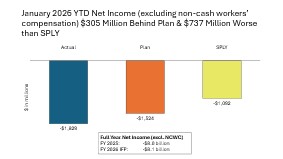
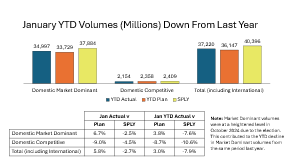
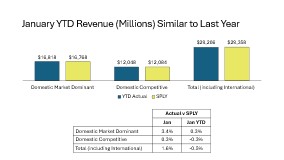
The USPS on February 24, 2026 filed its January 2026 financial results with the Postal Regulatory Commission (PRC). As can be seen in the below slides (prepared by SLS Consulting), the USPS’ January 2026 year-to-date (YTD) net income (excluding non-cash workers’ compensation) was $305 million below its plan and $737 million worse than the same period last year (SPLY). Total volume for January year-to-date were also down compared to the same period last year (-7.9%), but it should be noted that volumes were at a heightened level in October 2024 due to the election, which contributes to the decline when comparing volumes to last year. In terms of revenue, the results for January year-to-date were similar to last year.
PRC Approves USPS Request to Recalculate CPI for Next Price Increase
As a result of the lapse in government appropriations last fall, the United States Bureau of Labor Statistics (BLS) did not publish an inflation index value for October 2025. The Postal Regulatory Commission (PRC), in its first time dealing with such an event, used a method of accounting for the missing October 2025 index value which the USPS contended produced unrepresentative results. The USPS proposed an alternative method for calculating the available CPI-U rate authority in light of the missing October 2025 index value, which it stated “will produce more representative measures of inflation.” The PRC this week granted the USPS’ request to recalculate the October 2025 CPI using its recommended formula. [In the next Alliance Report, we will share an updated chart showing the USPS’ available rate authority based on the recalculated CPI.]
New Nonprofit Stamp Coming in 2026
The USPS announced release dates and locations for more new stamps coming out in 2026 , including a new nonprofit bulk mail stamp, Summer Sunset, scheduled for release June 25.
The Alliance Welcomes New Sponsor!
The Alliance of Nonprofit Mailers is delighted to welcome another new sponsor:
- Whittier Mailing Products (https://wmpwebstore.com/)
We greatly appreciate their support of the Alliance!
Alliance April Webinar for members & sponsors only – Register Now!
Our 2nd webinar for 2026 will be held in April and will be for Alliance nonprofit members and sponsor members only. This next webinar will focus on the details of the USPS’ July 2026 price change, update on regulatory proceedings and news from the March meeting of the Mailers Technical Advisory Committee (MTAC).
The webinar will be held on Friday, April 17, 2026, from 1-2 EST. This webinar will be open to current members and sponsors only. Registration is open at https://zoom.us/meeting/register/W6PTrjgzQXKTzFQHO0omdQ
The Alliance is planning to hold more webinars in 2026, some will be restricted to Alliance members only, others will be open to all. If there are specific topics or speakers your organization is interested in having a webinar on, email me at kathy@nonprofitmailers.org.

Leave a Reply