

Alliance Report
June 15, 2026
Issue 26/10
The leading voice of nonprofits on postal issues for over 45 years.
Copyright 2025: Alliance of Nonprofit Mailers—All rights reserved.
The Alliance of Nonprofit Mailers is a 501 (c)(4) nonprofit organization established by nonprofits for nonprofits.
PRC Approves Competitive Services Price and Classification Changes
The PRC on June 12, 2026, approved the USPS’ proposed rate and classification changes and updates to the Mail Classification Schedule (MCS) to reflect the new prices.
In response to concerns with the structural changes raised by some in the shipping and mailing industry, the PRC largely encouraged the Postal Service “to consider the commenters’ concerns,” and “work with the mailing industry to ensure the rollout is operationally successful.”
On concerns raised around the new fee-based addresses API implementation, the PRC “encourages the Postal Service to further engage with the shipping industry to minimize potential confusion and disruptions associated with software changes and implement a reasonable grandfathering period to ensure changes can be implemented as smoothly as possible.”
In response to concerns raised that the addresses API violates statues around USPS competing with the private industry, the PRC said that “[w]hile the Commission is sensitive to the concerns raised by the commenters, none have identified with specificity how the proposed Addresses API in this docket establishes terms of competition in a defined market to the detriment of an identifiable class of private competitors.” The PRC said that at this juncture, it “has no evidentiary basis or fact pattern on which to find a potential Section 404(a) violation that would require Commission action at this time.” It said it “does not pre-judge the merits of any future complaint involving the Addresses API and will revisit any alleged section 404(a) issues on a fuller evidentiary record if necessary.” “Should such an evidentiary basis subsequently arise, the Commission reminds interested parties that they may file a complaint…”
The changes will take effect July 12, 2026, along with the Market Dominant price and structural changes.
Senate to Hold USPS Board of Governors Nomination Hearing
The Senate Homeland Security & Governmental Affairs Committee (HSGAC) on June 17, 2026, will hold a hearing to consider multiple nominations, including the nominations of Jeffrey Brodsky, William Gallo, Anthony Lomangino, and Robert Steffens to be Governors of the USPS. https://www.hsgac.senate.gov/hearings/nominations-14/
May 2026 CPI and Updated USPS 2027 Price Change Outlook
The Bureau of Labor Statistics on June 10, 2026, released the May 2026 CPI, which increased by 4.2 percent from May 2025 and by 0.5 percent from April 2026 (seasonally adjusted). According to Alliance economist SLS Consulting, “the CPI price cap authority now stands at 0.935 percent,” for a July 2027 USPS price change. See the table below for the updated estimated July 2027 rate authority under the existing Market Dominant ratemaking system. “Given the substantial recent increases and volatility in energy costs,” SLS cautioned, “these estimates are subject to heightened uncertainty and may change.”
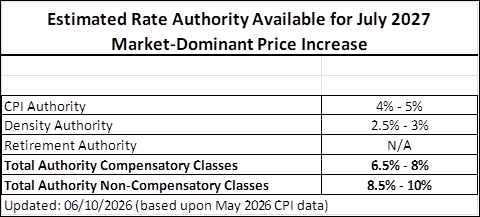
In a price change webinar held earlier this week, the USPS shared the below slide with its estimates of price changes for the next few years. It should be noted that the USPS’ estimate for July 2027 is higher than the estimate shown above because the USPS is estimating 4% for the Density Authority it will have available for 2027. The exact amount of Density Authority will not be determined until the USPS submits its FY2026 Annual Compliance Report (typically end of December) and the PRC approves the data in its Annual Compliance Determination (typically issued end of March).
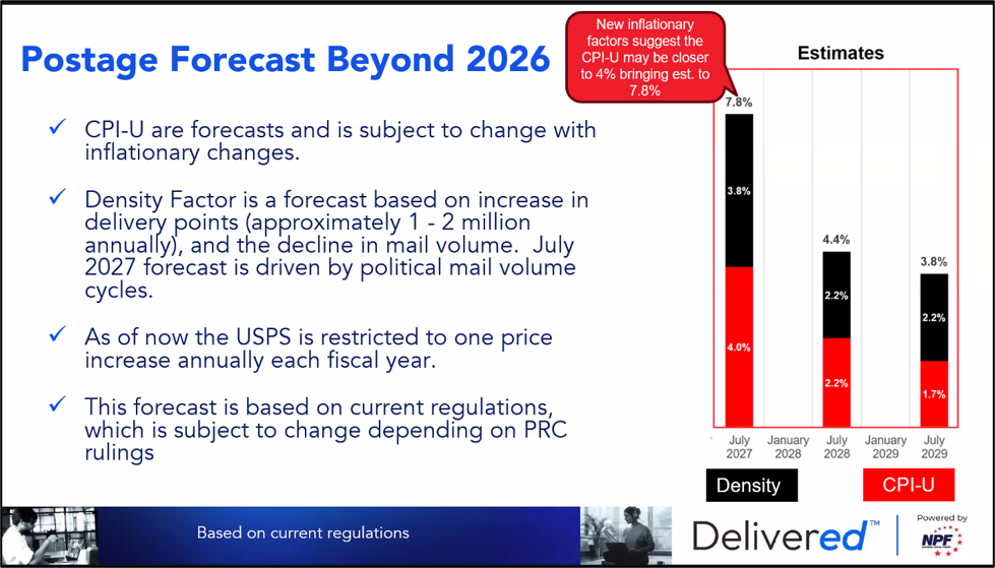
In addition, the PRC is in the process of reviewing the rate-making system and may make changes that could be implemented prior to a July 2027 price increase. The bottom line is that while this information can be used as current estimates, there are potential changes that could impact what happens in July 2027.
Petition Filed at PRC on Election Mail Changes
On June 11, 2026, a petition was filed with the Postal Regulatory Commission (PRC) calling on the PRC to initiate proceedings concerning the Postal Service’s proposed “nationwide changes in the nature of services for Federal Postal Ballot Mail,” no later than July 1, 2026.
The petitioners, Fiat Fiendum, Inc., and Sai (its President), say they have “principled interests in ensuring that everyone who can vote does vote, and that every vote counts, as reliable and universal voting is essential to the health of our republic — and in ensuring that agencies obey the law, act transparently, are accountable, etc., as these are fundamental principles of good government.” They filed two petitions – one that they say “address[es] the Postal Service’s evasion of Commission oversight,” and another that requests codification of Election Mail in the Mail Classification Schedule.
The petitioners take the position that rather than simply publishing proposed rules in the Federal Register (see article in the last issue of the Alliance Report) on changes in election mail, the USPS is required to ask the PRC for an advisory opinion. “The Postal Service has abrogated to itself a power it does not have: the power to unilaterally alter its regulations affecting the nature of postal services,” they said. “It is only allowed to do so with the Commission’s oversight following public notice & comment, in a formal proceeding before the Commission,” the petitioners said. Referring to statute contained in U.S. Code 39, the petitions argue, “[w]e note that § 3661(c) does not constrain the Commission to sit idly by because it has not received a docketed proposal directly from the Postal Service.” “The Postal Service’s proposal has been published in the Federal Register,” it noted, “and we have in this petition given the Commission formal notice thereof.” “Holding § 3661(c) hearings to regulate the Postal Service is core to the Postal Regulatory Commission’s powers and duties,” they argued. The petitioners ask that the PRC initiate proceedings no later than July 1, 2026 because the commend deadline to the USPS’ proposed rules in the Federal Register is July 2, 2026.
The second petition asks the PRC “to add every variation of Election Mail to the Mail Classification Schedule, in exactly their current forms as of the time of this filing, with the additional specifications we believe are necessary as discussed below.” “In the alternative,” the petitioners ask, “to the extent the Commission rejects our proposed specifications, we ask that Election Mail be added without such rejected parts.”
“Election Mail should encompass all official election-related mail — to or from voters, from state-authorized voter initiative petition collectors to states, intra-governmental election mail (e.g. from precincts to bulk counting sites), etc.” The petition includes rationale in support of the petitioners’ request that Election Mail be codified, noting that “[t]here is ongoing dispute and litigation over whether Election Mail must be (a) delivered by the applicable Election Day, or (b) posted by then, and delivered within a few days thereafter as set by State legislatures.”
“Whatever the outcome thereof may be,” the petitioners wrote, “we ask that 100% guaranteed conformance with it be encoded in the MCS — i.e., that the Postal Service must, with absolute reliability, deliver all ballots, by the applicable Election Day and time (even in “posted by” states, to limit disputes), if possible for USPS’ fastest available service to do so (including by USPS’ same-day, next-day, and any other express or special delivery, to the extent available and needed) — and, only if impossible to deliver by that day, as soon as possible thereafter.” “Given repeated legal disputes hinging on postmark dates,” they said, “we also ask that all Election Mail must have a clear and reliable postmark showing the date of its entry into the mail, with zero obligation or burden on the voter.”
The PRC has not yet acted on the petitions, which were only just filed June 11.
Alliance Statement Following PRC Hill Testimony
The Alliance submitted a statement for the record following the June 3, 2026, testimony by the Postal Regulatory Commission (PRC) before the House Subcommittee on Government Operations. [Highlights from the hearing were included in our June 8, 2026, Alliance Report newsletter.]
The Alliance commended the House Subcommittee for the ongoing work it is doing on the critical issues facing the USPS, and described the critical importance for nonprofit organizations to have access to affordable and reliable postal services, as well as the devastating impact that “the magnitude and frequency of postage rate increases have had on nonprofit organizations over the past five years, which unfortunately will only be exacerbated by the upcoming July 2026 postage increases.”
The Need for a Strong Regulator. In response to some of the issues raised in the June 3 hearing, the Alliance said it supports the need for a strong regulator to provide necessary oversight of the USPS, which continues to hold two monopolies (letter mail delivery and access to the mailbox). “While we do not always agree with the actions of the Postal Regulatory Commission (PRC),” the Alliance said, “we agree that there needs to be strong regulatory oversight of the U.S. Postal Service.” “If anything, we believe that some of the PRC’s responsibilities and authority need to be clarified and, in some cases, strengthened, the Alliance said, using service performance as one example of an “area where we believe the PRC needs additional authority.” The Alliance continued,
“As discussed by Commissioners during the hearing, the PRC issues non-binding advisory opinions when the Postal Service proposes changing service standards, service performance targets, its service performance measurement system and other initiatives that impact service such as the Regional Transportation Optimization (RTO) changes. The PRC holds in-depth proceedings in these cases, with input being received from all affected stakeholders, but in the end all it can do is give the Postal Service recommendations which the Postal Service does not have to follow. There needs to be a better process to ensure that service performance does not continue to be degraded, particularly as prices continue to rise.”
“A Postal Service that is simply granted unrestrained pricing power without sufficient regulatory oversight and without incentives for cost management is a Postal Service that is doomed to fail,” the Alliance noted, “and that failure will harm our members and the industry at large.”
The Impact of Significant Price Changes. The Alliance reiterated and expanded on information it had provided the Subcommittee after its March 2026 hearing on the Postal Service, that significant price increases have accelerated the decline of nonprofit mail volume.
“Despite repeated references to the magnitude of the USPS’ postage price increases over the past five years during the hearing,” the Alliance said, “we believe there is not a full understanding of the impacts of price increases above inflation on mail volume.” “While we appreciate the comments made during the hearing about the need to retain and grow mail volume,” it said, “there does not seem to be an understanding that price increases above inflation have accelerated the decline of mail volume.” The Alliance continued,
“This is particularly true for nonprofit organizations – the rate of mail volume decline has over doubled during the past five years as a result of the magnitude of price increases. [S]tarting in 2021, nonprofit mail volumes (Nonprofit Periodicals and Nonprofit Marketing Mail) declined by an average of 3.5% annually from FY 2021 to 2025. Over the prior 15 years (which included extraordinary events like the Great Recession and pandemic), nonprofit mail volumes declined at a slower pace — by an average of 1.7% annually. The annual rate of decline in the last five years has more than doubled, even in the absence of recession and COVID-19.”
“This acceleration of mail volume decline is a direct result of the additional rate authority above inflation given to the Postal Service by the PRC in 2021,” the Alliance told the Subcommittee. “To its credit,” it said, “the PRC has since determined that the changes to the rate-making system it implemented in 2021 are not meeting the statutory objectives and it is in the process of conducting another review of the rate-making system.” “The PRC also recently issued an order limiting the Postal Service to one significant price increase for Market Dominant products per Fiscal Year,” the Alliance added, “which will help stabilize the frequency of price increases, but does not prevent the Postal Service from continuing to raise prices significantly above inflation.” “Unfortunately,” the Alliance emphasized, “these greater-than-inflation price increases will continue to drive the very mail out of the system that the Postal Service needs to retain and grow.”
“We believe that Congress had it right,” the Alliance said, “when it enacted the Postal Accountability and Enhancement Act (PAEA) and included a CPI-cap for postage price increases for Market Dominant products.” “The USPS’ financial condition has not been helped by greater-than-inflation price increases that have resulted in driving mail from the system,” ANM noted. “We believe that an updated business model for the Postal Service needs to include better incentive and oversight of the USPS’ cost reduction measures, which are key to it regaining financial stability,” it said.
Defining the USO. The Alliance told the Subcommittee that it agrees with PRC testimony in that “there is a need to fully define the Postal Service’s universal service obligation (USO) for the future, determine the costs of the updated USO, and then determine how to fund the Postal Service.” “There is now time to pursue this process thoroughly and thoughtfully,” the association noted, “and we hope the Committee will do so.”
The Alliance also supported the “PRC’s proposal in its testimony to allow it to oversee, with Congressional guidance, a process to fully define the USO for the future, as long as there is close involvement with all postal stakeholders and an opportunity to provide feedback on what users of the mail system need in terms of the USO.” “The PRC is well-versed in issues related to the USO,” the Alliance said, “since it produces an annual report on the cost of the USO based on seven basic attributes on universal service.” “We believe that Congress, the PRC, and postal stakeholders must review the basic attributes and metrics for the future as part of this process,” the Alliance said.
In Conclusion. The Alliance reiterated its belief that “significant changes are needed to the Postal Service’s business model to ensure its financial viability in the future, and we believe guardrails are necessary to prevent the USPS from above-inflation price increases that are driving mail volume reductions that weaken its ability to operate efficiently and affordably.” “We urge Congress to use the current timeframe wisely,” the Alliance said, “and undertake a process to define the USO needed for the future to serve America.”
Nonprofits in the Indianapolis Economic Region Recovered Slowly After COVID-19 Employment Losses
According to a new report released by the Indiana Nonprofits Project, COVID-19 took a toll on nonprofit employment in the nine-county Indianapolis Economic Growth Region (EGR 5), but the years that followed told a story of recovery and resilience. The report analyzed data on paid employment from 2018 through 2023 as well as some preliminary data from 2024.
“The report highlights the long-term impact that the COVID-19 pandemic imposed on nonprofit employment, payroll, and wages in the Indianapolis economic region between 2018 and 2023,” said Indiana University in its article about the report. “Total nonprofit employment in the region declined by 5% in 2020 for the first time since 1995, when the project launched its data series,” it said.
“The study focuses on five major nonprofit industries and subindustries in health care, education, social assistance, arts, entertainment, and recreation (AER), and membership associations,” it noted. “The immediate impact of COVID-19 on paid employment in 2020 was uneven across these key nonprofit industries,” the University said, noting that “[w]ith the temporary closure of non-essential services at the height of the pandemic, the AER industry absorbed the most dramatic impact, while health care—where essential services such as hospitals and ambulatory care were indispensable–had virtually no employment losses.”
“The arrival of COVID-19 in early 2020 presented major challenges for families, communities, government and service providers everywhere, including Indiana nonprofits,” said Dr. Kirsten Grønbjerg, Director of the Indiana Nonprofits Project. “We know from our previous reports that nonprofits had to change service delivery formats and lost funding while still trying to meet the rising needs of communities.
“Massive federal pandemic relief efforts enacted in 2020-2021 softened the blow, but as nonprofits had to cut costs, our new findings suggest they selectively retained higher paid, skilled staff in their attempts to keep programs operating,” Gronbjerg said.
The University said “[t]he post-pandemic recovery for the region’s nonprofits was slow,” adding that “[t]otal nonprofit employment did not completely recover to 2019 levels until 2022, with preliminary data showing continued growth in 2024.” “However, ”it said, “the recovery was uneven across the key nonprofit industries, and nonprofits recovered more slowly than did for-profits in most of these industries.”
“Nonprofits in the Indianapolis EGR showed considerable resilience during and after COVID-19,” Grønbjerg said. “However, their slow and uneven recovery since suggests they have found it difficult to expand their own revenues, operations, and services to meet existing needs, let alone any increase in needs.”
The report is a joint effort of the Indiana Nonprofits Project, the Indiana Business Research Center, the Paul H. O’Neill School of Public and Environmental Affairs, and the Lilly Family School of Philanthropy all at Indiana University.
Into the Postal Weeds…
For those who live in the “postal weeds,” and are looking for news on mail entry, preparation, discounts, incentives, and more, this column in the Alliance Report will be right up your alley! We won’t go all the way into the weeds…but we will offer up highlights on useful resources and mailing standard changes.
- USPS Stamp Encore contest winner announced – Mister Rogers! As part of the organization’s 250th anniversary celebration, “USPS invited customers and employees to vote on a favorite from among 25 releases issued between 1997 and 2022. The contest was called Stamp Encore because the winning stamp would be reissued. Voting was open July 23-Sept. 30, and nearly 600,000 ballots were cast. https://news.usps.com/2026/06/11/mister-rogers-was-a-wildly-popular-choice/
- USPS Publishes DMM Changes for July Price and Structural Changes. The USPS on June 2, 2026, published in the Federal Register the final rules with revisions to the Domestic Mail Manual (DMM) to implement the price and structural changes to take effect July 12, 2026. Changes include elimination of the ADC rate category from Market Dominant mail classes; restructuring of Outside County Periodicals rates; Marketing Mail weight adjustments and introduction of Heavy Printed Matter with addition of container and pallet discounts; change to minimum volume requirements for FCM cards and letters combined in a mailing; package barcode quality noncompliance fee; price restructure for Bound Printed Matter (BPM) flats and Parcels Presorted and Carrier Route; elimination of bundling for Marketing Mail flats prepared in trays; and 2027 Mailing Promotions.
Alliance August Webinar for members & sponsors only – Register Now!
Our 3rd webinar for 2026 will be held in August and will be for Alliance nonprofit members and sponsors only. This next webinar will provide updates on regulatory and legislative postal proceedings as well as news from the July meeting of the Mailers Technical Advisory Committee (MTAC).
The webinar will be held on Wednesday, August 5, 2026, from 2-3 EST. Registration is open at https://zoom.us/meeting/register/gSoLn9aqRRW-O9FLKqTEEw.
The Alliance is planning to hold more webinars in 2026, some will be restricted to Alliance members only, others will be open to all. If there are specific topics or speakers your organization is interested in having a webinar on, email me at kathy@nonprofitmailers.org.
Leave a Reply