

Alliance Report
August 28, 2026
Issue 26/17
The leading voice of nonprofits on postal issues for over 45 years.
Copyright 2025: Alliance of Nonprofit Mailers—All rights reserved.
The Alliance of Nonprofit Mailers is a 501 (c)(4) nonprofit organization established by nonprofits for nonprofits.
USPS Files for Fall Price Increase on Competitive Services Products
The USPS on August 25, 2026, filed notice with the Postal Regulatory Commission (PRC) that it intends to implement a temporary price change for Competitive Services products for the 2026 Holiday Shipping period.
The planned change for peak season affect prices on the following retail and commercial domestic competitive parcels: Priority Mail Express (PME), Priority Mail (PM), USPS Ground Advantage, and Parcel Select. No other products or services would be affected. Pending favorable review by the PRC, the temporary rates would go into effect at 12 a.m. CT on Oct. 4 and remain in place until 12 a.m. CT on Jan. 17, 2027. The planned price changes include:
Retail:
Priority Mail and USPS Ground Advantage: Zones 1-4
- $0.50 increase for Zones 1-4, 0-3 lbs.
- $0.80 increase for Zones 1-4, 4-10 lbs.
- $1.25 increase for Zones 1-4, 11-25 lbs.
- $3.90 increase for Zones 1-4, 26-70 lbs. and Oversized.
Priority Mail: Zones 5-9
- $1.00 increase for Zones 5-9, 0-3 lbs.
- $2.10 increase for Zones 5-9, 4-10 lbs.
- $4.30 increase for Zones 5-9, 11-25 lbs.
- $9.10 increase for Zones 5-9, 26-70 lbs.
Priority Mail Flat Rate:
- $2.10 increase for Large Flat Rate Boxes.
- $1.00 increase for all other Flat Rate Products.
USPS Ground Advantage: Zones 5-9
- $0.75 increase for Zones 5-9, 0-3 lbs.
- $1.40 increase for Zones 5-9, 4-10 lbs.
- $2.75 increase for Zones 5-9, 11-25 lbs.
- $7.50 increase for Zones 5-9, 26-70 lbs. and Oversized.
Priority Mail Express: Zones 1-9
- $1.40 increase for Zones 1-4, 0-3 lbs.
- $2.35 increase for Zones 5-9, 0-3 lbs.
- $2.45 increase for Zones 1-4, 4-10 lbs.
- $6.30 increase for Zones 5-9, 4-10 lbs.
- $5.05 increase for Zones 1-4, 11-25 lbs.
- $11.70 increase for Zones 5-9, 11-25 lbs.
- $12.70 increase for Zones 1-4, 26-70 lbs.
- $20.80 increase for Zones 5-9, 26-70 lbs.
Priority Mail Express Flat Rate:
- $2.35 increase for Flat Rate Envelopes.
Commercial:
Priority Mail and USPS Ground Advantage: Zones 1-4
- $0.40 increase for Zones 1-4, 0-3 lbs. and Cubic Tiers 1-3.
- $0.65 increase for Zones 1-4, 4-10 lbs. and Cubic Tiers 4-5 (PM), 4-9 (GA).
- $1.05 increase for Zones 1-4, 11-25 lbs. and Cubic Tier 10 (GA).
- $3.15 increase for Zones 1-4, 26-70 lbs. and Oversized.
Priority Mail: Zones 5-9
- $0.85 increase for Zones 5-9, 0-3 lbs. and Cubic Tiers 1-3.
- $1.75 increase for Zones 5-9, 4-10 lbs. and Cubic Tiers 4-5.
- $3.85 increase for Zones 5-9, 11-25 lbs.
- $9.10 increase for Zones 5-9, 26-70 lbs.
Priority Mail Flat Rate:
- $1.75 increase for Large Flat Rate Boxes.
-
- $0.85 increase for all other Flat Rate Products.
USPS Ground Advantage: Zones 5-9
- $0.55 increase for Zones 5-9, 0-3 lbs. and Cubic Tiers 1-3.
- $1.05 increase for Zones 5-9, 4-10 lbs. and Cubic Tiers 4-9.
- $1.75 increase for Zones 5-9, 11-25 lbs. and Cubic Tier 10.
- $7.70 increase for Zones 5-9, 26-70 lbs. and Oversized.
Priority Mail Express: Zones 1-9
- $1.40 increase for Zones 1-4, 0-3 lbs.
- $2.35 increase for Zones 5-9, 0-3 lbs.
- $2.10 increase for Zones 1-4, 4-10 lbs.
- $5.55 increase for Zones 5-9, 4-10 lbs.
- $4.90 increase for Zones 1-4, 11-25 lbs.
- $10.50 increase for Zones 5-9, 11-25 lbs.
- $12.55 increase for Zones 1-4, 26-70 lbs.
- $18.20 increase for Zones 5-9, 26-70 lbs.
Priority Mail Express Flat Rate:
- $2.35 increase for Flat Rate Envelopes.
Parcel Select: (all entries)
- $0.40 increase for 0-3 lbs.
- $0.50 increase for 4-10 lbs.
- $0.80 increase for 11-25 lbs.
- $2.35 increase for 26-70 lbs. and Oversized
The complete Postal Service price filings with prices for all products can be found on the PRC website under the Daily Listings section at prc.gov/dockets/daily. For the Shipping Services filing, see Docket No. CP2026-10.
Judge Blocks USPS from Implementing Mail-In Voting Changes (Again)
[This is one of those stories where developments are occurring by the hour – by the time you read this article, things may have changed yet again…but here is the latest as of August 28, 2026.]
A federal judge on August 27, 2026, issued a temporary restraining order that prevents the USPS from implementing its mail-in voting rules (see below article) while litigation continues. “The decision by Boston-based U.S. District Judge Indira Talwani in one case brought by the League of Women Voters and other groups and another brought by a coalition of states means part of the executive order remains blocked for at least 14 days, NBC News reported, “with time running out to implement it ahead of the November election.”
“This rule is a clear attempt by the federal government to interfere in elections it has no power to control,” New York Attorney General Letitia James said in a statement. “Today, a federal court halted it before this administration could wreak havoc on our elections.” Judge Talwani “wrote that the regulation is most likely unlawful because the president cannot insert the federal government into elections without the express authorization of Congress.”
The article notes that the Administration “could seek to quickly overturn her decision by rushing to the Supreme Court.”
Supreme Court Issues Ruling on Mail-In Voting
The Supreme Court on August 24, 2026, issued a ruling on mail-in voting, “[b]ut with the start of voting for this fall’s midterm elections just weeks away, legal and practical challenges loom over whether the U.S. Postal Service and other federal agencies can finish carrying out Trump’s directives,” said NPR.
The Supreme Court ruling “paused a lower court’s ruling that had blocked key parts of an executive order that Trump issued back in March,” NPR said, noting that “[t]he lower court’s ruling applied to 23 mainly Democratic-led states, plus Washington, D.C., that sued the administration.” The Supreme Court decision does not weigh in, however, “on the legality of Trump’s executive order, which has so far not directly affected eligible absentee voters’ option to cast ballots by mail.” “Instead,” NPR said, “the ruling focused on the ability of the mostly Democratic-led states to challenge Trump’s order when they did.”
It should be noted that “[a] broader injunction remains in place,” according to NPR. “As part of a separate but related lawsuit, the Postal Service is blocked from following Trump’s directives under a nationwide ruling released Aug. 11 by U.S. District Judge Indira Talwani in Boston,” it reported, but noted that in a “court filing late Monday, the administration says it plans to ask the 1st U.S. Circuit Court of Appeals to pause that ruling if Judge Talwani does not pause or cancel the ruling by 5:30 p.m. ET on Tuesday.” On Wednesday, August 26, 2026, NPR reported that Judge Talwani “canceled a nationwide ruling she had issued that blocked the U.S. Postal Service from working on Trump’s directives.” “The decision sets the stage for another possible consideration of the executive order by the Supreme Court,” NPR reported, noting that “[s]o far, the high court has ruled on a procedural issue, but not weighed in on whether Trump’s order is legal.”
The Supreme Court’s ruling this week pertained to “an earlier decision by Talwani, in June.” The order said “that its ‘disposition of this application does not mean that any measure taken by the Government to implement the Order will necessarily be lawful.’” “On that score, time will tell,” the court noted, according to NPR..
Shortly after Judge Talwani canceled her earlier nationwide ruling, the Colorado and 24 other states sued to block the USPS over its ballots rule (see below article). “The filing in Massachusetts claims the rule violates the Constitution and federal statutes many times over, flouts the Privacy Act and federal voting rights laws, and is inconsistent with USPS’s own governing statute,” the article reported.
“In a dissenting opinion,” it said, “Justice Ketanji Brown Jackson noted that the Supreme Court’s ruling ‘needlessly injects chaos and uncertainty into the upcoming midterm elections.’” “To be sure, the Court has not foreclosed States from challenging this blatantly unconstitutional Order,” Jackson added. “But it declines to explain when, exactly, is the right time to bring a meritorious election-rule claim challenging unconstitutional interference with electoral processes. The majority just signals that these claimants had to wait—even though the election cycle had started and despite facing pocketbook costs, threats of prosecution, and an affront to their sovereignty—before receiving the relief to which they are likely entitled.”
NPR reported that the states challenging the Executive Order are “now exploring legal options.”
As a reminder, the Executive Order calls “for the Department of Homeland Security to develop state lists of adult U.S. citizens and for the Postal Service to obtain lists of eligible mail voters from states,” NPR said. “Additionally, USPS is supposed to deliver mail-in ballots only to people on those lists,” it said, noting that “[a]ll election officials would also be required to have certain barcodes on their mail ballot envelopes.”
The USPS has published a final rule for federal ballot mail in response to the Executive Order (see below article).
USPS Publishes Final Rule on Election Mail Ballots
The USPS on August 21, 2026, published a final rule regarding the transmission of mail-in or absentee ballots for federal elections, effective immediately. The USPS in its final rule said that given the legal injunctions currently in place, it “will not take actions to implement the rule specifically for the 2026 election unless and until the government obtains relief from those injunctions.” “If the government obtains timely relief from the injunctions, implementation immediately thereafter will provide election officials as much time as possible before the next election to comply with the rule’s preparation standards for Federal Ballot Mail envelopes,” the USPS said, “and to prepare to submit data to the Federal Ballot Mail Portal (‘Portal’), before the mail-in and absentee ballots subject to this rule are mailed (which generally occurs in September or thereafter, as determined by state law).”
The USPS said its portal and the verification process that relies on the data therein would “become active…at the time of the publication of the system of records (‘SOR’) governing the Portal,” which it said would occur on or after August 17, 2026 (pending the USPS’ separate consideration of the comments on that SOR proposal).
The USPS reported that it received “more than 200,000 responses during the comment period.” It said,
“These comments consisted primarily of form letters that appeared to be drawn from templates; brief statements of general support for or opposition to the proposed rule; and individualized messages from concerned citizens. Additionally, organizational commenters individually and jointly submitted over 250 letters. This group of commenters included postal unions; federal, state, local, and tribal officials, including state attorneys general, governors, and members of Congress; election officials, including secretaries of state and county election administrators; voting rights organizations; and a range of other issue-based and political advocacy groups.”
The USPS reported that “supportive comments emphasized several themes,” including the problem of voter fraud and how the proposed rule helps restore voters’ confidence in election integrity; how the proposed rules would enhance election security by improving ballot mail visibility; the benefits of creating reconcilable data with a neutral administrative check to strengthen confidence in elections, and to reduce uncertainty on whether ballots have reached their intended destination.
Comments received in opposition to the proposed rule generally urged the USPS “to withdraw the rule or to delay its implementation until after the November 3, 2026, general election.” It said that “[c]oncerns raised by opposing commenters largely fell into three broad categories,” including the “alleged legal deficiencies of the proposed rule;” “the purported practical implementation challenges;” and “the proposed rule’s alleged broader political and social impact.” The USPS responds to these concerns in its final rules.
USPS Says States Remain in Control of Voter Lists. The USPS in its final rule said its verification process will only “ensure that states adhere to the mailpiece design and data reporting standards.” “By checking the outbound barcode,” it said, “the Postal Service will be able to verify that the state or political subdivision thereof has satisfied the Portal data entry requirements (e.g., certifying that Outbound and Return Federal Ballot Mail envelopes have been submitted for Mailpiece Design Analyst (“MDA”) review and that feedback has been received, all required data fields have been entered).”
The USPS emphasized that “the Postal Service will exercise no discretion or authority over whether an individual should or should not be on the list a state provides.” “This rule does not involve or authorize inspection of a mail-in ballot’s contents, review of individual voter’s eligibility, or auditing of state voter rolls,” the USPS said, noting “[i]t instead focuses exclusively on exterior mailpiece criteria and barcode scan data.” It continued,
“Specifically, DMM 705.24.1.b limits enrollment in the Portal to users authorized by a state’s chief election official; accordingly, and as detailed in DMM 705.24.4.3, the Postal Service will compile and return to each state only the information that the state itself has submitted, thus preserving the states’ control over who is (and is not) able to vote by mail. It further bears emphasizing that the verification process delineated in DMM 705.24.5 would not involve voter eligibility determinations in any way; it will not entail scrutiny into, or any attempt to evaluate, individual voters. Finally, as plainly stated in DMM 705.24.5.2, ‘Postal Service personnel are not authorized to open mail sealed against inspection.’ In short, the rule adds a layer of security and accountability while leaving the administration of elections firmly in the hands of the states.”
New Mailpiece Preparation Requirements. The USPS rule introduces new mailpiece preparation requirements and data reporting standards for Federal Ballot Mail that must be satisfied prior to presenting Outbound Federal Ballot Mail for acceptance into the mailstream. “However,” the USPS acknowledged, “as many commenters acknowledged, and consistent with the stated authority above, the Postal Service will generally not accept Outbound Federal Ballot mailings unless compliance with the rule’s new standards has been verified, as further detailed below and in the final rule.”
The rule “creates an optional process through which a state’s chief election official (including those representing D.C. and U.S. territories) may alert the Postal Service of the state’s intent to allow mail-in or absentee ballots to be transmitted by the Postal Service,” it said. “This notice may be given 90 days prior to a federal election,” the USPS said but noted the provision “does not require a response from the state official, and also does not require preparation of a list of individuals to whom a ballot will be mailed or coordination with local officials (although the state official may choose to do so).”
“When the Postal Service knows that a state plans to send ballots for a federal election using the mail,” it said, “it can conduct outreach on mail preparation, provide resources related to IMbs, and offer guidance on how access and use the Federal Ballot Mail Portal.” “While the process to enroll in the Portal is straightforward,” the USPS said, “beginning this process sooner—as the 90-day notice would allow—will be logistically beneficial.” “Alternatively,” it noted, “the chief state election official can provide no notice at all.” It said
“This does not preclude the state from using the Postal Service to transmit mail-in and absentee ballots for federal elections. Ballots for federal elections may still be sent through the mail so long as the chief state election official, and any other Federal Ballot Mail Portal User, creates a Portal account, satisfies the rule’s mail preparation requirements, enters the required information into the Portal, and successfully completes verification prior to their Outbound Federal Ballot Mail being accepting for mailing.”
The USPS said that the “chief state election official may also provide notice that they do not intend to transmit ballots using the mail or that they do not intend to use the Portal.” “This also provides the Postal Service with valuable information to plan its resources and may inform internal training,” it said. “It should also be emphasized that these notices are not binding,” the USPS explained. “For example,” it said, “if the chief state election official initially informs the Postal Service that they do not intend to use the Portal, they may later change their mind and send ballots using the mail by following the steps outlined above.”
Envelope Design. The rule makes several of the Postal Service’s longstanding mailpiece design preparation recommendations required elements for Federal Ballot Mail. “As many commenters recognized,” the USPS said, “these elements—the Official Election Mail logo, automation-compatible envelope design, uniquely serialized IMbs on outbound and return envelopes, and mailpiece design review—are not novel.” “Each of these design elements is already recommended in the Postal Service’s Official Election Mail Guide (“Kit 600”) and included as a best practice in DMM 703.8.0,” it said, noting that “[s]ome jurisdictions have, on their own initiative, already opted to implement these recommendations to varying degrees.” “However,” the USPS said, “nothing in the rule prevents or discourages election officials from including envelope design elements required by state law, such as printed affidavits.” “Nor does anything in the rule prevent states from complying with accessibility laws or including unique envelope design elements intended to accommodate voters covered by these laws,” it said, explaining that “[t]he rule will not create a single, uniform ballot envelope design across all states; variation will remain.”
The USPS outlined the tools and services available today for generating IMbs, noting that the USPS “also anticipates making modifications to the IMsb Tool to further enhance its functionality for Federal Ballot Mail.” “For instance,” it said, “the Tool will be able to create lists for Portal submissions that contain a file with the name, address, and unique outbound and return IMb of individuals on the election official’s mailing list.” “Another change for Federal Ballot Mail in the IMsb Tool will allow election officials to generate a unique IMb even where the address cannot be verified using Delivery Point Verification (“DPV”),” the USPS said, noting that “[a]lthough DPV helps to identify issues that may hinder delivery, this modification will reduce the chance of an administrative or technical issue that could prevent an election official from generating a unique IMb.” The USPS said election officials can also choose to work with a vendor, as many do today.
Mailpiece Design Analyst Review. “Once election officials or their vendors have designed the Outbound and Return Federal Ballot Mail envelope to include the required elements, as set forth in DMM 705.24.3,” the USPS said, “the mailpiece must be submitted to the Postal Service for review by one of its MDAs.” “The envelope design must be reviewed each election cycle,” it said, noting that “[i]f a state uses a single design, each political subdivision thereof does not need to separately submit the envelope for review.” The USPS noted that the MDA review process is the existing process “”that many in the election community already utilize.” “More information about the MDA review process is available in Kit 600 or at https://postalpro.usps.com/node/773,” the USPS said.
Federal Ballot Mail Portal. Under the new rules, “Federal Ballot Mail Portal Users, including state and local election officials and other authorized users, such as MSPs, must submit certain data into the Federal Ballot Mail Portal prior to presenting an Outbound Federal Ballot mailing for acceptance,” the USPS said, noting that “[c]hief state election officials are not required to enter this data themselves or to consolidate data for all political subdivisions within their state before data can be entered into the Portal.” “The chief state election official of each state does, however, authorize access for other Federal Ballot Mail Portal Users within their state,” it said, noting that the rule “also allows other individuals to enter information into the Portal if authorized, such as staff members, MSPs, or other vendors, thereby minimizing any potential administrative burden on election officials.” The USPS said it “recognizes that many states have decentralized election administration,” but noted that “[t]t is important that the state, through the chief state election official, maintain ultimate control over access to the Portal because they will have more visibility into their own election structures than will the Postal Service.” The USPS explained the portal process:
“Once Federal Ballot Mail Portal Users have set up a Portal account, they will be prompted to certify that their Outbound and Return Federal Ballot Mail envelopes have been submitted for MDA review and that they have received feedback. Federal Ballot Mail Portal Users will not be able to upload any data into the Portal until the certification is complete. This will ensure compliance with DMM 705.24.3.1 and 705.24.3.2 and reduces the information that is verified prior to acceptance of an Outbound Federal Ballot mailing. Business Mail Entry Unit (“BMEU”) technicians and Retail clerks will not perform a separate review of this information. After completing the certification, Federal Ballot Mail Portal Users must provide: the name and address of the voter as found on Outbound Federal Ballot Mail envelope; the issuing state; and the IMbs on the Outbound and Return Federal Ballot Mail envelopes. This information must be uploaded to the Portal prior to presenting Outbound Federal Ballot Mail for acceptance.”
The USPS said it “does not anticipate that providing Portal data should require any change to statewide systems or databases.” “States must necessarily already maintain lists or databases with the relevant name and address information,” the USPS said, “otherwise it would never have been possible to mail those ballots in the first place.” “These systems are intended to remain separate,” it said, “and do not need to be interconnected with the Portal.” “One commenter mentioned that states may wish to update their databases to include IMb data,” the USPS said but noted, “[s]tates are free to undertake such actions, but it is not required by the rule.” The USPS includes more details in its final rule around the Portal and data requirements, and notes that the process “is designed to be flexible to account for variation in state law.”
Outbound Federal Ballot Mail Entry. The USPS final rule requires that, “[w]hen preparing Outbound Federal Ballot mailings, Authorized Ballot Mailers must segregate Outbound Federal Ballot Mail from other types of ballot mail, such as primary ballots, UOCAVA ballots, or ballots for state or local elections only.” “Comingling nonfederal ballot mail with Outbound Federal Ballot Mail may impact the verification process and could prevent or delay proper acceptance of mailings,” the USPS said. The final rules include other requirements for submission/acceptance of Outbound Federal Ballot Mail.
The USPS noted that it also is working “on establishing Federal Election Mail and Non-Federal Election Mail Service Type Identifiers (“STIDs”).” “Specifically,” it said it is “planning to convert the current Election Mail STIDs to Federal Election Mail STIDs,” and that “[n]ew STIDs will be developed for non-Federal elections.” “This approach will assist jurisdictions that may have already finalized the printing process for their 2026 general election envelopes relying on the existing STID table,” the USPS said, “and will support their ability to comply with the final rule.” It said that it will publish a notice in the Federal Register prior to finalizing and releasing the new STIDs.
“Once Outbound Federal Ballot Mail is accepted by the Postal Service,” it stressed, “it will enter and move through the mailstream as it has in prior elections.” “It will not be intercepted, returned, or delayed due to the rule,” it said, noting that “[t]he verification process does not entail scrutiny into, or any attempt to evaluate, individual voters.” “The Postal Service is not verifying addresses, names, voter eligibility, or citizenship status as part of this verification process,” it emphasized. “Portal data will be regularly refreshed to minimize the risk that the verification process incorrectly flags, delays, or disrupts lawful federal ballot materials,” the USPS said.
State-Specific Mail-In and Absentee Participation List. The USPS in its final rule said that on or about Election Day, it will “generate a state-specific Mail-In and Absentee Participation List, which compiles all Federal Ballot Mail Portal entries submitted for the originating state.” “This list will be securely transmitted to the chief election official of each state,” it said, noting that the USPS “will not disclose the Lists to the public.” “The List is in effect a manifest,” the USPS said, “and is primarily intended to assist election officials and law enforcement to understand who may have been mailed a ballot, in order to identify potentially anomalous incidents that may merit further investigation.” It emphasized, “the state-specific Lists are not intended to substitute for or supplant state voter rolls.” “It simply offers another data point at the chief state election official’s disposal based on their own Portal data,” the USPS said, noting that “[t]he chief state election official is free to choose whether and how to use the state-specific list.” “Those decisions are not dictated by the Postal Service or this rule,” it stressed, noting that “[s]tates have sole responsibility for ensuring the accuracy of their voter rolls and counting ballots as permitted under state law.” It continued,
“The Portal data is the sole data source used to generate the Lists. These data are provided directly by election officials (and other Federal Ballot Mail Portal Users) based on the mailings they actually made or planned to make. The List will not be based on external sources of information, such as federal databases made available by the Department of Homeland Security or the Social Security Administration. Nor will the Postal Service compare Portal data to any other internal or external source (e.g., National Change of Address data, federal data lists), filter the information, or otherwise alter the Portal data on its own when compiling the state-specific List. The Lists will also not contain any scan data. As one commenter correctly stated, the rule ‘require[s] USPS to provide the state with the List that contained the same information that the state provided to USPS.’”
Election Officials. The USPS noted that election offices were among those most frequently raising concerns opposing the rule, primarily if the rule were implemented immediately. “Commenters, particularly election officials, secretaries of state, governmental officials, and voting organizations, stated that it would be difficult if not impossible to implement the rule in time for the 2026 general election,” the USPS said. “Election officials asserted that their preparations for the 2026 election are already underway and that they lack the time, funding, and staff to implement the proposed rule,” it said, noting that some “asserted that they have already purchased envelopes for the 2026 election cycle, and that generating unique barcodes for both outbound and return ballot mailings in some cases would require significant changes to their ballot envelope design, as well as procurement of those redesigned envelopes on an expedited timeline, which they assert would not be possible.”
Clarifications and Revisions from the Proposed Rule. The USPS clarifies that the verification process for mail sent by authorized ballot mailers does not apply to Return Federal Ballot Mail, and provides information on how to proceed in the event a voter loses or misplaces the Return Federal Ballot Mail envelope provided by the Authorized Ballot Mailer, or if a compliant return envelope is not provided.
The USPS in the final rule also clarities how “the MDA review requirements would be verified and enforced, and the circumstances under which the MDA review requirements could lead to an Outbound Federal Ballot mailing being rejected.” It noted that certification of MDA review does not happen when the mailing is presented for acceptance, instead, “prior to uploading data into the Portal, Federal Ballot Mail Portal Users will be prompted to certify that their ballot envelope design has been submitted for review by an MDA and that the MDA has provided feedback.” “If they do not provide such certification,” the USPS said, “Federal Ballot Mail Portal Users will be unable to upload data into the Portal.” The USPS in its final rules includes language to reduce confusion and clarify responsibilities of Federal Ballot Mail Portal Users.
The USPS also in its final rule has revised language to clarify that “Authorized Ballot Mailers are responsible for creating IMbs,” and to clarify “that the unique IMb submitted into the Portal is the IMb printed on the Outbound and Return Federal Ballot Mail envelopes.”
The USPS also said it is revising language to clarify that “only commercial mailings are subject to commercial mailing standards and regulations.” “There was confusion over whether non-commercial mailings must be entered at BMEUs or otherwise meet commercial mailing standards,” the USPS said, so it has simplified the language to help avoid confusion.
Lastly, the USPS is changing the term “Ballot Portal User” to “Federal Ballot Mail Portal User” to “clarify the relationship between Federal Ballot Mail, the rule’s data standards, and the Federal Ballot Mail Portal.” “The Postal Service’s hope is that this reduces confusion about the application of rule’s data-entry requirements to other ballot mail as well as confusion about data entry that needs to be performed at the state-level,” it said.
The USPS has published information around the final rule at https://about.usps.com/what/government-services/election-mail/#resources.
USPS July Financials
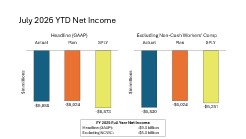 The USPS on August 24, 2026, filed its July 2026 Preliminary Financials with the Postal Regulatory Commission (PRC). For FY2026 year-to-date through July, net income was above the USPS’ Plan and above the same period last year (SPLY).
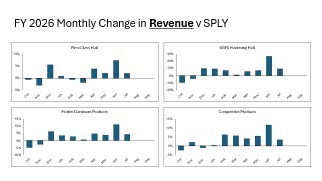
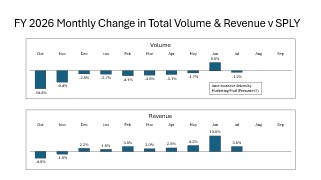
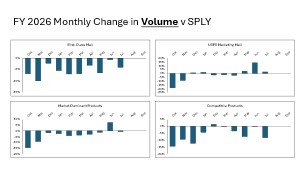
July YTD mail (Market Dominant) volume was down 4.0% from last year, while mail revenue was up 2.6% from last year. Mail volume for July was 1.2% less than SPLY, driven largely by a decline in First-Class Mail volume (Marketing Mail volume for July remained above SPLY), while mail revenue for July was up 3.5% over the same period last year.


Into the Postal Weeds…
For those who live in the “postal weeds,” and are looking for news on mail entry, preparation, discounts, incentives, and more, this column in the Alliance Report will be right up your alley! We won’t go all the way into the weeds…but we will offer up highlights on useful resources and mailing standard changes.
- Time-Limited 2026 Price Change Documents Posted. The USPS has posted price change documents on its Postal Explorer web site in preparation for its Time-Limited 2026 Price Change (Competitive Services products).

Leave a Reply