

Alliance Report
Nov. 13, 2026
Issue 26/24
The leading voice of nonprofits on postal issues for over 45 years.
Copyright 2025: Alliance of Nonprofit Mailers—All rights reserved.
The Alliance of Nonprofit Mailers is a 501 (c)(4) nonprofit organization established by nonprofits for nonprofits.
USPS Files Parcel Price Change at PRC
The U.S. Postal Service on November 12, 2026, filed notice with the Postal Regulatory Commission (PRC) recommending 2027 price adjustments for its Competitive Services parcel products. Under the USPS’ proposal, prices would increase January 17, 2027, for USPS Ground Advantage, Priority Mail, Priority Mail Express, Parcel Select and some competitive special services. No changes are proposed for the price of First-Class Mail stamps as part of the filing.
“The adjustments would raise domestic shipping services prices 5.9 percent on average for Priority Mail service, Priority Mail Express, USPS Ground Advantage and Parcel Select,” the USPS said in its press release. The USPS also said it will “convert the 8 percent transportation-related price change implemented in April of this year to a permanent 8 percent fuel surcharge, plus an additional 3 percent given the recent further elevation of fuel prices for a total of 11 percent.” “The surcharge, which will not impact international products at this time, will be reevaluated in July 2027 based on fuel prices in the first half of 2027,” it said.
The USPS said it also will “adjust prices on some competitive special services and introduce new fees that better align with the industry.” “This includes adjusting prices on some competitive special services, including but not limited to address enhancement services, premium forwarding services, and several competitive ancillary services; competitive PO Box prices will not be changing in January,” the USPS said.
“In addition to increasing domestic competitive rates, the Postal Service is also adjusting international mail and shipping rates as well as the country rate group structure and group assignments,” the USPS said, noting “[t]he adjustments will raise prices by an average of 7.9 percent for Priority Mail Express International, Priority Mail International, First-Class Package International Service, and International Priority Airmail.”
“The Postal Service is also introducing a new optional Outbound Proof of Delivery service for Priority Mail International and expanding USPS Delivered Duty Paid (DDP) service to include International Priority Airmail,” it said, noting that “[t]his change in the DDP service will allow outbound customers to pay the duties while mailing or at a later time.”
“Although mailing services price increases are based on the consumer price index,” the USPS said, “shipping services prices are primarily adjusted according to market conditions.” “The USPS governors believe these new rates will keep the Postal Service competitive while providing the agency with much needed revenue as it continues to struggle with financial issues,” it said.
The PRC will review the changes before they are scheduled to take effect. The complete Postal Service price filing, with prices for all products, can be found on the PRC website under the Daily Listings section at prc.arkcase.com/portal/filings. The Competitive Products filing is Docket No. CP2027-1. The price tables are also available on the Postal Service’s Postal Explorer website at pe.usps.com/PriceChange/Index.
USPS Reports FY2026 Financials
The USPS on November 10, 2026, during its open Board of Governors meeting, shared its financial results for FY2026 (which concluded 9/30/26) as well as FY2027 (10/1/26-9/30/27) plan. As shown in the below charts, the USPS reported its net loss (according to generally accepted accounting principles — GAAP) for FY2026 was $6.5 billion, down from $9 billion in FY2025. Excluding non-cash workers’ compensation (NCWC) adjustments (which can vary significantly based upon changes in interest rates), the FY 2026 loss was $8.0 billion, the same as in FY 2025.
In looking ahead to FY2027, the USPS is projecting a loss of $7.8 billion, similar to the net loss (excluding NCWC adjustments) in FY 2026 (the Postal Service does not project NCWC adjustments).

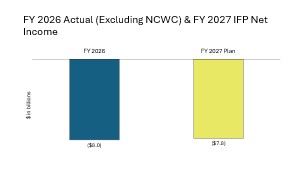
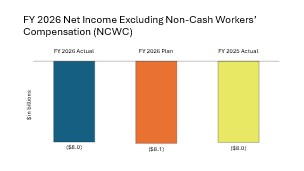

USPS Short-Term Liquidity Preservation. As expected, the USPS didn’t make amortization, RHB top-up, or Apr to Sept FERS employer contribution payments. “These temporary cost conservation plans,” the USPS said in its Form 10-K financial report, “which delay required payments, have provided relief to allow for sufficient liquidity to continue operating through at least November 2027.” As shown in the chart above (right), the USPS had $9.3 billion in unrestricted cash at the end of FY2026.
The USPS in its press release announcing the FY2026 financial results said, “[T]his $2.5 billion decrease in net loss is attributed to a $2.4 billion increase in operating revenue, along with a $2.4 billion decrease in workers’ compensation expense and a $277 million decrease in retirement expenses.”
“These improvements were partially offset by increases in other operating expenses of $894 million, retiree health benefits of $726 million, compensation and benefits of $456 million, transportation expense of $225 million, along with the net decrease in income (expense) of $252 million, and a decrease in other revenue of $106 million,” it said. “Controllable loss,” the USPS said, “which excludes certain expenses that are not controllable by management, was $2.4 billion for the year, compared to controllable loss of $2.7 billion for the prior year.”
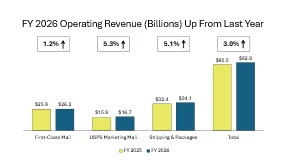
Revenue Up, Volume Down. Looking at the USPS’ revenue and volume for FY2026, it reported that “[t]otal operating revenue was $82.9 billion for the year, an increase of $2.4 billion, or 3.0 percent, compared to the prior year. “ “The improvement continues to be driven by expansion and positive response to our USPS Ground Advantage Shipping and Packages subcategory and strength in our Marketing Mail category,” the USPS said, noting that “[t]his was supplemented by price increases in our First-Class Mail and Marketing Mail categories and a transportation-related, time-limited price increase for certain offerings in the Shipping and Packages category.” “These increases were partially offset by declining volumes in the First-Class Mail and Shipping and Packages categories,” it noted.
The USPS reported that its “Shipping and Packages revenue increased $1.7 billion, or 5.1 percent, on a volume decline of 359 million pieces, or 5.3 percent, compared to the prior year.” “Marketing Mail revenue increased $843 million, or 5.3 percent, on a volume decline of 640 million pieces, or 1.1 percent, compared to the prior year,” it said, noting that “First-Class Mail revenue increased $311 million, or 1.2 percent, on a volume decline of 2.2 billion pieces, or 5.1 percent, compared to the prior year.” The below charts show the volume and revenue changes by for FY2026.

“While the Postal Service continues to face systemic challenges associated with the business model and regulatory framework established by Congress, the results we are reporting for the year demonstrate solid improvements in revenue generation, cost control and service performance,” said Postmaster General David Steiner. “Because of our ongoing financial crisis, we are continuing to balance the needs of our daily business operations with our need to conserve cash. We are also seeking legislative actions to establish a better and more durable business model for the Postal Service and for the benefit of the American public we serve.”
USPS Requests Additional Congressional Appropriation for First Time in Decades
The USPS Board of Governors at its open meeting held on November 10, 2026, voted in favor of a Congressional reimbursement request (appropriation) totaling $2.016 billion. Of that amount, $1.082 billion is funding for the Postal Inspection Service (USPIS), Office of Inspector General (OIG) and Postal Regulatory Commission (PRC).
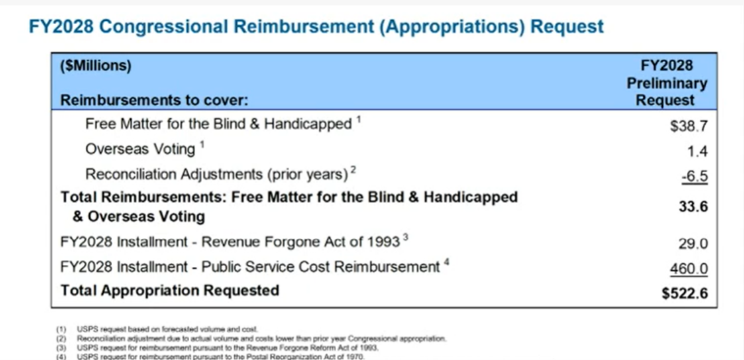
The USPS also is requesting $411.7 million as reimbursement for prior years of Revenue Foregone (payments that were due to the USPS in prior years when Congressional appropriations funded nonprofit rates but which Congress never paid), and $522.6 million to cover the annual appropriation for Free Matter for the Blind & Handicapped and Overseas Voting plus payment for unpaid prior years, plus an appropriation of $460 million to cover “Public Service Costs.” The latter is an appropriation that was established in 1971 when the Post Office Department was converted to the U.S. Postal Service. Although the USPS requested and received the annual appropriation of $460 million for some years, it stopped requesting it in the early 1980s and has not requested it since.

“Despite aggressively pursuing self-help avenues within the mandated business model,” the USPS said in its press release, “the organization’s financial position remains precarious and urgently needs the following administrative and legislative reforms:
- Increase the statutory debt limit of $15.0 billion, which is set by Congress and has not been increased since 1992, to access the capital necessary to achieve the mission and continue to compete with private sector companies that have access to credit and capital markets
- Modify retiree pension benefit funding rules determining how the Office of Personnel Management (OPM) apportions the costs for the Civil Service Retirement System (CSRS) benefits of employees and retirees that worked for both the Postal Service and the Post Office Department to allocate these costs between the Postal Service and Treasury by utilizing modern actuarial principles
- Allow diversification of pension and retiree health assets and the ability to invest in market-based instruments to allow greater flexibility
- Adopt private sector best practices for workers’ compensation administration”
“Additionally,” the USPS said, “the Postal Service continues to request that Congress eliminate certain uneconomical aspects of our legislative business model or help fund them through modest appropriations.”
In addition to its legislative and appropriation requests, the USPS also said in its press statement that it “continues to urge the PRC to provide needed flexibility to its regulations in order to help enable long-term financial sustainability and continue providing the nation with reliable, affordable, universal mail service.”
“Our financial results for the year reflect improvement compared to the prior year, as we continue to grow revenue and manage the costs under our control, transportation network consolidation, and reduction of work hours,” said Chief Financial Officer Luke Grossmann. “However, our actions alone cannot resolve the challenges brought on by an outdated business model. We will continue to do our part but we need meaningful legislative, regulatory, and administrative reforms to propel the Postal Service toward long-term financial sustainability.”
Updated Forecast for July 2027 Rate Increase
Based on the updated CPI data released by the Bureau of Labor Statistics this week, the projected July 2027 postage rate increase (if current regulations stay in place) is 5.7-6.2% for Market Dominant mail classes that are deemed compensatory by the Postal Regulatory Commission (PRC) in its Annual Compliance Determination (which does not come out until March 2027). For “underwater” classes, the forecast currently is 7.7-8.2% since under current rules these categories are assessed an additional two percent.
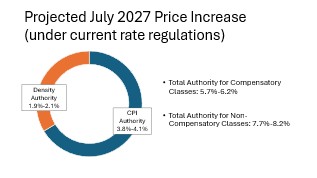
Keep in mind that the PRC currently is in the process of reviewing the Market Dominant rate system, and is expected to proposed changes, which could impact the above forecast.
USPS FY2027 Financial Plan
The USPS at its open Board of Governors meeting on November 10, 2026, shared its FY2027 Integrated Financial Plan (IFP). The USPS is forecasting a $7.8 billion net loss for FY2027, which is similar to the net loss experienced for FY2026.

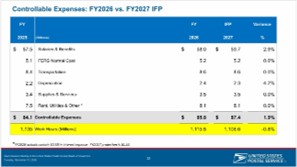
The USPS FY2027 IFP projects an increase of $2.4 billion (2.9%) in revenue over FY2026, including a 5.8% increase in packages revenue. The USPS is projecting a 0.7% increase in First-Class Mail revenue, and a 2.0% increase in Marketing Mail revenue.

In terms of its capital commitments, the USPS for FY2026 had planned for $4.7 billion but its actual was $3.7 billion due to over a billion less being spent on Facilities. For FY2027, the USPS is planning capital commitments of $4.9 billion, compared to its five-year (FY2021-2025 actual) average of $3.8 billion, with $3.2 billion of that amount going to Facilities (compared to actual spend of $2.2 billion on Facilities in FY2026).

2027 National Postal Forum to Feature “Nonprofit Day”
The Alliance is excited to announce that the 2027 National Postal Forum will include a special “Nonprofit Day.” The NPF will be held May 16-19, 2027, in Orlando FL, and Nonprofit Day will be Tuesday, May 18, 2027. For a $300 registration fee, attendees can attend all the NPF events on May 18th, including the General Session, educational sessions, lunch, the Exhibit Hall, and Exhibit Hall reception to be held that day.
“We’ve been working with NPF on the concept of a nonprofit focused day at NPF for a long time,” said Alliance of Nonprofit Mailers Executive Director Kathleen Siviter, “and it will be wonderful to see it come to fruition at the 2027 event.” “It’s just another example of how the NPF is working to bring great educational content to all sectors of the mailing industry,” she said. The Alliance is submitting several session proposals for inclusion that day, and will be putting together nonprofit panels for each session that is approved. In addition, the Alliance will have a booth in the Exhibit Hall.
Registration is open — simply go to the NPF web site (https://www.npf.org/), click on the “Register Now” button at the top right, then select the Nonprofit Day registration type when you register.
We encourage all Alliance members and sponsors to spread the word about this unique opportunity for nonprofits and their service providers to not only attend the National Postal Forum, but to meet with the Alliance and learn more about the important work we do on their behalf. Members interested in presenting at the event should contact Kathleen Siviter (kathy@nonprofitmailers.org). More details will be published as they become available.
Into the Postal Weeds…
For those who live in the “postal weeds,” and are looking for news on mail entry, preparation, discounts, incentives, and more, this column in the Alliance Report will be right up your alley! We won’t go all the way into the weeds…but we will offer up highlights on useful resources and mailing standard changes.
- Discontinuance of USPS Tracking Labels. The USPS announced that effective January 17, 2027, it will discontinue USPS tracking labels 888, 889, 891, 892, because they are “incompatible with updated USPS processing equipment and no longer support operational needs of the Postal Service.”
- New National Industry AIM Co-Chair – Alexis Nicoletta. The USPS announced the selection of Alexis Nicoletta as the new National Industry AIM (Areas Inspiring Mail) Co-Chair. Nicoletta “is currently a Strategic Account Leader at Salem One, a commercial print and packaging company serving regional and national brands.”
- USPS Peak Webinars to Start Nov. 12. The USPS reported that due to technical difficulties, its peak webinars – which were scheduled to start on November 10, 2026, will begin on November 12, 2026. The webinars will be held 1-3 times per week through January 6, 2027, and provide an opportunity for customers to hear updates from the USPS on peak conditions related to Processing, Delivery, Logistics, Mail Transport Equipment, and Weather-related impacts.
Leave a Reply