

Alliance Report
July 27, 2026
Issue 26/14
The leading voice of nonprofits on postal issues for over 45 years.
Copyright 2025: Alliance of Nonprofit Mailers—All rights reserved.
The Alliance of Nonprofit Mailers is a 501 (c)(4) nonprofit organization established by nonprofits for nonprofits.
USPS Asks PRC for Approval to Calculate Density Rate Authority for January Price Change
As noted in our July 20, 2026, Alliance Alert, the USPS has filed a request at the Postal Regulatory Commission (PRC) for waiver of the rules regarding when calculations are done for the Density Rate Authority in order to be able to raise Market Dominant postage rates in January 2027 and utilize an annual January cycle after that.
The USPS proposes employing a “modified calculation of the available density rate authority based on a mix of actual and forecasted FY2026 data, which will allow the Postal Service the flexibility to transition to a January rate change cycle in 2027 in a financially responsible manner.” It noted that its “[m]anagement is evaluating a shift to its planned annual market dominant rate adjustments to a more traditional January cycle, subject to approval of the Governors.” “A January rate change cycle is preferable to the majority of our customers,” the USPS stated, “as the cycle aligns with most budget-planning cycles.”
If the USPS’ waiver request is approved by the PRC and the USPS Board of Governors decide to do a January 2027 price increase, and the Density rate authority is calculated in the manner the USPS proposes, the Alliance projects that a Jan 2027 price increase would be in the ballpark of 4.5 percent (2.628 percent density authority + 1.8-1.9 percent CPI authority) for compensatory classes, and about 6.5 percent for non-compensatory classes (e.g., Periodicals, Marketing Mail flats).
“In order to pursue a potential January 2027 market dominant price change case,” the USPS said, “the Postal Service must receive approval from the Governors no later than September 2026, and thus the full picture of the Postal Service’s rate authority must be resolved in the immediate future, even in the absence of a full year of data for a traditional DRA calculation.”
“In order to meet the Postal Service’s required timeline to develop rates and present at a Board of Governors meeting,” the USPS said, “the Postal Service respectfully requests a Commission response to the instant motion no later than August 16, 2026.” The PRC on July 20, 2026, extended the deadline for comments to the USPS’ petition from the statutorily required seven days from filing to now be due by July 29, 2026.
The Alliance will be submitting comments opposing the USPS waiver request and will provide highlights in the next issue of the Alliance Report. If the USPS were to raise Market Dominant prices in January 2027, under current PRC rules it would not be allowed to raise Market Dominant rates again any sooner than October 1, 2027 when the next Fiscal Year begins.
June CPI and Updated Postage Rate Increase Forecast
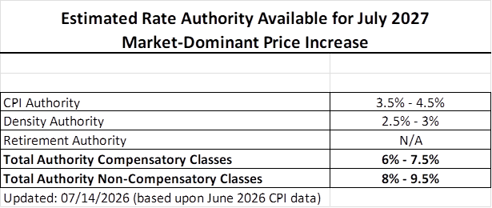
Last week, the Bureau of Labor Statistics released the June 2026 CPI, which increased by 3.5 percent from June 2025 and decreased by 0.4 percent from May 2026 (seasonally adjusted). The CPI price cap authority to the USPS for a price change now stands at 1.229 percent. The table below, prepared by SLS Consulting, provides the estimated July 2027 rate authority that would be available to the USPS under the existing Market Dominant ratemaking system. Given the substantial volatility in energy costs, these estimates are subject to heightened uncertainty and may change. In addition, as noted in the above article, the USPS has requested a waiver from the PRC to rules on calculating the Density rate authority – if approved, the waiver would allow the USPS to file a January 2027 price increase. The below table applies only to a potential July 2027 price change.
OIG White Paper Looks at Options to Address the USPS’ Financial Gap
The USPS Office of Inspector General (OIG) on July 23, 2026, published a white paper, “Options for Addressing the U.S. Postal Service’s Financial Gap.” “To support efforts aimed at addressing the Postal Service’s financial gap,” the OIG said, “the U.S. Postal Service Office of Inspector General (OIG) compiled 15 revenue-generating and cost-saving options for long-term sustainability.” “These options are not OIG recommendations,” it stressed, “[i]nstead, they are policy proposals made by various stakeholders over time, including the U.S. Government Accountability Office (GAO), mailers and shippers, think tanks, and Congress.”
The OIG said the 15 options “include strategies to grow revenue, fund the Postal Service’s universal service obligation (USO) activities, enact benefits reform, restructure the workforce, and reduce operational costs.” “Because no single option is likely sufficient to address the financial gap in the near term,” it said, “this white paper also combines the 15 options into four theoretical scenarios designed to achieve financial breakeven status.” “The scenarios range from prioritizing current service levels over independent self-sustainability,” it said, “to ensuring self-sustainability through service cuts, as well as balanced approaches in-between.”
The 15 options identified in the OIG white paper are categorized into 5 buckets: Growing Operating Revenue (adjust Market Dominant pricing by modifying the price cap system); Obtaining Government Funding (receive government funding for fulfilling the Universal Service Obligation (USO)); Making Changes to the Workforce (change the USPS’ workers’ compensation rules, restructure the Postal Service’s workforce, explore modifications to collective bargaining rules); Enacting Benefits Reform (invest CSRS and FERS assets in a diversified portfolio, invest PSRHBF assets in a diversified portfolio, change the allocation of CSRS costs to reduce the portion owed by USPS, adopt a new pension model, amend the funding of retiree health benefits); and Reducing Operational Costs (outsource the middle mile, outsource the retail network, convert door delivery points to curbside or cluster box, reduce delivery days, stop providing select USO services).
For each of the 15 options identified in the white paper, the OIG prepared an Impact Summary that describes the change and included the OIG’s assessment of the level of stakeholder involvement, the timeframe, the impacted stakeholder(s), the decision-maker(s) and the level of financial impact.
“Given the Postal Service’s mounting financial pressures,” the OIG said, “maintaining the status quo is no longer a viable path.” “USPS is limited in its ability to achieve breakeven status through self-help measures alone,” it said, recommending that “[a] dialogue among stakeholders to address the complex choices and difficult trade-offs [is] required to restore the Postal Service’s financial sustainability is both timely and essential to secure its future.”
USPS Files NCOA+ Request with PRC
The USPS on July 14, 2026, filed a request with the Postal Regulatory Commission (PRC) to add the NCOA+ price category to the Mail Classification Schedule (MCS). The USPS had proposed the NCOA+ price category as part of its July 2026 price change, but after receiving comments alleging that the introduction of NCOA+ could violate 39 U.S. C. 404a,3, the PRC said it needed additional time to consider the request and that USPS should file it separately.
In its request, the USPS explains that the NCOA database holds all change-of-address (COA) records and that NCOA services allow entities access to the database in order to ensure correct addresses on mailings. Currently, the USPS offers six NCOA services, which license the database (updated weekly or monthly depending on the license) to these entities and allow for the development and sale of software utilizing the database, the updating of the mailing lists on behalf of mailers by licensees, the self-updating of mailing lists by individual licensee-mailers, and use on mail processing equipment to remove undeliverable-as-addressed (UAA) mail and supply correct addressing information. “The Postal Service states that each of the six services have different requirements,” the PRC said in its recap, “limitations, and features associated with them and are offered at differing price points.”
The Postal Service states that “NCOA+ is proposed to be offered as an additional NCOA price category and would provide the exact same data as the other NCOA price categories,” the PRC said, noting that the USPS “represents that the primary difference between NCOA+ and the other NCOA services would be the way in which the underlying NCOA database is accessed.” The USPS states “that the six current NCOA services require use of both Coded Accuracy Support System (CASS) compliant software and NCOA software (that licensees develop themselves or license from a provider),” the PRC noted. The USPS explains that NCOA+ would provide “cloudbased access to the NCOA software and database through an encrypted, modern application programming interface (‘API’)[,]” with the API functioning “as a direct conduit to lookup a single address and receive new address information when a match is found.” The USPS “explains that NCOA+ users therefore would not have to develop or purchase ‘specifically compliant software[,]’ and ‘NCOA+ will provide a more secure and easier way for licensees to instantly access and retrieve the most up-to-date data without having to wait for the next file distribution,’” the PRC said.
The PRC noted that the USPS states NCOA+ would have several “enhancements” over current NCOA offerings, including the ability for a single address lookup, more frequent updates, the simplification of Privacy Act compliance requirements, and reduced administrative burdens on licensees. “The Postal Service also notes that NCOA+ would provide the Postal Service with several benefits,” the PRC said, “including reductions in costly UAA mail and improved ability to track and monitor database usage.” “The Postal Service explains that NCOA+ would be priced based on the licensee’s number of API calls per month,” it said. It continued,
“The Postal Service represents that NCOA+ would be available to all mailers on the same terms and conditions and could be utilized by current NCOA licensees to access NCOA+’s distinct features. The Postal Service expects that NCOA+ would be used by some current NCOA licensees and also that NCOA+ will attract new users to use NCOA data because of the lower technical barriers to entry. The Postal Service also expects that many current licensees would continue using the other NCOA services for various reasons, including how their systems are optimized and potential switching costs.”
In response to the prior allegations that the offering violates 39 U.S. C. 404a,3, the USPS “acknowledges that in reducing barriers to access, some mailers who currently pay licensed intermediaries to check addresses may opt to use NCOA+ instead and that the number of available software providers may increase,” the PRC recapped. “The Postal Service states that in this way, NCOA+ would likely increase competitive pressure on some current NCOA licensees but that ‘[a]ny competitive pressure will arise from the fact that other companies would be empowered by easier access to Postal Service data products.’” “The Postal Service notes, however, that although access to the database may be easier with NCOA+, software will still be necessary and ‘NCOA+ is not a direct replacement for all the services current licensees either do for themselves or purchase from a third-party,’” the PRC said.
The Postal Service asserts that “competition law and policy, including [39 U.S.C. 404a], is designed to increase competition, improve what is offered in the market, and protect consumers” and not “entrench current market participants or insulate them from market shifts related to technological advancement, changes to customer preferences, or new entry.” The Postal Service also asserts that 39 U.S.C. 404a is inapplicable to this proceeding as it does not establish any “rule or regulation” within the meaning of the statute.
“Given the straightforward nature of these changes and the fact that the public was first introduced to NCOA+ several months ago,” the USPS said, “nothing about this proceeding is genuinely new, nor should it require excessive time to comment thereupon.” “Therefore, the Postal Service requests that the Commission review and approve these changes within 60 days,” it said, “with a planned launch by October 4, 2026, already several months later than originally planned.”
Comments on the USPS’ are due by July 31, 2026, but it should be noted that stakeholders have asked the PRC to extend the comment deadline by 14 days until August 14, 2026. The PRC has not yet responded to the request for comment deadline extension.
Senator Calls on HSGAC Chair to Delay USPS Board of Governors Nominations
U.S. Senator Gary Peters (D-MI), Ranking Member of the Senate Homeland Security and Governmental Affairs Committee, is calling on Chairman Rand Paul (R-KY) to “delay the Committee’s consideration of two pending nominees to the United States Postal Service (USPS) Board of Governors until President Trump consults with Senate Democrats and nominates qualified Democratic candidates to preserve the Board’s bipartisan independence.”
In a letter to Chairman Paul ahead of the Committee’s consideration of two USPS Board nominees, Peters raised concerns that “President Trump has nominated four Republicans to the Board of Governors and refused to consult the Senate Minority Leader or Committee Democrats on Democratic nominees, breaking with decades of longstanding bipartisan practice and jeopardizing the political independence Congress built into the Postal Service’s governing board.” “The USPS Board of Governors is required to be made up of bipartisan members,” he said, noting that “[f]ederal law limits the number of Governors from any one political party and directs the President to consult with congressional leadership from both parties when making nominations to the Board.”
SEC E-Delivery Proposal Would Negatively Impact the USPS
The Securities and Exchange Commission (SEC) on July 16, 2026, issued a press release announcing its proposed “Regulation E-Delivery,” which it said would be “a new rule that would expand the ability of issuers, broker-dealers, investment advisers, and others to use electronic delivery to satisfy information delivery requirements under the federal securities laws.” Currently, these communications are required to be delivered in paper format through the mail.
Although the SEC announcement notes that “[c]urrently, required regulatory information typically is delivered in paper format unless the recipient affirmatively elects otherwise,” it also said that its proposed approach “includes requirements and conditions under which required information could be delivered electronically without first obtaining affirmative consent.” “It generally would supersede the Commission’s decades-old, guidance-based e-delivery approach and provide savings to issuers, market intermediaries, and, ultimately, investors, in paper, printing, and postage costs,” it said.
At a time when the USPS’ financial condition is being reviewed by Congress, adoption of the SEC proposal would negatively impact the USPS’ finances through a significant loss of First-Class Mail. One observer estimated the revenue loss for USPS could be nearly $2 billion.
In addition, groups advocating for consumer choice have long opposed legislative proposals that attempt to make the same changes as the SEC proposal. According to research conducted by Pew Research Center in 2025, 22% of adults in the U.S. do not have home access to broadband internet, and the percentage without access increases for seniors, households with lower income and education, and those in rural communities. Opponents of changes such as the SEC proposal argue that it takes away access to information for these groups, who should be able to exercise consumer choice to receive communications through the mail. Making it more difficult for them to do so should not be the default, they argue.
The AARP, for example, in a July 2025 letter to the Financial Industry Regulatory Authority, urged FINRA to “ensure that it maintains strong investor protections, particularly for seniors, who are frequent targets of fraud and financial abuse,” and specifically cited “[r]etain paper delivery as the default delivery method for financial disclosures,” as one of the things the FINRA should ensure. AARP noted that “[p]olling and research consistently show that a significant majority of older adults prefer to receive paper statements.” It said “AARP’s polling indicates that most adults with employer-sponsored retirement plans would prefer to receive paper statements in the mail at least once a year.” “This preference is especially pronounced among those aged 50 and older, individuals with household incomes under $50,000, and those who do not use computers at work,” it said, noting that “[s]imilar findings have been reported by Vanguard and FINRA.”
“This widespread preference underscores the importance of honoring the preference of Americans and maintaining paper statements as a default option to ensure that all investors have access to critical financial information in a format that they can easily review and retain,” AARP said.
The SEC proposal will be published in the Federal Register with a 60-day comment period.
Into the Postal Weeds…
For those who live in the “postal weeds,” and are looking for news on mail entry, preparation, discounts, incentives, and more, this column in the Alliance Report will be right up your alley! We won’t go all the way into the weeds…but we will offer up highlights on useful resources and mailing standard changes.
- DMM Revision: Plus One Labeling and Traying. Effective November 2, 2026, the Postal Service™ will revise Mailing Standards of the United States Postal Service, Domestic Mail Manual (DMM®), sections 204.3.2.4, 245.7.5 and 602.11.2, to update text related to Postal Service requirements for labeling and traying Plus One cards and host pieces.
Next Week — Alliance August Webinar for members & sponsors only – Register Now!
Our 3rd webinar for 2026 will be held in August and will be for Alliance nonprofit members and sponsor members only. This next webinar will provide updates on regulatory and legislative postal proceedings as well as news from the July meeting of the Mailers Technical Advisory Committee (MTAC).
The webinar will be held on Wednesday, August 5, 2026, from 2-3 EST. Registration is open at https://zoom.us/meeting/register/gSoLn9aqRRW-O9FLKqTEEw.
The Alliance is planning to hold more webinars in 2026, some will be restricted to Alliance members only, others will be open to all. If there are specific topics or speakers your organization is interested in having a webinar on, email me at kathy@nonprofitmailers.org.

Leave a Reply