

Alliance Report
August 7, 2026
Issue 26/15
The leading voice of nonprofits on postal issues for over 45 years.
Copyright 2025: Alliance of Nonprofit Mailers—All rights reserved.
The Alliance of Nonprofit Mailers is a 501 (c)(4) nonprofit organization established by nonprofits for nonprofits.
USPS Reports Q3 FY2026 Results
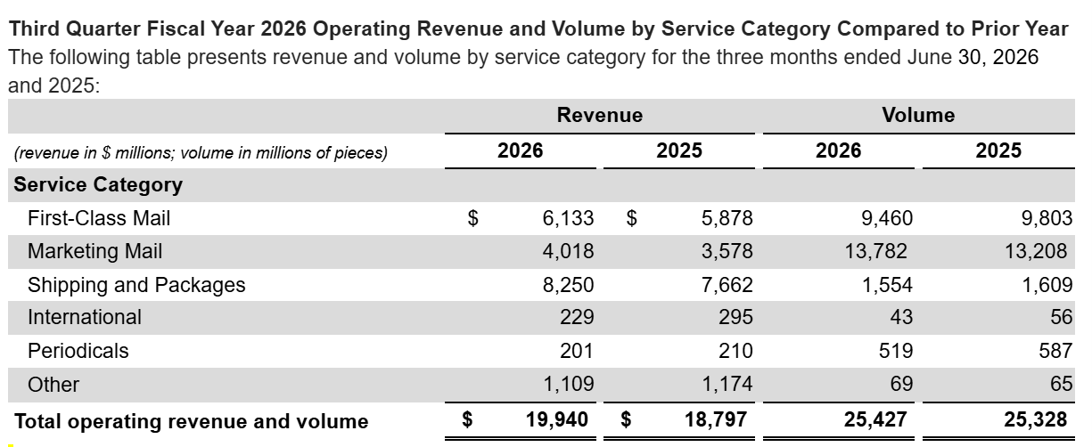
The USPS Board of Governors during its scheduled meeting on August 7, 2026, shared the USPS financial results for the third quarter of Fiscal Year 2026 (Q3FY2026). The USPS’ operating revenue was $19.9 billion, a 6.1 percent increase compared to the Same Period Last Year (SPLY). Its controllable loss decreased $584 million and its net loss decreased $562 million compared to SPLY. “Despite improved third quarter results,” the USPS said in its news release, “the long-term liquidity crisis continues.”
The USPS’ net loss for the quarter totaled $2.5 billion compared to $3.1 billion SPLY. The USPS attributed the $562 million decrease to an operating revenue increase of $1.1 billion along with a decrease in workers’ compensation of $416 million, partially offset by increases in retirement benefits of $324 million, retiree health benefits of $195 million, and compensation and benefits of $129 million.
“Our results this quarter reflect some progress relative to those areas of the business where we can exercise control, namely with revenue generation, cost control and service improvement,” said Postmaster General David Steiner. “Nevertheless, the Postal Service is today continuing to face a severe liquidity crisis, and our financial losses this quarter reflect systemic challenges inherent in our Congressionally established business model and regulatory framework. We are taking responsible steps to conserve cash to extend our operating window, but we require thoughtful legislative and other actions to establish a financially sustainable Postal Service capable of serving the American public far into the future.”
The USPS said the $1.1 billion (6.1 percent) increase in operating revenue compared to SPLY was “driven by continued growth in our USPS Ground Advantage Shipping and Packages subcategory and strength in our Marketing Mail category.” “This was supplemented by price increases in our First-Class Mail and Marketing Mail categories and a transportation-related, time-limited price increase implemented on April 26, 2026, for certain offerings in the Shipping and Packages category,” the USPS said, noting that “[t]hese increases were partially offset by declining volumes in the First-Class Mail and Shipping and Packages categories.”
The USPS reported that “Shipping and Packages revenue increased $588 million, or 7.7 percent, on a volume decline of 55 million pieces, or 3.4 percent, compared to the same quarter last year. Marketing Mail revenue increased $440 million, or 12.3 percent, on a volume increase of 574 million pieces, or 4.3 percent, compared to the same quarter last year. First-Class Mail revenue increased $255 million, or 4.3 percent, on a volume decline of 343 million pieces, or 3.5 percent, compared to the same quarter last year.”
The USPS’ “Total operating expenses were $22.5 billion for the quarter, an increase of $438 million, or 2.0 percent, compared to the same quarter last year.” “This increase was primarily due to higher retirement benefits, accrued retiree health benefits top-up expenses, higher compensation and benefits expenses, and the impacts of rising fuel costs that led to higher transportation expenses and higher other operating expenses,” it said. “These increases were partially offset by the favorable impact of actuarial revaluation of existing workers’ compensation cases.”
The USPS acknowledged the waiver the Postal Regulatory Commission (PRC) granted it on making required payment toward its annual pension amortization obligations, as well as the USPS’ election to suspend payments for the bi-weekly normal cost contributions for employees covered under the Federal Employees Retirement System (FERS) and deferred approximately $1.4 billion this quarter. “However,” it said, “the Postal Service’s financial situation, and specifically its liquidity, remains precarious as these actions are only temporary measures.” “The pension obligations will have to be eventually satisfied, therefore these measures cannot represent long-term solutions for the Postal Service,” it said.
The Postal Service said it “continues to urge the PRC to provide needed flexibility to their regulations in order to help enable the Postal Service to achieve long-term financial sustainability, while also fulfilling the primary mission to serve the American public.” “Additionally,” it said, “the Postal Service continues to urgently request administrative and legislative reforms to address the following:
- Increase the statutory debt limit of $15.0 billion, which is set by Congress and has not been increased since 1992, to access the capital necessary to achieve our mission and continue to compete with private sector companies that have access to credit and capital markets
- Modify retiree pension benefit funding rules determining how the Office of Personnel Management (OPM) apportions the costs for the Civil Service Retirement System (CSRS) benefits of employees and retirees that worked for both the Postal Service and the Post Office Department to allocate these costs between the Postal Service and Treasury by utilizing modern actuarial principles
- Allow diversification of pension assets and the ability to invest in market-based instruments to allow greater flexibility
- Adopt private sector best practices for workers’ compensation administration”
“Absent such changes and reforms,” the USPS said, “the Postal Service’s financial outlook remains dire.” “The financial results for the quarter reflect a slight improvement compared to the same quarter last year, as we continue to grow revenue and manage the costs under our control, including reducing 4 million work hours during the quarter,” said USPS Chief Financial Officer Luke Grossmann. “However, management actions alone will not resolve ongoing financial problems that are caused by an outdated business model that isn’t responsive to change. We need to pair those helpful management actions with legislative, regulatory, and administrative reforms to get our organization on its way to financial sustainability.”
USPS Board of Governors Chair Amber McReynolds during the meeting said that as the USPS continues to undertake important work and the Board and USPS leadership are doing all they can to shore up the USPS’ finances, “we can not do so alone.” She said there are ongoing issues the USPS needs policymakers to address, referring to the list of legislative changes to the USPS’ business model mentioned earlier in this article. “Ultimately,” she said, “the fiscal cliff is here.” “The Board continues to make uncomfortable default decisions,” she said, “and we don’t want to continue to operate this way.”
Postmaster General David Steiner echoed much of what was included in the above USPS press release. He noted good progress made on the USPS’ financials during Quarter 3, with reduced workhours and improved service performance. He said the USPS is focused on what it can control, and that the new network is functioning more smoothly with each passing month. “Once we finish end-to-end implementation, we will see even more improvements,” he reported.
Steiner also said the USPS recently has been meeting its growth projections. “When we pair popular products with good pricing and good service, we attract more business,” he said, but said that the bottom line is that Congress needs to help the Postal Service by fixing the business model.
“Pricing is one lever we can use right now,” the Postmaster General said, noting the USPS has been raising prices consistent with its regulatory authority for Market Dominant mail. “Volumes have declined,” he said, “but revenue has increased in 14 of the last 16 quarters.” He said use of its pricing authority is necessary and that the USPS needs more pricing flexibility if it is expected to cover its costs alone. “We would like to grow volume and revenue,” he said, “but if we can only do one, we want to maximize total revenue and profitability.” He said it would be “financially irresponsible” for the USPS not to continue using its maximum pricing authority given its finances. He noted that the USPS has filed for a waiver with the PRC which would enable it to increase Market Dominant prices in January 2027, which he said is worth $600-800 million to the USPS versus waiting to increase prices in July 2027. “This should be an easy decision for the PRC,” Steiner said, “given our financial health.”
“While pricing is important to our long term viability,” Steiner said, “reform is crucial.” He said the USPS is preparing to detail its legislative asks to Congress, and it believes the choices are clear. “The only thing that dooms the USPS is not to make any choice,” he said, noting that uneconomical mandates need to either by funded or eliminated. “This is for Congress to decide,” the Postmaster General said, noting the USPS has its own view but its role is to present options to Congress and let them decide.
The Postmaster General said Congress needs to look beyond just the Postal Service to the entire $2 trillion ecosystem that depends on it. “A small investment in the USPS would help the larger economy,” he said, noting that the USPS’ request for a modest investment could be revisited over time and could be temporary.
Steiner said that while no significant actions will be taken during the upcoming peak season, “if we can’t get agreement on a legislative plan this year, changes like closing thousands of unprofitable post offices, reducing service levels and increasing prices,” will be actions the USPS will be forced to take. He said the USPS looks forward to working with Congress but needs Congress to work with the USPS as well. He criticized a recent bill that just passed in the Senate Committee that includes provision of new ZIP Codes which he said would cost the USPS $800 million. “With the stroke of a pen,” he said, “the $600 million we gained in the last quarter is replaced with $800 million in costs.” He said service would be disrupted not just in those ZIP Codes but in areas around them. He urged Congress to set aside the bill before it does irreparable harm to the Postal Service. The Postmaster General noted that there is an alternate bipartisan bill that directs the USPS to find alternatives to help communities that was also passed in the Senate that would be much better for the USPS.
Alliance Opposes USPS Waiver Request that would Enable a January 2027 Price Change
The Alliance of Nonprofit Mailers on July 29, 2026, submitted comments to the Postal Regulatory Commission (PRC) opposing the Postal Service’s request for a waiver on calculating the Density rate authority, which would allow it to increase Market Dominant prices in January 2027.
The USPS asked the PRC to grant a partial waiver of the regulations that apply to the applicability, data sources and calculation of the density rate authority, so that the USPS could implement a January 2027 Market Dominant price increase. Under existing rules, the USPS has to wait until after the PRC issues its Annual Compliance Determination (ACD), which typically occurs late March, in order to know the density rate authority calculation it can use for the next price change. The USPS’ waiver would allow the density rate authority to be calculated differently and then an adjustment made later on if the calculation were not accurate. The USPS argues that it needs to increase prices sooner due to its financial condition, and said that most customers prefer a January increase.
Motions for waiver are not granted lightly. The Alliance noted that the PRC may only grant these types of waiver when “permitted by law upon a showing of good cause” and when the waiver “will be consistent with the public interest and will not unduly prejudice the interests of other participants.”
“The Postal Service’s motion does not meet this standard,” the Alliance said, noting that “[i]ts desire to rush implementation of a rate increase – merely six months after its last one and based on a mishmash of partial-year, unaudited, averaged, and aged data – when it is not facing a short-term liquidity crisis, does not constitute good cause.” “And its imposition of another above-CPI rate increase sooner than expected will unduly prejudice captive mailers and will be inconsistent with the public interest,” it said, urging the PRC to deny the USPS’ waiver request.
Alliance Reiterates Its Position – Price Changes Should be Paused until PRC Completes Rate Review. The Alliance in its comments reiterated its position “that USPS price changes should be paused until the Commission completes its ongoing review of the ratemaking system.” It noted that the PRC has determined the existing ratemaking system is not achieving the statutory objectives. “Continuing to allow the USPS to raise prices under the current noncompliant system perpetuates the significant flaws the Commission itself has determined need correcting,” the Alliance said, repeating its rationale.
Negative Consequences of a January 2027 Price Increase Significantly Outweigh Short-Term Benefits to USPS. The Alliance responded to the USPS’ statement in its waiver request saying the reason it is considering a January 2027 price change is that “[a]n earlier implementation would generate much needed additional revenue sooner for the Postal Service, to help address our ongoing financial challenges.” The Alliance said it “believes the long-term negative consequences on captive mailers from a January 2027 price increase far outweigh any short-term benefits to the Postal Service’s finances.”
“The Commission itself has determined that there is no pending liquidity crisis for the Postal Service,” the Alliance said, “and the Postmaster General acknowledged the same during recent Congressional testimony.” It noted that the PRC also has granted the Postal Service flexibility and breathing room (specifically a multi-year waiver) to address its deteriorating financial condition…. “The Postmaster General in June testified before the Senate Committee on Homeland Security and Governmental Affairs that the ‘short-term deferring of employer contributions to retirement payments, and freeing up the use of restricted cash, has extended our cash liquidity projections,’” the group said. It continued,
“The Commission has also recognized that whatever additional near-term revenue accrues from more frequent price increases does not meaningfully address the Postal Service’s financial challenges, and Postal Service assertions to the contrary are overstated. When codifying a once-per-year limitation on non-de minimis market dominant price increases, the Commission rejected the Postal Service’s claim that the ratemaking system must ‘prioritize revenue generation to continue allowing multiple rate increases per fiscal year for the opportunity to obtain fractionally more revenue from captive customers.’ To the contrary, noted the Commission, ‘obtaining these incremental revenues [from semiannual price increases] is not essential to the Postal Service’s short-term financial stability.’ There is no reason for the Commission to now credit USPS claims than an early rate increase – six months after the most recent increase went into effect – will somehow ameliorate the Postal Service’s financial condition.”
The Alliance reiterated its often-stated position that the “Postal Service has a cost control problem, not a revenue problem.” It noted that the USPS’ recent efforts to more aggressively work on reducing its costs have not yet borne fruit in terms of its finances.
“The USPS’ monthly financial reports for June will be available in early August,” the Alliance noted, “and will reflect whether the Postal Service’s actions have resulted in any meaningful cost reduction to date.”
A January 2027 Price Increase Would be Significantly Detrimental to Captive Customers. The Alliance strongly opposed the USPS increasing Market Dominant prices in January 2027. “The timing of such an implementation would come only six months on the heels of the July 2026 price increase,” it said, noting that “[a]lthough it would not violate the Commission’s order limiting the USPS to one Market Dominant price change in a Fiscal Year, captive mailers will experience another significant price increase within the same six-month period – which is the same price increase cadence that the Commission eliminated in Order No. 9426.” “The policy reasons underscoring that Order (e.g., mitigating the harm of semiannual rate increases to mailers, creating predictable and stable rates) apply equally here,” the Alliance argued, “where the Postal Service is attempting to use the waiver process as an end-run around the Commission’s recent restrictions.” “If the USPS decides to switch to an annual January rate change cycle for Market Dominant mail, it should do so no sooner than January 2028 to give mailers time to plan and budget appropriately,” the Alliance said.
The Alliance disputed the USPS’ contention that implementing market dominant price adjustments in January “is preferable to the majority of [Postal Service] customers, as [it] aligns with most budget-planning cycles.” “A January rate change cycle is certainly not preferable to Alliance Board member nonprofit organizations,” it said, “who would uniformly prefer an annual July price change cycle for budget purposes over a January one.” “Their budgets run on a summer-to-summer fiscal year, as do many nonprofit organizations, largely to align with school-year cycles (many nonprofits are educational institutions), or major grant disbursements (government funding alignment), or to be able to finish processing year-end donations before evaluating their past year (typically December and January are big periods for donations),” the Alliance told the PRC.
Rate System Changes Are Under Consideration. “Regardless of whether Congress takes any action in the current session on making changes to the USPS’ business model or other postal legislation, changes to the USPS’ rate system are already in the works,” the Alliance said, in that the PRC has an open proceeding where it is considering changes to the USPS’ rate system. “Those changes are likely to be significant and could impact many aspects of the ratemaking system,” it said, “rendering the USPS’s instant request for waiver moot.” “In addition,” the Alliance said, “the USPS’ financial condition currently is being reviewed and discussed by both the House and Senate. Lastly, granting a waiver to these types of Commission rules would negatively impact rate stability and predictability.”
If Approved, Amend Scope of Waiver to Protect Against Over-Estimation of the Density Rate Authority. Lastly, while repeating its opposition of the USPS’ request for waiver, the Alliance told the PRC that if it should grant the USPS’ request, “it should not allow the Postal Service to ‘bank’ overestimated density authority as negative rate authority – the USPS could simply not use it and let it expire.” “If the USPS’ request is approved with this provision,” the Alliance cautioned, “the USPS should be explicitly required to subtract any negative rate authority from rate authority available in the subsequent price change.”
Others Weigh in on USPS’ Waiver Request. Other mailing groups and mailers also submitted comments on the USPS’ waiver request, mostly opposing it.
The Association for Postal Commerce (PostCom) said the PRC should deny the USPS’ request. “Allowing the Postal Service to rely on estimates of density authority would introduce complexity and uncertainty into the ratemaking process without providing offsetting benefits,” the group said. “Contrary to the Postal Service’s suggestion, the mailing industry is not seeking a change in the price change schedule,” PostCom told the PRC. “Rather than solving an urgent problem, the Postal Service’s request will inflict harm on its customers and continue the failed strategy of maximal rate increases that has contributed to the erosion of the Postal Service’s financial condition,” it said, recommending that instead of granting “this unnecessary waiver,” the PRC should “expedite its reexamination of its rate regulations in Docket No. RM2024-4.”
On the USPS’ statement that the majority of customers prefer a January price increase timing, PostCom said that its “necessarily limited effort to confirm the Postal Service’s speculation has been unsuccessful.” “In fact,” it said, “some mailers consider January implementation to be inherently problematic because they require significant development efforts during the winter holiday season and may conflict with peak-period ‘code freezes.’” The group noted, as did others, that the USPS has “not provided any support for its assumptions regarding customer preferences.” “Even if one accepts the Postal Service’s assertion in general,” PostCom said, “it is highly doubtful that even the mailers favoring a January price change schedule would favor a price change in January 2027.”
PostCom reminded the PRC that beginning in 2017, it has “expressed concern that the density-based rate authority would undermine incentives for efficiency and reward negative behavior by the Postal Service.” “The empirical evidence unfortunately validates our concerns,” the group said, noting that the “advent of the density adder presaged the worst productivity performance in the history of the Postal Service.” “Despite the record revenues enabled by supplemental rate authorities, the Postal Service’s financial condition has worsened thanks to greatly attenuated incentives for cost containment,” it said. “It is regrettable that the Postal Service is unwilling to confront its obligation to control expenses,” PostCom said, urging the PRC not to “reward such laxity with continued indulgence.” It continued,
“While the Postal Service has provided no forecast indicating the revenue impact of its requested waiver, recent history is clear; no amount of additional postage revenue is sufficient to overcome the systemic productivity problems plaguing the Postal Service’s network. Presumably, the additional revenues arising from an additional six months of higher rates will have a marginal impact on the Postal Service’s reported income in 2027. Given the Postal Service’s recent performance and its avowed intention of seeking appropriations to support universal service, it would be irresponsible for the Commission to condone any further use of supplemental rate authority.”
PostCom, as did others, also pointed out that there are other “important ratemaking impacts of the Annual Compliance Review” that are being ignored in the USPS’ waiver request. “Were the Commission to grant the Postal Service’s request,” it said, “workshare passthroughs based on cost avoidance estimates based on 2025 cost data will persist at least into FY2028.” “Any price signals determined to be inefficient because of the 2026 Annual Compliance Report findings would remain in place into the 2028 fiscal year,” PostCom noted. It continued,
“Further, existing Commission rules obligate the Postal Service to apply supplemental rate authority to non-compensatory products and classes when rates on Market Dominant products are increased. The Postal Service’s waiver request creates the possibility that some postal customers would be unfairly subject to supplemental rate authority should 2026 cost data indicate that a product had become compensatory. Finally, if the Postal Service were to move to a January rate change schedule going forward from January 2027, it would face this same calculation issue every year. Unless the Commission changes its rules regarding the timing of the Annual Compliance Determination and the calculation of density rate authority, it will have to waive those rules every year to allow the Postal Service to estimate its authority. The ‘temporary’ waiver requested by the Postal Service is, in effect, a petition to permanently revise the Commission’s regulations.”
“Even if the Postal Service’s justification for waiving the rules for a January 2027 rate increase was reasonable,” PostCom told the PRC, “its proposal as to how to calculate the authority it would apply is not.” “These modifications do not provide sufficient protection against overestimates and could lead to providing the Postal Service with a significant advance on its rate authority,” it said. PostCom provided a series of table showing the “sensitivity of the density rate authority value to changes in [Quarter 4] volume and institutional cost.” “The 5% reduction proposed by the Postal Service might not be sufficient to account for the potential difference between estimated and actual density authority if these estimates vary from actuals in line with historical variances,” PostCom concluded.
The Berkshire Company also asked the PRC to deny the USPS’ waiver request. “[U]nder the existing system,” it said, “the USPS must submit actual density delivery data on December 31 of each calendar year, which the Postal Regulatory Commission (PRC) will then use to calculate any additional rate authority.” “Only then will the USPS have 12 months to implement a rate change that incorporates any authorized authority,” it said, noting that “[t]his timeline meant that any new rates would remain as predictable as possible.” “Mailers will know the additional rate authority 7 to 8 months before the USPS submits the rate increase request to the PRC,” it commented, pointing out that “[t]he CPI-U is calculated monthly, with easy-to-follow trends.” “This allows ample time for planning,” it said.
“Unless the PRC eliminates the DRA [Density Rate Authority], this partial waiver would become permanent,” Berkshire said, “and the USPS would have to use a mix of actual and forecasted to calculate DRA impact in the future.” “The USPS has provided no factual data to back their assertion that a January rate increase is preferred by most of their customers,” it said. “Replacing actual DRA data with estimated data creates uncertainty for mailers,” the company said, concluding “[t]he request for a partial waiver should be denied.”
NAPM (National Association of Presort Mailers) told the PRC that “[a]llowing the Postal Service to calculate and access density rate authority before FY 2026 data have been finalized would undermine rate predictability and stability.” “However,” it noted, “if the Commission determines that it is appropriate to estimate Density Rate Authority calculations for purposes of a January 2027 rate adjustment, it should likewise estimate updated workshare cost avoidances for the purpose of determining compliance with the Commission’s workshare rules.” It continued,
“The Postal Service’s motion highlights a practical problem created by the timing of a January 2027 rate adjustment before issuance of the Annual Compliance Determination. The same timing issue affects the development of efficient workshare discounts. The Commission has previously recognized the inefficiencies that can result from the substantial lag between the fiscal year for which avoided cost estimates were developed in the most recent ACR proceedings and the period during which the workshare discounts will be in effect.
Raising market dominant rates in January would exacerbate this problem. Rather than reflecting Fiscal Year 2026 cost avoidance data that will be included in the March 2027 ACD, January 2027 rates would continue to rely on FY 2025 avoided cost estimates. As a practical matter, the lag between modeled avoided costs and rates in effect would increase from the approximately 21 months in the just-implemented rate increase to approximately 27 months (the lag between FY 2025 and CY 2027). This extended lag would increase the likelihood that workshare discounts are set at inefficiently low levels during the period in which they are in effect.”
NPPC (National Postal Policy Council) also opposed the USPS’ waiver request because “the requested waiver would not serve the public interest, would disserve the mailing community, and would conflict with the predictability and stability of rates promoted by current regulations.”
“The Postal Service request is an unprecedented attempt to set price capped rates on the basis of unaudited data inputs, estimated volumes, and projections,” NPPC said. “Under the Postal Service’s proposal,” it told the PRC, “mailers would be charged rates filed on such uncertain bases for several months before the Commission would calculate the actual density authority, and the Postal Service does not propose a mechanism for a mandatory rollback of any overcharge.” “Rates set on that basis could remain in effect for an unlimited period while serving as the starting point for future rates,” it said. “The simple desire for more revenue does not justify jumping the gun to include a density authority – one based on unaudited data, estimates and assumptions – six months before the Commission actually determines such authority,” NPPC said.
NPPC also said the USPS’ requested waiver “does not propose any accountability for how the extra funds extracted from mailers would be used.” “Conspicuously absent is any commitment to reduce costs or to improve productivity, or even an explanation as to how the additional cash might be used,” it noted. “As such,” the group said, “it yet again highlights the flaws of the current Market Dominant ratesetting system that allow the Postal Service to raise rates without showing real improvement in its operational efficiency.”
Like others, NPPC also took issue with the USPS’ proposed method of handling any inaccuracy in the estimated density authority. It said if the PRC were inclined to grant the USPS’ motion “it should require that any overestimate of the density authority be applied as a negative offset to the next rate increase, not ‘banked’ as a negative number as the Postal Service suggests.” “’Banking’ would not, by itself, lead to a rate offset because the Postal Service has no obligation to use banked authority and would not likely do so if it were negative,” NPPC told the PRC. “Banking an overestimate, rather than making a future rate reduction mandatory, would allow the Postal Service to retain forever not only any excessive revenue obtained in the first year, but to compound it in all subsequent years as well,” it said.
“Finally,” NPPC said, “if the Governors choose to shift generally to raising Market Dominant rates in January, it is likely that the Postal Service would make the same request to use estimated density authority in future years.” “That would lead to rates consistently not being based on actual, historical data, but on estimates dependent upon unaudited data and assumptions about changes in delivery points and proportions of institutional costs,” it said. “While doing so for one filing alone would be a significant change, setting a precedent that could be cited for years to come would be a step away from sound ratemaking and should be avoided,” NPPC concluded.
The News Media Alliance, representing “over 2,200 news and magazine publishers,” also opposed the USPS’ waiver request. “While any future rate increases are devastating,” it said, “if the USPS wishes to move to a January one-time a year increase, we advocate for an increase that includes density authority in January 2028, not 2027.”
“Our members are still working through the impacts of the latest increase which took effect on July 12, with some publications reporting 11 to nearly 50 percent increases, well above what they budgeted for,” the News Media Alliance told the PRC. “After years of double-digit increases, far exceeding inflation, a January increase so soon on the heels of the previous one would compound publishers’ difficulties, especially if the increase is magnified by density authority.” “The USPS motion is a self-inflicted issue with mail volume decreasing, employee productivity plummeting, and service decreasing, yet they are spending billions on a new delivery network,” it told the PRC, noting that “[t]he repeated steep price hikes facing publishers continue to force them to make difficult decisions regarding staffing, reducing print days, shuttering titles, distribution areas, or ceasing altogether.” “Poor service is causing lost subscribers and advertisers,” it said, noting that “[r]educing hard-copy news and information does not serve the public interest, particularly in rural areas.”
The Package Shippers Association (PSA) told the PRC that “[t]he arguments advanced by the Postal Service are not new or persuasive, nor do they establish good cause or demonstrate that the requested relief is in the public interest, as required by the Commission’s rules.” “Allowing the Postal Service to obtain additional pricing authority based on projected and estimated inputs before FY 2026 data have been finalized, audited, and incorporated into the Commission’s review processes would undermine the predictability and stability of the ratemaking system,” PSA said.
PSA also told the PRC that the USPS’ “assertion that a January rate increase would help address its financial challenges does not justify the requested relief.” “The argument rests on the flawed premise that additional pricing authority is the only solution to the Postal Service’s financial condition,” it said, noting that the PRC “has repeatedly recognized, however, that the Postal Service’s financial challenges stem from a broader structural imbalance between costs and revenues.” “Addressing those challenges requires a comprehensive strategy that includes pricing and operational efficiency improvements, productivity improvements, and meaningful cost reductions, in addition to pricing initiatives, PSA said.
PSA also noted that the USPS “has indicated that it may continue to seek January implementation of future Market Dominant rate adjustments.” “If the Commission grants this request,” it said, “it will likely invite similar waiver requests in subsequent years.” “Establishing a precedent that permits pricing authority to be calculated using estimated and unaudited data would undermine the predictability, stability, and integrity of the ratemaking system and erode the benefits the Commission sought to achieve through Order No. 9426,” PSA said.
The PRC Public Representative also opposed approval of the USPS’ waiver request. “[T]he Public Representative believes that the Postal Service has not shown good cause for a partial waiver and that the requested relief is not in the public interest,” it said, noting that “if the Postal Service wishes to shift its Market Dominant rate adjustments to January of each calendar year, the Commission should direct the Postal Service to file a rulemaking petition with sufficient lead time to implement any changes no earlier than January 2028.”
“The Postal Service accurately identifies a timing mismatch in the calculation of the DRA and its potential use,” the Public Representative said, “but that mismatch does not support an immediate partial waiver of the DRA regulations.” It said it understands the PRC’s “waiver authority as a mechanism by which the Commission may excuse the Postal Service from compliance with a rule or regulation, particularly when the Postal Service demonstrates that compliance would be overly burdensome or immaterial.” “In the Public Representative’s opinion, however, the Postal Service’s request here goes far beyond excusing compliance with regulations.” “Rather,” it said, “the Postal Service effectively asks the Commission to replace the existing DRA calculations with a new methodology, which incorporates different data sources, a delivery point forecast, and a five-percent haircut.” “Moreover, the Postal Service proposes a new reconciliation and banking mechanism that is not currently in effect,” it noted. “In essence, the Postal Service is requesting substantive changes to the DRA regulations while presenting the request as a partial waiver of those regulations,” the Public Representative concluded.
“Further,” it said, “the urgency underlying the Postal Service’s motion is largely self-created.” “Under the current rules, to use the DRA that will be granted in March 2027, the Postal Service would need to maintain its current practice of filing for a Market Dominant rate adjustment that takes effect in July 2027, or switch to a January rate cycle in 2028,” it said. “But this issue should have been foreseeable at least six months ago, when the Commission limited the Postal Service to one Market Dominant rate adjustment per fiscal year,” the Public Representative noted. It continued,
“In fact, the Public Representative raised the very same concern in his comments filed in that docket approximately one year ago. The Public Representative does not believe the partial waiver process is the appropriate vehicle for the Postal Service to address this complication, which arises from the Postal Service’s own decision to change the timing of its rate adjustments.”
The PRC’s Public Representative, like others, expressed concern “that a partial waiver would undermine the predictability and stability of rates.” “In addition,” it said, “the reconciliation mechanism could ultimately grant the Postal Service a windfall at the expense of mailers.”
On the USPS’ alleged preference by mailers of a January price change, the Public Representative said that “even if some mailers prefer a January rate cycle, an unanticipated DRA-driven rate increase in January 2027 is unlikely to enhance rate stability or to align with the Postal Service’s customers’ interests.” “Further,” it said, “because the DRA estimate relies on a methodology that has not been vetted through rulemaking, mailers may be unable to anticipate the final DRA figure until weeks after rates go into effect.” “For these reasons, the Public Representative doubts that estimating the DRA in time for a rate adjustment this coming January would be in the best interests of mail users,” it told the PRC.
“Perhaps the most troubling aspect of the Postal Service’s motion is the proposed reconciliation mechanism,” the Public Representative continued, noting that the USPS acknowledges that the PRC “will continue to calculate the DRA as part of the ACD and issue its final determination in March 2027.” “If the Postal Service underestimates the correct amount of DRA,” it noted, “the Postal Service suggests that the differential be added to its banked rate authority.” “If the Postal Service overestimates, the likelihood of which the Postal Service claims is low, then the differential would be added to its banked rate authority as a negative value,” it said, noting that it “believes that the reconciliation mechanism is both legally suspect and contrary to the public interest.”
“The Public Representative does not suggest that the Postal Service designed the reconciliation mechanism to get a windfall,” it said, “[b]ut the mechanism appears to be significantly one-sided in the Postal Service’s favor, and the Postal Service’s motion fails to address this issue or explain why it is consistent with the public interest.” “Indeed,” the Public Representative said, “unless the estimated DRA is exactly accurate, mail users face a no-win situation: either pay more now without being made whole, or pay more in the long run due to the compounding effect.”
Quad/Graphics told the PRC that it “supports the Commission’s objective of moving the annual Market Dominant price adjustment to January.” “Aligning annual postage rate changes with the beginning of the calendar year will provide substantially greater certainty for mailers by allowing them to incorporate postage costs into their annual budgeting and business planning before most organizations finalize their budgets.” Quad said. “This change would improve planning for both the Postal Service and its customers and represent a positive modernization of the current rate adjustment schedule,” it noted.
“However,” it said, “Quad has significant concerns regarding the mechanism proposed by the Postal Service to implement this transition.” “Specifically, Quad opposes the Postal Service’s request to estimate the impact of the various rate authority adders in establishing January prices,” it told the PRC. “Quad agrees that annual rate changes should occur in January rather than July,” it said, noting that “[a] January implementation date provides a more logical and predictable framework for the mailing industry and better aligns with the financial planning cycles of businesses that rely on the mail.” “The benefits of moving the annual adjustment to January, however, should not come at the expense of pricing certainty.” Quad told the PRC. “The Postal Service proposes to estimate the amount of additional pricing authority associated with the various adders when establishing rates,” it said, noting that “Quad believes this approach introduces unnecessary uncertainty into the pricing process and diminishes one of the principal benefits of moving rate adjustments to January.” It continued,
“Under an estimation approach, mailers would no longer know with confidence how much pricing authority would ultimately be exercised in any given year. Instead, future rate adjustments would require corrections for differences between estimated and actual rate authority while simultaneously incorporating new estimates for subsequent years. Such an approach would create a cycle of continual adjustments that makes annual postage increases more difficult for mailers to forecast and budget. Rather than improving transparency and predictability, it would inject additional uncertainty into the ratemaking process. If the Commission approves the transition to a January rate cycle, it should require that the additional pricing authority be incorporated into annual rates based on actual data from the prior year rather than projected estimates.”
“Quad believes there is an even better path forward,” it told the PRC. “Rather than granting the Postal Service’s requested waiver and creating a temporary estimation methodology,” it said, “the Commission should make the waiver request unnecessary by completing its ongoing work in Docket No. RM2024-4 to establish a new rate making structure altogether.” “Quad has consistently advocated for reforms that promote stability, predictability, transparency, and affordability in postal pricing,” it said.
“Concurrent with these comments, Quad respectfully requests that the Commission consider the comments it previously submitted in Docket No. RM2024-4 advocating for a return to a Consumer Price Index (CPI)-based rate cap and related reforms that would restore greater pricing discipline and certainty to the postal system,” it told the PRC.
“Those recommendations remain directly relevant to the Commission’s consideration of this proceeding and are attached to these comments for reference,” Quad submitted.
Short comment letters were also filed at the PRC by the Rural Carrier Protection & Accountability Alliance (RCPAA) and James Brennan, a postal employee, opposing the USPS’ waiver request.
The next step in the proceeding is likely to be a ruling on the USPS’ waiver request by the PRC. The USPS had asked the PRC to respond by mid-August so that it would have time to file a January 2027 price increase, which would need to be filed 90 days in advance.
PRC Releases USPS FY2025 Performance and FY2026 Plan Review
The Postal Regulatory Commission (PRC) on July 29, 2026, released its “in-depth review of the Postal Service’s Fiscal Year (FY) 2025 Performance Report and FY 2026 Performance Plan.” The PRC noted that the statutorily-required review “evaluates whether the Postal Service met its performance goals and assesses the viability of its planned targets.” “As part of its mandate,” the PRC said, “the Commission’s report offers recommendations regarding the protection or promotion of key public policy objectives established by Congress for the postal system.”
“The Commission’s thorough analysis revealed that, in FY 2025, the Postal Service failed to meet any of its four core performance goals,” it said, recapping the USPS FY2025 performant by category.
High-Quality Service. The PRC found that the USPS “failed to meet the High-Quality Service performance goal for FY 2025, with none of the targets for the eight public performance indicators achieved.” The PRC found that applying the Sunday/Holiday exclusion to service standards “produced a meaningful but uneven increase in annual FY 2025 High-Quality Service results, by as much as 1.99 percentage points.”
The PRC recommendations for this category included instructing the USPS to provide greater transparency in its FY2027 Performance Plan “regarding the specific factors and methodologies used to establish performance targets, including whether and how the Postal Service considered lengthened service standards and the Sunday/Holiday exclusion when setting FY 2027 targets.”
The PRC also recommended to the USPS, “If transit alignment or ‘temporary’ disruptions continue to be reasons for missing the High-Quality Service goal in FY 2026, then (1) explain what it means to be ‘temporary’ with specific start and end dates for each disruption; (2) identify the facilities and operations affected by temporary disruptions; and (3) quantify the duration of each disruption and the resulting impact on FY 2026 High-Quality Service results.
The PRC included several other recommendations in its report around the High Quality Service goal.
Excellent Customer Experience. The PRC found that the USPS “did not meet the Excellent Customer Experience performance goal in FY 2025 because it met two targets but missed six targets.” The PRC said it “finds that the Postal Service provided satisfactory explanations for missing FY 2025 targets.” “To promote transparency and accountability,” it said, “for each target that is not met in FY 2026, the FY 2026 Report must identify specific reasons why and describe plans to meet FY 2027 targets.”
The PRC included several other recommendations for the USPS to improve in this area, including proceeding “with its plans to resume offering the Facebook ChatBOT and explain in the FY 2026 ACR how the Virtual Agent Assistant improved customer experience in FY 2026.” The PRC found that the USPS “appeared to effectively leverage Artificial Intelligence tools to help customers and improve customer experience in FY 2025.”
Safe Workplace and Engaged Workforce. The PRC found that the USPS “did not meet the Safe Workplace and Engaged Workforce goal in FY 2025 because it missed targets for both the Total Accident Rate and Engagement Score.” “In FY 2025,” the PRC said, “the Postal Service appears to have taken appropriate actions to reduce the number of motor vehicle accidents and, by extension, improve the Total Accident Rate.”
The PRC recommended that, if the USPS does not meet FY2026 targets for the Total Accident Rate or Engagement Score, “the FY 2026 Report should provide a detailed explanation why and identify significant factor(s) contributing to missing the target.” “If the accident rate per million miles driven increases in FY 2026,” it said, “the Postal Service should investigate and address the root causes and provide an explanation in the FY 2026 Report or ACR.” It also recommended that the USPS “explain to employees the concrete and measurable changes or improvements made based on survey feedback, which could improve Positive Response Rates for statements related to employee feedback and opinions, as well as the Engagement Survey Response Rate.”
Financial Health. The PRC found that the USPS “did not meet the Financial Health performance goal in FY 2025.” The PRC said that it “expects the Postal Service to report on the Delivering For America (DFA) Plan’s effects on Financial Health and labor productivity in all Annual Reports through the first year after the DFA Plan’s completion.”
The PRC recommended that the USPS “[c]ontinue reporting Controllable Income (Loss) and non-controllable expenses in all future annual performance plans and reports, regardless of whether the performance goal was met,” “[c]ontinue monitoring and reporting on Total Factor Productivity (TFP), labor productivity, and related trends in future reports and explain the reasons for any changes in TFP and/or labor productivity in FY 2026.”
The full report, including a summary of the PRC’s key observations and recommendations for each goal, is available in Appendix A of the report on the Commission’s website: www.prc.gov.
Administration Asks Supreme Court to Allow Mail-In Voting Restrictions
CNBC reported that the Administration on July 27, 2026, asked the Supreme Court to intervene in the legal fight over the Executive Order issued in March 2026 restricting mail-in voting. A federal appeals court recently left in place an order blocking key parts of the Executive Order that directs federal agencies to create voter eligibility lists and restrict USPS delivery of ballots not tied to those lists. A coalition of 23 states argue that the Administration lacks the authority to impose federal rules on elections administered by state and local officials.
Brookings Looks at Size and Scope of USPS
An article published August 6, 2026, by the Brookings Institute takes a look at the size and scope of the U.S. Postal Service. “Any plan to restructure the Postal Service has to reckon with what it actually is: one of the largest institutions in the American economy,” the article states. “Its size reflects what the law requires of it, not how it chooses to run,” it said, noting that “[w]here a private company might scale back or drop the routes that lose money, cutting its workforce, shrinking its fleet, and reducing its footprint until it produces a profit; USPS cannot.” “It’s a public operation required by law to reach every address, and its scale is what meeting that requirement takes,” Brookings said.
The article notes that “[w]ith about 600,000 workers, USPS is the third-largest employer in the United States, behind only Walmart and Amazon…” “But this ranking undersells what those jobs are and where they sit,” it said, noting that “Postal jobs offer middle-class pay and federal benefits, often without requiring a college degree, and they have long been a reliable ladder into the middle class, especially for Black Americans.” It noted that “Nearly 30% of postal workers are Black, more than double their share of the national labor force,” and said that “[a] workforce of this size means the Postal Service’s finances aren’t only a budget question.” “They’re also a labor-market question, and the communities with the fewest alternatives have the most at stake,” Brookings said.
Brookings also looked at the size of the USPS’ retail network, noting that “[t]he same mandate that carries mail to every address gives USPS more retail locations than any company in the country.” “Its network of roughly 33,700 post offices outnumbers every private chain, with thousands more locations than Subway or Dollar General, the largest by store count, and more than twice as many as McDonald’s,” it said. “Because these locations exist to serve universal delivery, they reach places private retailers may not serve profitably,” it said, noting that “[i]n many rural communities that have lost bank branches and pharmacies, the post office is often one of the few outlets left.”
“By revenue, too, USPS runs with the largest private carriers,” Brookings wrote. “In fiscal year 2025, it took in $81.4 billion in revenue, on par with FedEx ($87.9 billion) and UPS ($88.7 billion).” “But its rivals also build the postal network into their own operations,” it said, noting that “UPS alone hands USPS nearly a million packages a day to finish the last mile, deliveries it cannot make as cheaply itself.” “USPS is at once a competitor to the private carriers, a service they pay for, and part of the backbone that their own networks run on,” it said.
“None of this settles how to fix USPS’s finances,” Brookings said, “[b]ut it shows what a fix has to account for.” “The Postal Service is big—but how big matters less than how much depends on it: the post office that remains open in a town that’s lost its bank or pharmacy; the 600,000 people it employs and the 700,000 retirees it supports; the million packages a day it delivers for its own competitors,” it said. “A plan that balances the books but overlooks all of that has done only part of the job,” it concluded.
The Alliance Welcomes New Sponsor!
The Alliance of Nonprofit Mailers is delighted to welcome another new sponsor:
We greatly appreciate their support of the Alliance!
Into the Postal Weeds…
For those who live in the “postal weeds,” and are looking for news on mail entry, preparation, discounts, incentives, and more, this column in the Alliance Report will be right up your alley! We won’t go all the way into the weeds…but we will offer up highlights on useful resources and mailing standard changes.
- The USPS has published updated guidebooks for some of the 2027 Promotions: https://postalpro.usps.com/promotions/2027guidebooks
- DMM Revision: Standards Related to Price-Change Initiatives. The USPS published in the Postal Bulletin on August 6, 2026, revisions to the DMM to clarify standards related to price change initiatives that took effect July 12, 2026.
- The USPS has updated and published a new web area for its “Postal Facts” with extensive information presented in a user-friendly format and divided up into categories such as security, one-day, innovation, history, common good and more!
Alliance Exhibit Booth at Bridge
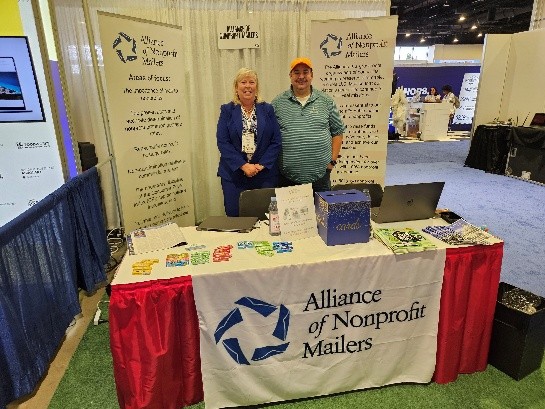
The Alliance was delighted to participate in the 2026 Bridge to Integrated Marketing & Fundraising Conference held in National Harbor last week. It was great to catch up with and meet many of our nonprofit and sponsor members! Many thanks to Alliance Vice President Jerry Mathis, ALSAC/St’ Jude Childrens Research Hospital, for helping staff our Exhibit Booth at the event!
Alliance Executive Director Talks Postal with Nonprofit Times
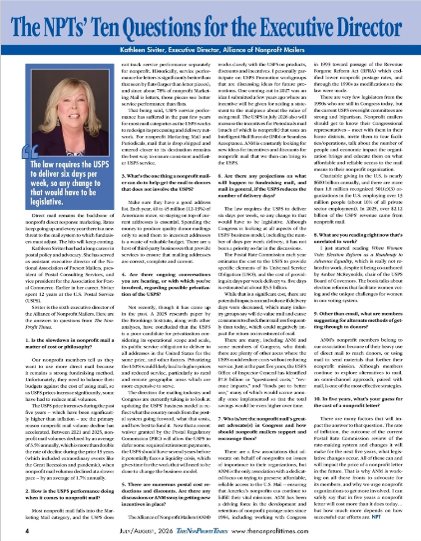
Alliance Executive Director Kathleen Siviter recently had the opportunity to talk “postal” with The Nonprofit Times in their July/August edition. Topics ranged from Nonprofit mail use, to USPS service, incentives for nonprofits, and the future of the USPS. The Alliance appreciates the opportunity from the Nonprofit Times!
Alliance to Present Nonprofit Direct Mail Session for NPF Delivered™ Series
The Alliance of Nonprofit Mailers will be presenting an education session as part of the National Postal Forum (NPF) Delivered™ webinar series. The Alliance session will be Tuesday, November 10, 2026, from 1:00 – 2:00 pm EST (mark your calendar!). We will send out the registration link once it becomes available. The education session will focus on the value of nonprofit mail, trends in nonprofit mail use, direct mail success stories for nonprofits and more!

Leave a Reply