

Alliance Report
June 26, 2026
Issue 26/12
The leading voice of nonprofits on postal issues for over 45 years.
Copyright 2025: Alliance of Nonprofit Mailers—All rights reserved.
The Alliance of Nonprofit Mailers is a 501 (c)(4) nonprofit organization established by nonprofits for nonprofits.
Charitable Giving Increased in 2025
In its just released annual report, “Giving USA 2026: The Annual Report on Philanthropy for the Year 2025,” Giving USA reported that donors gave U.S. charities $617 billion in 2025, donating an estimated $617.2 billion, which was a 5.7% increase compared to 2024’s total. The U.S. inflation rate for 2025 was 2.6%. Individuals again led all funders with an estimated $394.2 billion, which was 64% of all giving. “Total charitable giving reached a new high in current dollars and the second-highest amount on record in inflation-adjusted dollars,” reported the Nonprofit Times.
Giving USA 2026: The Annual Report on Philanthropy for the Year 2025 is published by the Giving USA Foundation and researched and written by the Indiana University Lilly Family School of Philanthropy. The report slices overall giving into four pieces – individuals, foundations (19% of giving), bequests (10% of giving) and corporations (7% of giving).
“A strong stock market and economic growth contributed to the uptick, despite upheaval caused by federal cuts,” says Wendy McGrady, chair of Giving USA. “All donor types stepped up to give amid the turmoil,” McGrady notes, because charities made their needs known. “Those that were effective in sharing their story saw their donors respond,” McGrady says.
“Bequests last year jumped by nearly 17%,” according to the report, “the third year of the last four to clock double-digit increases in this form of giving.” “The trend could signal the beginning of the long predicted Great Wealth Transfer — in which baby boomers begin passing their enormous wealth to their children and charities,” it said. “Overall, giving increased among all categories: corporations, living individuals, bequests, and foundations,” it reported.
All types of donors increased their giving in 2025, and giving to most causes also rose. Education nonprofits saw an 8.9% uptick, organizations in the “public-society benefit” category had an 8.7% increase, and environment and animal nonprofits were up 8.2%. Smaller increases were seen for charities with missions involving arts, culture and humanities (4.7%); health (3.3%); human services (2.6%); and international (1. 4%).
What About Nonprofit Mail in 2025? With charitable giving increasing in 2025, does that mean use of direct mail by nonprofits is also increasing? According to the “Donor Confidence and Giving Behavior: A 2026 Report,” published by Dunham & Co., “[t]he channels through which donors give are evolving rapidly.” “Direct mail remains remarkably effective across all generations,” it reported, “with Gen Z showing the highest responsiveness.”
“One of the most striking findings from our research challenges the conventional wisdom about direct mail’s declining relevance in a digital age,” Dunham noted. “Not only does direct mail remain highly effective,” it reported, “82% of donors say they respond to direct mail appeals, but its desirability is highest among the youngest generation of donors.” “Gen Z shows the highest responsiveness to direct mail across all generations with 93% saying they respond to direct mail,” it said, noting that “Gen Z donors are also the generation who want direct mail with 80% saying they want to receive monthly direct mail.” “By comparison,” it said, “just 64% of Millennials say the same.”
Alliance sponsor Moore observed the same thing in its “2025 in Review and the Road Ahead” report. “Overall, mail had a very stable 2025, with revenue per person holding steady compared to 2024.”
Both the Dunham and Moore reports note that response to nonprofit mail increasingly is being made through digital channels rather than through the mail. “[T]he journey from direct mail appeal to completed gift increasingly runs through digital channels,” the Dunham report said, noting that “[d]onors are now twice as likely to give online in response to a direct mail piece than to mail back a reply form, a shift that fundamentally changes how organizations must track and attribute revenue.” “This pattern appears strongest among Gen Z and Gen X donors,” it said, “though it’s present across all generations.”
“Nearly 50% who respond will do so by visiting the website and giving online,” Dunham reported, noting that “[o]nly around 20% will mail back a reply form with a check.” “For Gen Z,” it said, “the second most common response after going online is calling on the phone, not mailing back the form.” “This fundamental shift in response behavior has critical implications for revenue tracking and attribution,” Dunham said, noting that “[o]rganizations that only measure direct mail effectiveness by reply forms returned are counting only around 30% of the revenue that direct mail generates.” “The mail piece functions as the engagement driver, but the website (or phone) serves as the conversion point,” it said.
Moore also noted in its report that many times because donations are made online, they are not attributed back to the mailpiece that was actually the catalyst for the donation. It is essential for nonprofits to thoroughly analyze the data to assess the performance of their mailings.
Moore’s report also observed that in 2025, their nonprofit clients reduced use of First-Class Mail by 9.4% and increased use of nonprofit rate mail by 4.7%. “Most nonprofit mailing is done at the nonprofit rate,” it noted, “with about 10% done at the first-class rate.” “First-class mailing used to be more common,” it said, “but USPS postage changes have priced nonprofits, and many others, out of first-class mail,” which it noted increased in price by 52% from 2020 to 2025.
Clarifying the USPS’ Liquidity Position
There were many headlines following Wednesday’s Senate hearing on the USPS that said the USPS is “out of cash” and facing an imminent liquidity crisis. The headlines are not surprising, based on Postmaster General David Steiner’s testimony to the Senate Committee on Homeland Security and Government Affairs (HSGAC) (see below for coverage of the hearing).
In response to the question from the Committee as to when the USPS will run out of cash, Steiner said he wanted to make clarification despite what the PRC testified at the recent House hearing. “We are out of cash,” the PMG said. “If we had to pay all our bills today, we could not pay them,” he said. “What we are doing right now is borrowing money from employee retirement plans to fund current operations,” he told the Committee, noting “I am not comfortable with that, our employees are not comfortable and you should not be comfortable…”
To further clarify what this means, although the PMG’s statements are technically correct, it does not mean the USPS is going to cease operations due to cash flow anytime soon. According to the Monthly Statement of the Public Debt (page 15), the USPS had $9.283 billion in operating cash on May 31, 2026. This is similar to what the agency has held for months.
The PMG’s comments about the USPS being unable to pay all its bills refers to required payments into its employee retirement plan, for which the Postal Regulatory Commission (PRC) recently gave the USPS a waiver until 2030 in order to provide time for thoughtful discussion and action on potential solutions to the USPS financial issues.
Postmaster General Testifies Before Senate Committee
Postmaster General David Steiner on June 24, 2026, testified before the Senate Committee on Homeland Security and Government Affairs (HSGAC) in a hearing of the full committee, “Reforming the U.S. Postal Service’s Broken Business Model.”
Committee Chair Rand Paul (R-KY) in his opening remarks said the USPS plays by different rules than any private sector entity would — volumes have fallen but instead of cutting head count, the USPS has added 125k employees. When private partners can do work for less, outsource — but USPS does opposite. “The USPS asks for a higher credit limit and calls it reform,” he said. “The USPS has been protected from the hard choices to stop the bleeding, so the bleeding never stops.”
Paul said the Committee was told the 2022 Postal Service Reform Act (PSRA), which shifted $107b in costs away from the USPS, would pull it out of the hole. Then they were told the DFA plan would modernize the USPS’ network and restore solvency, that this time it would be different, “but it’s not.” He said since those promises, the USPS has lost another $26b and is spending money it doesn’t have on infrastructure it may not need. “This is not a rough patch,” he said, “it is a broken business model.” He noted the USPS has already maxed out its borrowing authority and the PMG has said it could run out of cash by September if it meets all its statutory obligations. “So the question is not whether the USPS needs more money,” he said, “but whether Congress will keep rewarding failure without requiring change.”
Paul said the USPS model was built for a country that no longer exists and it refuses to adjust to the one that does. He noted First Class Mail volume has declined 34% since 2014 but over the same period the USPS has grown its workforce by 9%. “That makes no sense,” he said, “volume down by a third but head count up — no private business would do that.” He said that 80% of the USPS’ costs are labor but labor costs for UPS, which is also unionized, are about 60%, “so the difference is not the union.”
Paul noted that current Postmaster General David Steiner did not make all these decisions, but he controls whether they continue. He said many things are not unavoidable costs, they are expensive choices and Congress deserves to know if the new leadership of USPS plans to continue them. He told the PMG that, at minimum, the USPS should implement a hiring freeze, but after a year the Committee has not seen any such actions in that direction. He noted that a stamp in the U.S. is still among the cheapest in the developed world, even while the USPS runs up these costs. “With its Market Dominant products priced below cost,” he said, “it is no wonder the USPS can’t break even.”
Paul said the USPS should show the Committee 5 things:
- a real plan to bring labor costs under control
- proof that private partners will be used where they cost less
- a commitment to stop capital spending that shows no return
- a willingness to consolidate facilities that no longer make sense
- and proof the service mandate can be met without further losses
“Anything less is not reform,” he said, “just a slower way to fail and the bill will be sent to the American taxpayers.”
Ranking Committee Member Gary Peters (D-MI) in his opening statement talked about how the USPS for 250 years has helped bind the nation together, connecting families, supporting small businesses, and ensuring Americans nationwide can receive essential mail and goods no matter where they live. He said the USPS provides an essential service each and every day.
Peters said that despite the 2022 PSRA reform, it is “clear the USPS continues to face significant challenges.” He said the Delivering for America (DFA) plan has not worked, costs are up, service is down, and “customers are paying the price.” He referred to the PMG’s testimony in March that the USPS could run out of cash as soon as this year, noting that since then the PRC has given the USPS additional flexibility amounting to $2.4b this year, and the USPS has suspended its normal contributions to employee retirement plan to conserve cash. “While the USPS has not provided a formal estimate of when it will run out of funds,” he said, “it is clear Congress must take action to ensure Americans continue to receive mail reliably and affordably for the next 250 years.”
Peters said the USPS has shared some proposals with the Committee, including more flexibility in investing its pension funds, revising CSRS obligations, and raising its borrowing authority, and has also asked Congress to consider reviving an appropriation for the Postal Service. “These proposals all deserve serious review,” he said, “but reforms must come with clear accountability, responsibility, and clear service improvement plans.”
Postmaster General David Steiner in his opening remarks said the USPS has driven growth of the United States for over 250 years, but the title of the hearing is apt because the USPS has a broken business model and welcomes the Committee’s focus on fixing it.
Steiner said that levers available to private sector enterprises and other government agencies are unavailable to the USPS, which is mandated by law to deliver to every address (more than 170 million with 1 million new stops added each year), 6 days per week. “This leads to 84% of city delivery routes and 52% of rural delivery routes being financially underwater,” he said, “and more than 50% (18,000) of post offices losing money, incurring over $2.5 billion in operating costs.” He said a private business would adjust routes or close stores, but the USPS is not allowed to do either. “We are not allowed to unilaterally raise prices and are required by law to give billions of dollars in discounts to many mailers,” he said. He said the USPS is not allowed flexibility in investing its retirement assets, pays an unfair allocation of CSRS benefits for its employees, can’t borrow more than $15 billion due to a limit established many years ago, can’t manage its workers comp claims, and more.
“Despite all these operational and accounting constraints,” the PMG told the Committee, “we are taking steps to fight our way back.” He said the USPS has reduced transportation costs by $2b, reduced workhours and overall headcount by 28k, and has made dramatic progress in improving service scores, seeing numbers not seen in at least last 5 years. He noted USPS has made “significant progress but not enough, we will continue to drive costs and drive service.” “The choice for Congress is clear to me,” Steiner said, “either remove the mandate that creates the unsustainable business model or compensate the USPS for money-losing mandates.” He noted the latter is not a novel idea since Congress in 1971 included an appropriation because it foresaw it would be asking the USPS to do things that lose money.
“Our preferred proposal is that Congress update this reimbursement,” the Postmaster General said, “however, we can also achieve profitability if we remove the money losing mandates. He cautioned that “doing so does not just affect the USPS, it affects an entire ecosystem around us,” which represents $2 trillion in revenue and 8 million jobs and the overall economy could suffer. “In closing,” he said, “I’m here to tell America we can do anything they desire but can’t do everything without help.” He said that subsidizing the Postal Service has been a “spectacular investment for the United States, and we believe it is worth saving.”
In response to those who asked when the USPS will run out of cash, Steiner said he wanted to make clarification despite what the PRC testified at the recent House hearing. “We are out of cash,” the PMG said. “If we had to pay all our bills today, we could not pay them,” he said. “What we are doing right now is borrowing money from employee retirement plans to fund current operations,” he told the Committee, noting “I am not comfortable with that, our employees are not comfortable and you should not be comfortable…”
Senator Paul’s response to the PMG’s opening remarks were that he would just remove the mandates, reduce delivery days and let people pay a fee if they want 6 day delivery. He then asked the PMG about a hiring freeze, noting estimates are it would reduce costs by about $1.8 billion per year. The PMG responded that the USPS about 40 days ago issued an internal memo freezing nonessential spending and also instituting a hiring freeze. Rand said he has heard it is not a full hiring freeze, but no details were shared during the hearing.
Focus on Election Mail Proposed Rules. Senator Peters was the first to raise the topic of the USPS’ proposed rules around election mail, but not the last as many other Senators echoed his concerns during the hearing.
Peters said he is “disappointed that the USPS chose to give in” to what he said were illegal demands by the President that risk disenfranchising millions of eligible voters nationwide. “The USPS Board of Governors did not even vote on these proposed changes,” he noted, which include use of a new national database of eligible voters controlled by the USPS and “an undefined ballot verification process.” Peters said that yesterday, he led an entire Democratic caucus to insist that the Postal Service “abandon this effort, uphold the law, and return to its core function.”
The election mail proposed rules came up many times during the hearing, with many Democrats voicing their concerns and opposition to the USPS having a role beyond delivering ballots. Postmaster General Steiner in response ultimately said the USPS would do whatever the law requires, emphasizing that the rules are currently proposed and not final and challenges have been made in various courts. He described the proposed changes as largely requiring barcodes and ballot envelope design, something he said the USPS has been recommending for years, and he minimized the parts of the proposed rules that pertain to a database of voters and the USPS’ role around that.
Of Note During the Hearing. Other things of note during the hearing:
- Paul and a few others suggested that the PRC and Board of Governors be combined into one body with authority to set postage prices and veto power by Congress.
- The topic of unique/dedicated ZIP Codes came up more than once as various legislators have asked the USPS to implement them for some places, but USPS says it costs $800 million to do so. The PMG tried to explain why this is to several of the Committee members when they raised the issue.
- The need to improve service performance came up repeatedly, with Senators talking about specific geographic areas within their jurisdiction.
- The concept of USPS employees helping with the Census came up from Senator Kim (D-NJ) (who is ranking member of the Subcommittee working on the Census), and the PMG was asked about the 2 current pilots as well as an earlier pilot — which the PMG said he was not aware of. During that questioning, the Senator criticized Steiner for not knowing about the earlier pilot, which he said was discontinued due to irreconcilable differences between laws in Title 39 and 13 (he also criticized the PMG for not knowing what those statutes are)
- The PMG noted that the USPS has brought in one of the preeminent restructuring firms to analyze the USPS and give recommendations, but said the report is not yet completed.
- Senator Scott (R-FL) made several disparaging remarks about Marketing Mail, which he noted brings in significantly less revenue per piece and said largely “ends up in our recycle bins.” The PMG initially responded criticizing the “antiquated pricing structure” established by the PRC and said the USPS essentially has no monopoly today. Several minutes later, however, he acknowledged that the USPS has a monopoly on the mailbox.
- Senator Ernst (R-IA) focused on the issue of service, particularly to rural areas, which he said was reduced with the DFA and regional transportation optimization (RTO) initiatives. Steiner responded that it is not just rural service that needs to improve, it is all areas. He said the USPS has built a vast network using tried and true logistics models but is still learning to operate the network effectively. “What irritates me more than anything,” he said, “is tail of mail — I don’t think your constituents care about 4 days vs 3 days delivery time, but they care when they get a wedding invitation after the wedding.” “That is our focus right now,” he said, “I would rather have 100% of the mail delivered within a certain time vs 95% and we don’t care about 5%.”
- Senator Hawley (R-MO) had a heated exchange with the Postmaster General when discussing an issue of mail being dumped in St. Louis in April and no word from the USPS as to the cause and what has been done yet. The PMG said he was “outraged” but it was the first he had heard of it, to which the Senator pointed out he had written to the PMG about it. Senator Hawley held up a sign with the amount given to USPS executives in bonuses, including Steiner and asked why that should happen when mail is not being delivered. He asked Steiner to commit to not taking a bonus until mail is being delivered, and in a back and forth accused the PMG of laughing during the discussion. Steiner said he was only laughing at the comment that the USPS had been given everything it has asked for. He committed to following up on the St. Louis issue and getting back to the Committee ASAP.
In closing, Paul again asked the USPS to commit to providing it with the report from the restructuring firm when available, as well as asking the USPS to provide the Committee by Friday with information on options, financial impacts, which are within the USPS control and which are not. The PMG agreed to provide the requested information.
Alliance Submits Statement Following Senate Hearing
The Alliance submitted a statement for the record following the Senate Committee hearing on the Postal Service (see above article). Our statement described the nonprofit organizations that make up our membership, and the impact that postage price increases significantly above CPI have had on those organizations over the past five years since the Postal Service was given additional rate authority above CPI.
“In recent proceedings before the Postal Regulatory Commission (PRC) as it reviews the future of the USPS postage rate system,” the Alliance said, “our members and other nonprofit organizations are on record sharing the devastating impacts the significantly above-CPI price increases are having on their ability to perform their critical nonprofit missions.” The Alliance in its statement recapped some of the impacts described by members in the PRC proceeding.
The Alliance talked about the importance of nonprofit organizations to the country and to the Postal Service. “Nonprofit organizations benefit the U.S. economy, with over 1.8 million recognized 501(c) organizations in the U.S. employing over 13 million people, representing 9.9% of all private sector employment,” it said. It also noted that “[f]or its Fiscal Year 2025, $2.12 billion of the Postal Service’s revenue came from nonprofit mail, which represented over 11% of total market-dominant mail volume,” noting that doesn’t include “mail in other categories that is generated as a result of a direct mail donation or subscription response.”
The Alliance stressed that the USPS can’t price its way to financial stability, that it needs to more aggressively pursue cost reductions. “Further raising postage prices – as was suggested by some during the hearing — is NOT the answer,” the Alliance emphasized. “Doing so will simply drive more volume from the system and the past five years have shown us that charging higher prices and providing less service has not helped the Postal Service achieve financial stability,” it said. “Higher prices lead to faster erosion of the USPS’ mail volumes, which is a serious concern for the long-term health of the system,” it stated.
“The USPS needs to reduce its costs and improve its efficiency,” the Alliance told the Senate Committee. “As the Committee is aware,” it said, “the last few years have seen the lowest productivity numbers from the USPS in its history, and workhours are not being reduced at the pace of volume declines, as was pointed out during the hearing.” The Alliance noted that “[a]n independent economic study prepared by EIG and submitted to the PRC as part of its rate system review showed that an annual two percent reduction in costs by the USPS would see it to break even status by 2030.” “While the Postmaster General said at the March hearing held by the House that achieving an annual two percent cost reduction ‘is not easy,’” the Alliance noted, “it is a fairly standard target in the private sector, and the USPS has accomplished that level of reduction and more in its ‘controllable’ costs many years in the past.”
The Alliance told the Congressional Committee that it supports “a return to the CPI cap that was an integral piece of the 2006 legislation that reformed the Postal Service.” “We believe the reasons a CPI cap did not achieve all the statutory objectives in the legislation between its 2006 implementation and the PRC’s 2016 finding to that effect was more due to impacts on the USPS and the economy from the Great Recession and later the COVID-19 pandemic, both of which had severe negative impacts for many years during the prior CPI-cap period,” it noted. “Reinstating a CPI cap would help stabilize postage prices and mail volumes as a result,” the Alliance said, “and would implement an incentive for the USPS to seriously work to reduce its costs.”
“[B]usinesses and nonprofit organizations largely fund the Postal Service’s Market Dominant business, not consumers,” the Alliance said, “and are significantly harmed by above-CPI price increases.” “Such price increases are accelerating the decline of mail volume, particularly for nonprofit organizations,” it summarized, noting that “[v]iable alternatives to using the mail are not always available to these organizations, particularly in rural America.”
“We support the Committee’s efforts to find solutions to the USPS’ financial condition that do not include continually raising prices for captive mailers, which accelerates mail volume declines,” the Alliance told the Committee. “Such solutions should include more aggressive cost-cutting focus by the USPS as well as legislative changes such as the USPS has requested Congress consider,” the Alliance stated.
USPS May 2026 Financial Performance
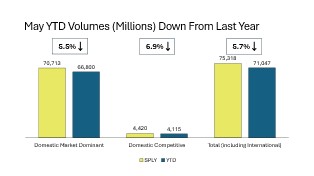
The USPS on June 24, 2026, filed its May 2026 Preliminary Financials with the Postal Regulatory Commission (PRC). As shown in the below charts prepared by Alliance economic consultants, SLS, the USPS May 2026 Year to Date (YTD) net income (excluding non-cash workers’ compensation) was $915 million behind its Plan and $495 million behind the Same Period Last Year (SPLY).

USPS volumes for FY2026 through May were down 5.7% compared to the Same Period Last Year for total volume; down 5.9% for First-Class Mail volume, down 4.9% for Marketing Mail volume, and down 6.9% for Competitive Services parcel volume.

House Subcommittee Hearing on Data Privacy
The House Energy and Commerce Subcommittee on Commerce, Manufacturing, and Trade held a legislative hearing on June 3, 2026, concerning the SECURE Data Act (H.R. 8413), the comprehensive federal privacy proposal developed by the committee’s Privacy Working Group under Rep. John Joyce (R-PA).
As reported by the American Commerce Marketing Association (ACMA), “[t]he bill represents the latest attempt to replace the growing patchwork of state privacy laws with a single national standard.” “With 22 states having now enacted comprehensive privacy laws, and dozens of amendments stacking up each session,” ACMA said, “the question of whether Washington can establish one set of rules has direct consequences for any business that collects or uses consumer data.”
ACMA explained that the SECURE Data Act “builds on the consensus framework that 21 of the 22 state laws already share, extending a core set of consumer rights and company obligations nationwide.” “It adopts the longstanding controller-processor distinction, requires affirmative opt-in consent for sensitive data, mandates an appeals process, includes anti-discrimination provisions, and establishes a data broker registry,” the association stated.
“Supporters describe it as taking the workable middle of the state laws rather than the strongest, and pair the framework with broad federal preemption so companies are not left tracking 50 separate rulebooks,” ACMA said, noting that “[e]nforcement would rest with the FTC and state attorneys general rather than a private right of action, and the bill includes a mandatory 45-day right to cure.” ACMA said that Republicans and others “have defended the bill as a proven, bipartisan-tested product, repeating Chairman Brett Guthrie’s (R-KY) framing that the U.S. is ‘not competing with Europe to regulate’ but ‘competing with China to innovate.’” “They emphasized small business compliance burdens,” ACMA said, “citing estimates that the compliance cost fragmentation could cost the economy up to $1 trillion over ten years, with $200 billion falling on small businesses.”
“Democrats were uniformly critical,” ACMA reported, with Subcommittee Ranking Member Jan Schakowsky (D-IL) saying “her party was excluded from the drafting process and that the bill protects corporations over consumers.” Other Democrats “argued the bill locks in a notice-and-consent status quo, lacks meaningful data minimization, omits a private right of action, and pairs weak rules with the broadest preemption available — potentially stripping protections under laws such as California’s Delete Act and Washington’s My Health My Data Act,” ACMA said.
“The SECURE Data Act’s so-called ‘data minimization’ provisions allow companies to collect and use data however they choose, as long as it’s disclosed in the fine print,” said full committee Ranking Member Pallone. “It continues to impose unreasonable burdens on consumers. I have long supported bipartisan national comprehensive privacy legislation. Previous bipartisan compromises like the American Privacy Rights Act and the American Data Privacy and Protection Act recognized that a federal privacy law must exceed the strongest protections of any state, not set a weak ceiling.”
For businesses and organizations using the mail, the current state-by-state patchwork already forces marketers and commerce businesses to maintain separate compliance postures across jurisdictions — a burden that falls hardest on smaller companies without dedicated legal teams, according to ACMA. “A single federal standard would simplify nationwide marketing, data collection, and customer outreach,” it said, “but the details matter enormously: the scope of preemption, the consent requirements for sensitive data, the data broker registry, and the absence of a private right of action would all reshape how companies handle consumer information.”
ACMA said that “[b]ecause the bill remains contested along party lines, its path forward is uncertain, but its core provisions preview where federal privacy compliance is heading.”
Federal Judge Blocks Use of Federal Database for Election Mail
A federal judge on Monday ruled that a recently revamped version of a federal tool central to the Administration’s efforts to nationalize elections can no longer be used, reported AP News on June 22, 2026.
U.S. District Court Judge Sparkle L. Sooknanan “sided with advocacy groups that argued the recent upgrades to the program, called Systematic Alien Verification for Entitlements, or SAVE, aggregated Americans’ sensitive personal data in a way that could result in voters being wrongly purged from voter rolls,” AP News reported.
“All in all, the federal government has knowingly trampled on the privacy rights of American citizens in a manner that threatens the sacred right to vote,” Sooknanan said in an order explaining the decision. “This Court cannot stand idly by while that happens.” She said Congress had expressly prohibited the government from centralizing Americans’ personal identifying information and that the federal agencies that created the SAVE program “knew that the database violates those statutory protections.”
The decision represents a “major legal setback” in the Administration’s efforts to use federal agencies to encourage a nationwide crackdown on having noncitizens illegally on state voter rolls, AP News said. “The modified SAVE system, which critics had referred to as an unlawful centralized federal database of voter information, had been a key pillar of the second election executive order the Republican president signed earlier this year,” it said, noting that “[t]he ruling leaves its future uncertain.”
Federal Judge Blocks Executive Order on Mail-In Voting
Subsequent to the above action, a federal judge on June 25, 2026, “barred the Postal Service on Thursday from restricting the delivery of mail-in ballots to states that don’t hand over a list of eligible voters, rebuffing President Donald Trump’s efforts to crack down on a voting method he has long targeted.” According to the article in Politco, “[t]he decision marks a win for the states that have challenged the president’s effort to crack down on mail-in voting ahead of a consequential November midterm.”
“The agency, charged with delivering parcels to every address in the nation,” the article reported, “neither possesses the constitutional authority to administer elections — a responsibility delegated to the states — nor has it been granted power by Congress to create binding regulations on voting by mail, U.S. District Judge Indira Talwani stated in the decision.” “The ruling is a victory for the 23 states and Washington, D.C., which sued the Trump administration over the president’s March executive order that demanded the agency implement such a rule,” Politco reported, noting that “Talwani’s decision also blocks another part of the executive order directing the federal government to compile a list of American citizens residing in states.” “The White House did not immediately respond to requests for comment,” it said, “and the Department of Justice declined to comment, but the Trump administration will likely challenge the ruling.”
Into the Postal Weeds…
For those who live in the “postal weeds,” and are looking for news on mail entry, preparation, discounts, incentives, and more, this column in the Alliance Report will be right up your alley! We won’t go all the way into the weeds…but we will offer up highlights on useful resources and mailing standard changes.
- USPS Launches Three Regional Processing & Distribution Centers (RPDCs) on June 29, 2026. “To support the Postal Service’s nationwide network modernization plan, three Regional Processing and Distribution Centers (RPDCs) will be activated on June 29, 2026. These RPDCs will help modernize our network to improve the employee experience and enhance operational capabilities to support package growth, while continuing to provide reliable, affordable, secure, and universal mail delivery. With these activations, USPS will have modernized 18 RPDCs, associated with 66 Local Processing Centers (LPCs) nationwide. There are no impacts to existing customer origin entry. All future FAST appointments and origin entry volume will be scheduled at the RPDCs listed below:
- Nashville, TN RPDC
570 Knight Valley Dr.
Nashville, TN 37227
NASS Code (372MA)
- Oklahoma City, OK RPDC
4025 W Reno Ave
Oklahoma City, OK 73125
NASS Code (730)
- Sacramento, CA RPDC
3775 Industrial Blvd
West Sacramento, CA 95799
Nass Code (956)
- Effective July 1, 2026, the Postal Service™ will revise Labeling List(s) L001, L007, L009, L012, L016, L201, and L606 to reflect changes in mail processing operations. Mailers are expected to label according to these revised lists for mailings inducted on or after the July 1, 2026, effective date through the August 31, 2026, expiration date.The changes can be found in the June 11, 2026, Postal Bulletin. Current Labeling Lists can be found on the FAST website at https://fast.usps.com/fast/fastApp/resources/labelListFiles.action
Alliance August Webinar for members & sponsors only – Register Now!
Our 3rd webinar for 2026 will be held in August and will be for Alliance nonprofit members and sponsors only. This next webinar will provide updates on regulatory and legislative postal proceedings as well as news from the July meeting of the Mailers Technical Advisory Committee (MTAC).
The webinar will be held on Wednesday, August 5, 2026, from 2-3 EST. Registration is open at https://zoom.us/meeting/register/gSoLn9aqRRW-O9FLKqTEEw.
The Alliance is planning to hold more webinars in 2026, some will be restricted to Alliance members only, others will be open to all. If there are specific topics or speakers your organization is interested in having a webinar on, email me at kathy@nonprofitmailers.org.

Leave a Reply