

Alliance Report
June 22, 2026
Issue 26/11
The leading voice of nonprofits on postal issues for over 45 years.
Copyright 2025: Alliance of Nonprofit Mailers—All rights reserved.
The Alliance of Nonprofit Mailers is a 501 (c)(4) nonprofit organization established by nonprofits for nonprofits.
Congressional Subcommittee Presses USPS for Financial Projections
In a June 15, 2026, press release, the House Subcommittee on Government Operations pressed the USPS to “provide Congress with five-year financial and service projections.” The Subcommittee noted that during Postmaster General Steiner’s March 17, 2026, testimony before the Subcommittee, “he agreed, in response to questioning from Congressman Walkinshaw, to provide Congress with five-year financial projections in the form of multi-scenario analyses.” “Despite that commitment,” the Subcommittee said, “USPS has not yet provided the requested data.”
The Subcommittee noted that a June 2, 2026 response from the USPS repeated its legislative requests for addition support, “it again did not provide the requested data, projections, and financial information.”
The lawmakers requested “updated projections that include scenario modeling on potential cost-cutting measures, including the financial impact of suspending planned capital investments under the Delivering for America plan, deferring scheduled retirement obligation payments, and implementing additional cost-cutting measures discussed with the Committee.”
They also raised concern that USPS recently suspended employer contributions to the Federal Employees Retirement System, affecting the retirement security of postal workers, while continuing major capital investments under the Delivering for America plan.
“Postal Service employees are already being asked to bear the burden of the Postal Service’s financial situation,” the lawmakers wrote. “On April 9, 2026, the Postal Service announced it is suspending employer contributions to the Federal Employees Retirement System, putting the retirement security of hundreds of thousands of postal workers at risk.”
The lawmakers said Congress needs the requested projections to understand the financial impact of USPS’ proposals, evaluate potential reforms, protect reliable service, and improve the Postal Service’s long-term stability.
“To implement reforms that would improve the Postal Service’s long-term financial stability, Congress must be equipped with clear data detailing the anticipated financial effects of the proposals you provided us with in your recent testimony,” the lawmakers wrote.
The letter requests that USPS provide the five-year financial and service projections within two weeks. A copy of the letter sent to USPS by the Subcommittee can be found here.
USPS OIG Releases Spring 2026 Semiannual Report to Congress
The USPS Office of Inspector General (OIG) has released its Spring 2026 Semiannual Report to Congress. For those looking at how the USPS can reduce costs…in just the six months ending 3/31/26 covered by the report, the OIG identified over $2.7 billion in questioned USPS costs, revenue impacts from OIG audits/investigations and fund that could be put to better use.
The OIG report highlights the state of USPS finances as well as its ability to provide timely mail delivery, reflecting concerns that have intensified in recent months. “Our work has increased transparency into postal finances in many ways,” said USPS Inspector General Tammy Hull. “We’ve issued a report exploring the Postal Service’s financial history and released a public-facing dashboard that makes it easy for anyone to see postal financial and productivity information and trends,” she said. “We have uncovered potential lost revenue from unused and excess space, as well as significant revenue loss from financial fraud,” the IG reported. “Our work around service performance continues to cover both national and local service issues,” she said, “including how the rollout of the Postal Service’s network is affecting timely mail delivery.”
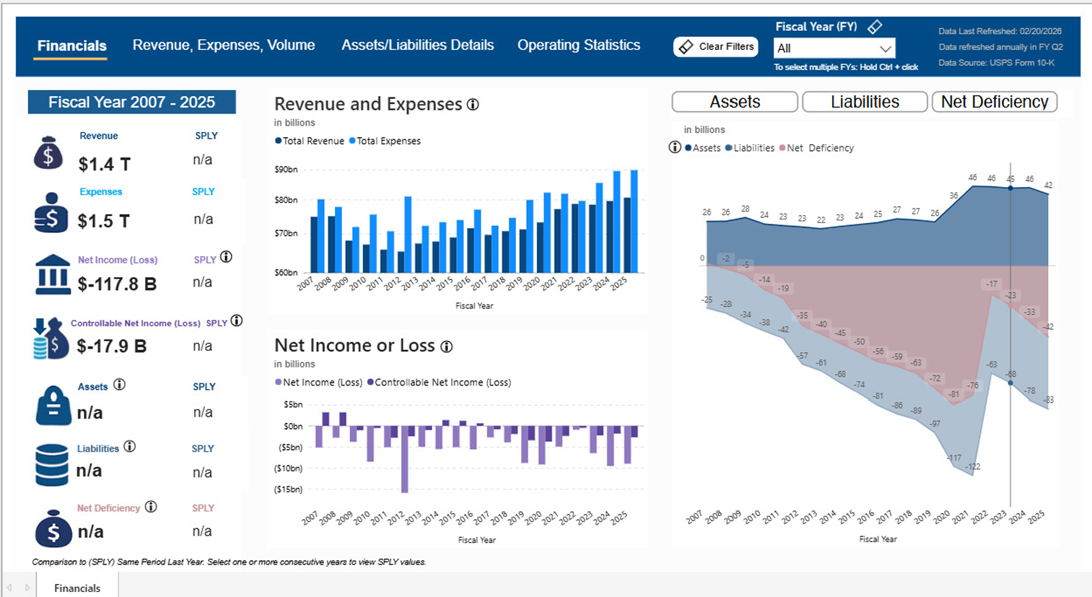
The OIG in its report highlighted a new tool it introduced in February 2026, “designed to enhance transparency into the Postal Service’s business and operational performance.” “The USPS Deeper Dive: Financials & Productivity Dashboard (shown below) is a one-stop dashboard that provides stakeholders and the public easy access to key postal financial metrics dating back as far as 2005,” the OIG report noted. “It integrates data from multiple public sources — including postal 10-K filings and PRC reports — into an aggregated platform, providing a complete view of long term trends in postal finances and productivity.” “The dashboard tracks how efficiently the Postal Service has used resources to handle its workload, provides a breakdown of the agency’s retirement expenditures, and allows users to trace how closely the value of the postal monopoly has kept pace with the cost of fulfilling the universal service obligation” the OIG reported.
“Users can also explore interactive tools to dive deeper into data about USPS’s mail volume, revenue and expenses, assets and liabilities, and operational statistics,” the report said, noting “[t]he dashboard will be updated annually following the release of new USPS and PRC reports, typically between December and March.” “However,” the OIG noted, “additional funding to enhance the dashboard could allow for quarterly or monthly data updates, additional financial and productivity metrics, and potential expansion of the dashboard to include other measures of the Postal Service’s organizational health.”
The OIG Semiannual Report to Congress provides a wealth of additional information of value, including audits that identified opportunities for USPS financial improvement, activities that protect postal finances by rooting out fraud, oversight of USPS service performance, mail theft investigations and other postal crime detection and prevention.
Senate Holds USPS Board of Governors Nomination Hearing
The Senate Homeland Security & Governmental Affairs Committee (HSGAC) on June 17, 2026, held a hearing to consider multiple nominations, including the nominations of Jeffrey Brodsky and William Gallo to be Governors of the USPS. No nomination hearing date has been published for Anthony Lomangino and Robert Steffens, who had also originally been scheduled for June 17th nomination hearing. According to an article in Federal News Network, “Senate HSGAC aide for the minority told Federal News Network that committee Chairman Rand Paul (R-Ky.) did not specify why the nominees were taken off the hearing, but said Lomangino and Steffens had not yet completed the committee’s required ethics paperwork.” “The aide said it’s not yet clear when the committee will hold a confirmation hearing for those two nominees,” it reported.
Committee Ranking Minority Member Senator Gary Peters (D-MI) kicked off the questioning for the two USPS Board of Governors nominees, asking their view of whether the USPS should be privatized. Gallo said he is opposed to USPS privatization, that he thinks the USPS’ situation is “fixable.” Brodsky initially said he has no view on the matter until Sen. Peters added that privatizing would make delivery difficult for rural communities, at which point Brodsky said he did not think the USPS’ current financial liabilities would be attractive to any private entity.
Senator Peters then asked the nominees whether they thought the USPS has the authority to refuse to deliver mailed absentee ballots sent to voters, to which both said no. Senator Josh Hawley (R-MO) talked about the long-standing concerns of his constituents in Missouri, where he said 68% of the addresses are rural and only served by the USPS, adding that it is vital the USPS remains committed to serving rural areas. Hawley showed a map where he said the blue areas (which included all of Missouri) are those negatively impacted by the USPS’ Regional Transportation Optimization (RTO) initiative. He said his state and representatives oppose this plan and asked the nominees if they support the continued mandate of the USPS to serve the whole country and protect rural delivery as a top priority. Brodsky referred to comments from Postmaster General David Steiner that the USPS needs to better implement these changes and said he would request that management focus on that if he were to serve on the USPS Board. He noted service declines since the implementation of the Delivering for America (DFA) plan and said they have to figure out why. Gallo agreed that rural areas should be served and a priority.
Senator Hawley then asked the nominees if they would support USPS executive bonuses when service is unacceptable, noting that former Postmaster General Louis DeJoy had received $567,000 in bonuses despite substantial losses for the agency. “Why,” he asked, “when the USPS is missing its internal projections and our constituents are being asked to accept slow delivery, why is the Postmaster General getting bonuses?” Brodsky said USPS management should be held accountable for performance and needs to come up with a new long-term plan, which he said he thinks the current Postmaster General is working on. Senator Hawley asked both nominees whether they would cease to vote for management bonuses until mail is delivered on time. Brodsky said metrics need to be put in place on which bonuses are based and agreed if someone doesn’t meet the goals they should not get a bonus, though he noted there are some compensation theories that support paying people “appropriately.” Gallo said it makes no sense to give a bonus if the agency is losing money and not making its goals.
Committee Chairman Senator Rand Paul (R-KY) remarked that it is an “absolute and utter failure” that the USPS is still losing billions. He further noted that 80 percent of the USPS’ costs to deliver mail is labor while UPS is about 50 percent and FedEx about 38 percent. “Another big problem is insourcing vs. outsourcing,” he said, noting that “government employees cost more than private and the bigger the USPS gets, the more money it will lose.” “I thought Louis DeJoy would understand that,” he said, “but he didn’t.”
Senator Paul asked the nominees if they had ideas on fixing the Postal Service. Gallo said that “as a businessman it is hard to understand how the USPS has $80 billion in revenue, a network to deliver mail everywhere in the U.S., the ability to borrow up to $15 billion, and it is still losing money.” “It is fixable,” he said, “raise revenue by $5 billion and reduce costs by $5 billion.” He said he read the DFA and many of the points made sense to him but we are six years into the plan – which is supposed to break even over ten years – and still losing the same amount of money, “so all the points made in DFA need to be looked at to determine what is working and what is not.” “The workforce is too big,” he said. Senator Paul stressed that solutions need to “be bold, not trim around the corners.”
Senator Elissa Slotkin (D-MI) noted that the Committee has a bipartisan interest in getting a fix for USPS right, one that recognizes the importance of rural communities. She asked the nominees about voting by mail and whether they think the USPS should have a role in saying who can vote by mail. Brodsky said the USPS should receive mailed ballots and deliver them as soon as possible, and should follow the law. He said the President’s Executive Order around voting by mail “is not yet the law,” and said be thinks the proposal will be clarified. Gallo said he read the Executive Order, which he noted “created a lot of legal disputes and public debate.” “The Courts and Congress need to make these decisions,” he responded. Both nominees agreed that voting by mail is safe and secure, Brodsky noting he has used it himself multiple times and Gallo qualifying agreement as “under proper guidance and monitoring.”
Senator Peters asked the nominees about the role of the Postal Regulatory Commission (PRC) in overseeing the Postal Service and ensuring pricing complies with the law, noting that earlier this year the USPS petitioned to be able to unilaterally set prices for a rive year period. Both nominees responded that the PRC has an important role and should be maintained.
Senate to Hold Hearing on Reforming the USPS
The Senate Committee on Homeland Security and Government Affairs will hold a hearing of the full committee on June 24, 2026, at 9:30 am EST, “Reforming the U.S. Postal Service’s Broken Business Model,” with testimony reportedly from the Postmaster General.
USPS Responds to Petitions Filed at PRC on Election Mail Changes
The USPS on June 18, 2026, filed its response to the petition filed at the Postal Regulatory Commission (PRC) last week requesting the PRC to open an advisory opinion proceeding concerning the USPS’ proposed changes to Election Mail published in the Federal Register [see Alliance Report 26-10].
The USPS told the PRC that all the petitioners’ requests “should be denied,” “because neither the Petitioners nor the Commission may commence an advisory opinion proceeding on behalf of the Postal Service.” “Furthermore,” the USPS told the PRC, “because the Petitions do not meet the requirements of a formal complaint under Section 3662 and 39 C.F.R. Part 3022, they cannot be construed as a complaint.” “Likewise,” USPS said, “Petitioners’ request to add Election Mail to the Mail Classification Schedule (“MCS”) fails to include the required elements of such a request under the Commission’s regulations.” “But,” the USPS added, “even if those deficiencies were corrected, the Postal Service objects to adding Election Mail to the MCS at this time, which prevents the Commission from approving the request.”
The USPS concluded,
“In any event, the Petitions should be denied because related questions are the subject of an ongoing rulemaking proceeding and active litigation before multiple federal courts. Petitioners are invited to offer their views on the proposed rule by submitting comments through the Federal Register Process. And questions concerning the directives in Executive Order 14,399 as related to the proposed rule, are being litigated now. In the interest of judicial economy, to preserve limited Commission and Postal Service resources, the Commission should allow these proceedings to unfold without interference.”
USPS Receiving Near-Record Number of Comments on Proposed Election Mail Changes
The USPS has informally disclosed that so far it has received over 70,000 comments in response to its proposed changes published in the Federal Register on June 2, 2026 (see Alliance Report 09-26 for more information). The USPS’ proposed changes are in response to the March 31, 2026, Presidential Executive Order 14399, Ensuring Citizenship Verification and Integrity in Federal Elections. The proposed rules apply to envelope design and review standards as well as providing for an optional pre-mailing notice that states may provide to the USPS and “facilitate the process for states to enroll individuals with the Postal Service for inclusion on state-specific lists for mail-in and absentee ballot participation.”
“Under this proposal,” the USPS said, “states would retain full control over who would (or would not) be able to vote by mail in federal elections within each state, as states would control enrollment with the Postal Service for inclusion on the state’s Mail-In and Absentee Participation List.” The proposed rules include establishment of a new verification standard “to support transmission of compliant mail-in or absentee ballots.”
The comment deadline is not until July 2, 2026, which means that the number of comments received by the USPS could break its prior record of over 120,000 comments received concerning a set of proposed changes.
To date, multiple lawsuits have been filed by groups opposing the Presidential Executive Order. The League of Women Voters on June 18, 2026, in a press release said that “[a] federal court today ruled that nonpartisan voting rights groups could continue with their legal challenge to President Trump’s executive order restricting mail-in voting ahead of the upcoming 2026 primaries and November midterm elections.”
“In the ruling,” the group said, “the court recognized that the Trump administration and the US Postal Service (USPS) are actively working to implement the executive order, which attempts to override state election laws, including by directing the Postal Service not to deliver certain mail ballots.” “In addition,” it said, “the Department of Homeland Security (DHS) is moving to compile and distribute ‘citizenship lists’ even though the Department of Justice’s own lawyers acknowledged in court that the lists will be underinclusive and incomplete.”
“Today’s ruling dealt only with a part of the federal government’s motion to dismiss the legal challenge to the executive order,” the group said, noting that “[t]he court has not yet ruled on other pending motions, including voting rights groups’ request for a preliminary injunction to block the US Postal Service from carrying out the executive order.”
Into the Postal Weeds…
For those who live in the “postal weeds,” and are looking for news on mail entry, preparation, discounts, incentives, and more, this column in the Alliance Report will be right up your alley! We won’t go all the way into the weeds…but we will offer up highlights on useful resources and mailing standard changes.
- USPS Discontinues Use of Priority Mail/Priority Mail Express Open and Distribute (PMOD) Parcels. The USPS on June 17, 2026, published final rules in the Federal Register discontinuing the use of Priority Mail and Priority Mail Express Open and Distribute parcels effective January 17, 2027. “Priority Mail Express and Priority Mail Open and Distribute service will continue to provide an option for mailers who want to expedite letter or flat mailings to destination postal facilities,” the USPS said. “As an alternative for parcel mailers, Priority Mail Express and Priority Mail Open and Distribute service will be made available to mailers through a negotiated service agreement (NSA),” it noted.
- USPS Publishes rules for PVDS mailings in conjunction with July 12, 2026 price change. “Current Prices — PVDS mailings verified and paid for on or before July 11, 2026, using the current prices will be accepted at destination entry postal facilities through Monday, July 27, 2026, when presented using eInduction® or with appropriate verification and payment documentation (PS Form 8125 or PS Form 8017). New Prices — PVDS mailings may be verified and paid for beginning June 28, 2026, using the new prices, provided the shipments, when presented using eInduction®, USPS Ship or with appropriate verification and payment documentation (PS Form 8125 or PS Form 8017), are not deposited at destination entry postal facilities before July 12, 2026. Mailers must enter a Mail Arrival Date on all documentation that is on or after July 12, 2026.”
Alliance August Webinar for members & sponsors only – Register Now!
Our 3rd webinar for 2026 will be held in August and will be for Alliance nonprofit members and sponsors only. This next webinar will provide updates on regulatory and legislative postal proceedings as well as news from the July meeting of the Mailers Technical Advisory Committee (MTAC).
The webinar will be held on Wednesday, August 5, 2026, from 2-3 EST. Registration is open at https://zoom.us/meeting/register/gSoLn9aqRRW-O9FLKqTEEw.
The Alliance is planning to hold more webinars in 2026, some will be restricted to Alliance members only, others will be open to all. If there are specific topics or speakers your organization is interested in having a webinar on, email me at kathy@nonprofitmailers.org.

Leave a Reply