

Alliance Report
Sept. 21, 2026
Issue 26/19
The leading voice of nonprofits on postal issues for over 45 years.
Copyright 2025: Alliance of Nonprofit Mailers—All rights reserved.
The Alliance of Nonprofit Mailers is a 501 (c)(4) nonprofit organization established by nonprofits for nonprofits.
USPS OIG Identifies $5.8 Billion in USPS Revenue Loss From Fraud
The USPS Office of Inspector General (OIG) on September 10, 2026, released the latest in a series of audit reports on USPS fraud, stating that its work has “uncovered numerous fraud schemes, resulting in five reports to date — including this report — that have identified almost $5.8 billion in revenue loss to the Postal Service.” “To mitigate future losses,” the OIG said, “the Postal Service and Postal Inspection Service must address gaps to better detect and intercept these fraudulent package labels and stamps being generated both domestically and internationally.”
This latest audit report deals with the USPS efforts to mitigate counterfeit postage. In its summary, the OIG noted that the USPS in FY2025 “shipped 6.8 billion packages, generating $32.6 billion in revenue.” “However,” it reported, “it lost an additional $1.6 billion in revenue the same year by accepting counterfeit postage labels.” “To address this growing concern,” the OIG said, “the Chief Information Security Office and U.S. Postal Inspection Service were tasked with combatting counterfeit labels and pursuing legal action against offenders.” The OIG’s objective in this latest work was to “evaluate the Postal Service’s and Postal Inspection Service’s efforts to address counterfeit postage.”
The OIG said that it found that the USPS and Postal Inspection Service made progress in mitigating the use of counterfeit labels, “but lacked comprehensive oversight and a formal decision authority to address this issue, and the volume of counterfeit labels remained high.” The OIG “identified gaps in their ability to detect and intercept counterfeit labels, resulting in an estimated revenue loss of $3.1 billion from March 2024 through February 2026, with the additional risk of losing $520 million in unrecoverable revenue by February 2028.”
“We also identified opportunities for USPS to collaborate with industry partners to explore the use of new label technology,” the OIG said, noting that the “USPS incurs millions of dollars in re-processing costs for misidentified counterfeit labels and could recoup some of these costs from late paying mailers.” “Lastly, while the Postal Inspection Service made efforts to combat counterfeit labels, opportunities exist to improve case referral oversight, funds recovery, case tips analysis, and response to counterfeit labels advertised online,” it reported.
Below are highlights from other USPS audits conducted so far in FY2026 around fraud, indicating the amount of revenue the USPS has lost or has the potential to lose as a result of fraud. Note that portions of the full audit reports contain redacted information, since the OIG and USPS obviously don’t want to publish material that could help criminals understand ways to fraud the USPS.
“Counterfeit Stamps.” In the OIG’s June 16, 2026, audit report on Counterfeit Stamps, it identified that shortfalls in USPS and Postal Inspection Service mitigation efforts resulted in “over $349 million in revenue loss and $1.7 billion of revenue at risk in fiscal year 2026.”
“Postal Service and Postal Inspection Service mitigation efforts are limited, with no substantive approach to identify counterfeit stamps in the Postal Service network,” the OIG audit reported, noting that “[w]hile the Postal Service and the Postal Inspection Service have increased prevention-related efforts, the quantity of counterfeit stamps in the network remains unknown.”
“Emerging Counterfeit Label Trend.” In the OIG’s April 8, 2026, audit report on emerging counterfeit label trends, it identified a loss of revenue over a six-month period to be $46.3 million, and said that “[w]ithout the implementation of timely measures to remedy this issue, the Postal Service could lose an additional $46.3 million in revenue during the next four months.”
The OIG’s audit noted that “[a]lthough the Intercept Process has been in place for three years, the Postal Service has not updated the process to keep up with evolving trends in counterfeit labels.” It said that to identify counterfeit labels, it reviewed the USPS’ Product Tracking and Reporting (PTR) data and found that the USPS processed over 10.7 million packages over a one year period with unpaid postage and a particular type of counterfeit label.
“Enterprise Payment Account Fraud.” In the OIG’s February 10, 2026, audit report on Enterprise Payment account fraud, it identified there were insufficient controls in place to prevent Enterprise Payment Account fraud, resulting in over $125 million in revenue loss in the month of December 2025 alone. Between February and December 2025, the OIG audit reported that the USPS lost over $537 million in expected revenue due to EPA fraud.
“As the Postal Service faced a $9 billion loss in fiscal year 2025,” the OIG reported, “and with the recent report by the Postal Service of the potential of running out of cash by early 2027, the agency must take urgent action to protect its revenue.” “The Postal Service stated that they first identified this type of fraud in May 2025,” the OIG reported, “yet in January 2026, their mitigation efforts have still not been effective.” “If further action is not taken,” it said, “we estimate that the Postal Service will lose an additional $1.3 billion in revenue in calendar year 2026 due to EPA fraud.”
Issues Identified with Counterfeit Postage. In the OIG’s October 15, 2025, audit report on counterfeit postage, it found that in April through August 2025, the number of suspected counterfeit package labels surged over 1500 percent, for an estimated loss of revenue of $82.5 million, and said that “without the implementation of timely measures to remedy this issue, the Postal Service could lose an additional $403 million in revenue during the next 12 months.”
Supreme Court Rules Against Mail-In Ballot Changes for 2026 Mid-Term Elections
The Supreme Court on September 14, 2026, ruled against the mail-in ballot changes included in an Executive Order issued by the Administration earlier this year. As reported by NPR, “[t]he ruling released Monday by the high court means the U.S. Postal Service is expected to continue delivering ballots as usual.” “Voting by mail has already begun in states including Alabama, North Carolina and Wisconsin, with more soon to follow — including Western states such as Hawaii, Oregon and Washington, where elections are held primarily or fully with mail ballots,” NPR reported.
As detailed in the last issue of the Alliance Report, the changes last week were blocked by another federal court injunction. “The judge found the requirements are likely illegal because the Postal Service has no authority to control mail-in voting,” NPR recapped. “Now, a majority of the Supreme Court decided to keep that injunction in place,” it said. “The court said the Trump administration was unlikely to succeed on the merits of its challenge,” NPR reported. It continued,
“Conservative Justice Brett Kavanaugh wrote a short concurring opinion, saying ‘there is at least a fair prospect that the final rule falls within the Postal Service’s statutory authority.’ But, he added, ‘applying the rule in the 2026 elections would be arbitrary and capricious in violation of the Administrative Procedure Act because state and local election officials do not have sufficient time to reasonably implement the rule before the elections.’”
“Indeed,” NPR reported, “several Republican state election officials, including from the mostly vote-by-mail state of Utah, signed on to a Supreme Court brief, warning that any attempt to carry out the USPS plan now ‘will almost certainly lead to mistakes, delays, and confusion for both voters and election officials.’”
USPS Issues Statement. The Postal Service on September 17, 2026, issued a brief statement affirming that it “is not implementing or enforcing Section 705.24 of the DMM: Ballot Mail for Federal Elections for the 2026 General Election.” “Our processes and procedures for this year will be consistent with previous election cycles,” the USPS stated, adding that “[a]s always, the Postal Service will continue to engage with state and local election officials and their mail service providers to provide technical assistance and advise on how to implement our best practices as spelled out in Kit 600: the Official Election Mail Guide.
AP News on September 17, 2026, reported that the Postmaster General said the agency has stopped working on developing a controversial computer system that was central to implementation of the Administration’s Executive Order. “’There’s an injunction so we’re not doing anything,’ postmaster general David Steiner told The Associated Press in an interview,’” it said. “Steiner also declined to take a position on Trump’s policy,” AP News reported, “presenting himself as the leader of an ‘independent agency of the executive branch’ whose influence over the president’s order was limited to operational concerns.” “’I don’t get to decide what rules that are put on us that I decide to accept or not accept,’ he said,” the article reported, “’I looked at it more from the execution side.’”
PMG Reportedly Wants to Quit…
A Reuters article published on September 17, 2026, reported that “[t]he head of the U.S. Postal Service has told confidants that he is deeply discouraged by his job and wants to resign, according to four people familiar with his thinking, as the agency comes under scrutiny over financial losses and President Donald Trump’s effort to tighten rules on mail-in voting.”
“Postmaster General David Steiner,” the article said, “who took office in July 2025 after the White House forced out his predecessor, has expressed frustration over a lack of help from the White House and Congress in addressing the mail service’s long-running financial woes, the people said.” “At the same time, the Postal Service was thrust to the center of a debate over the federal government’s role in voting after Trump directed it in March to serve as a clearinghouse for mail ballots,” Reuters reported, noting that “[t]he Supreme Court on Monday blocked the agency from implementing key elements of the plan, dealing the White House a significant setback.”
“The pressures culminated in a contentious June Senate hearing,” it reported, “where lawmakers from both parties interrogated Steiner over poor delivery service, Trump’s ballot restrictions and his compensation.” “The hearing left Steiner furious, the people said,” the article said, noting that “[i]n conversations afterward, Steiner described the job as thankless, warned that the agency’s finances were increasingly dire without federal aid, and said he wanted out, according to the people, who spoke on condition of anonymity.” “’The message was, this isn’t what he signed up for, and he didn’t come on board to get beat up like this,’ one of the people said,” according to the article. It noted that “[t]he Postal Service disputed the information from the sources, saying it had ‘absolutely zero validity,’ but did not comment on specific incidents.” “The agency did not respond to a request for an interview with Steiner,” it said.
Updated Price Change Forecast
The Bureau of Labor Statistics on September 11, 2026, released the August 2026 CPI, which increased by 3.4 percent from August 2025 and increased by 0.4 percent from July 2026 (seasonally adjusted).
The USPS’ CPI price cap authority now stands at 1.792 percent. See table below prepared by SLS Consulting for the estimated July 2027 rate authority under the existing Market Dominant ratemaking system. Given the substantial volatility in energy costs, these estimates are subject to heightened uncertainty and may change.

USPS OIG Assesses the USPS’ Network Changes
The USPS Office of Inspector General (OIG) on September 8, 2026, published an audit report, “Assessment of Postal Service’s Network Changes,” in which it looked at the “impacts that network change initiatives have had on the Postal Service and its stakeholders.” “For this audit,” the OIG said, “we focused on cost, savings, and service performance impacts of the Postal Service’s network processing, transportation, and delivery initiatives from fiscal year (FY) 2016 through FY 2026, quarter 2.”
The OIG reported that the USPS “has made significant changes to its network in the first five years of the DFA plan reducing mail processing, transportation, and delivery costs.” “However,” it reported, “the financial position of the Postal Service has not improved, and the operational changes have coincided with service performance declines, with rural communities experiencing the most noticeable impacts.” “Additionally,” it said, “the Postal Service does not have a long-term cost savings target nor does it track the financial impact of network change initiatives.” “Instead,” the OIG reported, “it manages initiatives on an annual basis but does not have an overall program schedule and timeline to track and report long-term progress.”
The OIG also reported that it “found issues with network changes that could have been identified through better planning and modeling.” It concluded, “[f]inally, the organization is missing an opportunity to better standardize the network of facilities envisioned at the outset of the DFA plan.” “As a result,” the OIG said, “the Postal Service continues to operate a fragmented system that hampers nationwide decision-making, limits expected efficiencies, and complicates efforts to measure performance.”
“Together, these issues place the Postal Service at risk of falling short of DFA’s intended goals: improved service reliability, enhanced operational efficiency, and long-term financial sustainability,” the OIG concluded. The OIG made recommendations with which the USPS agreed.
GAO Report Says USPS Cost-Cutting Initiatives and Other Factors Have Contributed to Declining Service Performance
The Government Accountability Office (GAO) on September 17, 2026, released its report, “U.S. Postal Service: Cost-Cutting Initiatives and Other Factors Have Contributed to Declining Service Performance.” The GAO noted that the USPS since publishing its Delivering for America (DFA) strategic plan in 2021, has reduced service standards twice as well as lowering its service targets, but is still failing to meet those targets.
The GAO said the USPS in October 2021, “added 1 to 2 days to its expected delivery times for certain products to accommodate its transportation change from air to ground;” and in April 2025, “USPS further changed expected delivery times by eliminating end-of-day or afternoon collection at the over 24,000 post offices that are more than 50 miles from a Regional Processing and Delivery Center.” In addition, the GAO said, “USPS lowered its service performance targets—the percentage of mail it expects to meet service standards—in fiscal year 2021 and has not met most targets since then.”
“While intended to achieve cost savings, USPS’s strategic plan initiatives have slowed service for some mail and had a disproportionate impact on rural customers, according to oversight entities and industry stakeholders,” the GAO reported. It published the below chart showing the USPS’ service performance for select First-Class Mail products:
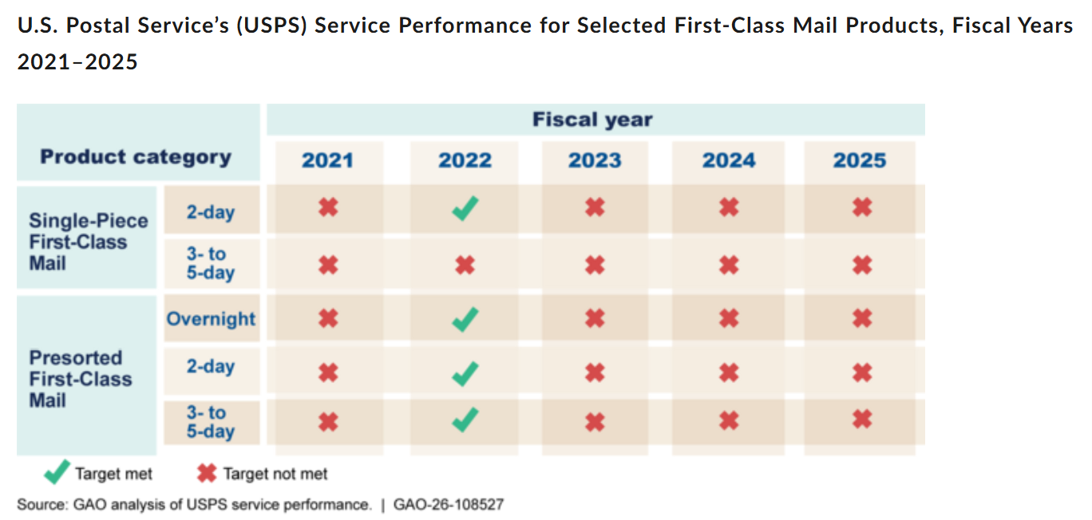
The GAO reported that the “USPS has tried to address service performance in several ways, including using diagnostic tools and regular operational meetings.” “However,” it said, “ongoing service performance issues indicate that USPS’s actions have not been sufficient.” “Moreover,” it said, “broader challenges—such as USPS’s poor financial condition—may contribute to the difficulty in doing so.” “Given persistent concerns about service performance, it is important that USPS clearly communicate about its ongoing and planned actions to address this issue, even as it seeks to cut costs, as well as about the challenges it faces,” the GAO said, noting that “[t]he upcoming update to USPS’s strategic plan, which is planned for 2027, presents an opportunity for USPS to communicate this information to Congress, the public, and relevant stakeholders.”
The GAO recommended “that USPS include details about its ongoing and planned actions to improve service performance in the next update of its strategic plan,” and reported that the “USPS agreed with this recommendation.”
OIG Finds Issues with USPS Customer Survey Integrity
The USPS Office of Inspector General (USPS OIG) on September 15, 2026, published its audit report on USPS Customer Survey Integrity, finding that although the USPS’ earlier adjustments were sufficient to address one scheme of survey manipulation (which it had reported to the OIG for investigation), “more widespread manipulation continued.” The OIG noted that the USPS “reported a 5 percent increase in customer satisfaction from FYs 2023 to 2025, driven, in part, by nationwide manipulation of C360 scores through two schemes, impacting over 124,000 of 3.8 million surveys (3.3 percent).” “Specifically,” it said, “we found employees created fake issues so when they received the customer satisfaction survey at their personal email addresses, they could complete the surveys with favorable results.” “Secondly,” the OIG reported, “we found a coordinated ‘booster’ effort in one area where employees improperly entered normal interactions (like daily mail delivery) as customer issues to generate surveys that were then manipulated to inflate local C360 scores.”
“Although management was aware of these schemes,” the OIG reported, “it did not address the underlying culture driving score manipulation.” “Some employees faced pressure, at times, from supervisors who benefited from the misconduct,” it said, noting that “[a]dditionally, we found weaknesses in policy, deterrence measures, and processes that allowed this misconduct to persist.” “Without corrective action,” the OIG said, “the integrity of C360 reporting will remain compromised, potentially exposing the Postal Service to fines by the PRC from uncorrected, inaccurate reporting.”
In outlining the original falsification scheme that led to the USPS reporting the issue to the OIG, the OIG said the scheme involved a “District Level Manager in Customer Relations,” who was “editing customer email addresses within C360 so the customer satisfaction survey would be sent to the manager rather than the customer.” It reported that “this manager made nearly 800 edits to customer email addresses in eleven days,” and said that “[o]ver the course of six months in FY 2024, the manager completed 2,589 positive C360 customer satisfaction surveys.” “This manager resigned after being placed on administrative leave while the Postal Service conducted their investigation,” the OIG reported, but said that “[n]one of these surveys were removed from the Local, Area, or National score reports to the PRC, despite confirmation that the results were falsified.”
In subsequent schemes, the OIG reported that one post office increased its customer satisfaction score by over 21 percent through falsification of surveys. It further reported that managers in the Western Pacific Area ordered staff to submit “walk-in” service requests to artificially boost their satisfaction metrics. The OIG found that “[e]xcessive pressure to raise customer satisfaction scores created a culture that led to widespread manipulation.” “In the WestPac Area,” it reported, “we found that leadership set artificial, unrealistic targets, sent constant reminders, and tracked daily status of C360 results, creating an environment where altering surveys became routine.”
“The 5 percent increase in customer satisfaction that the Postal Service reported between FYs 2023 to 2025 was driven, in part, by nationwide manipulation of C360 survey scores, impacting over 124,000 (3.3 percent) out of 3.8 million surveys,” the OIG concluded. It said that “[a]s a result of the inaction to address the ongoing score manipulation, the Postal Service’s C360 reporting to the PRC is not accurate.” It continued,
“Customer Experience did not correct its C360 submission to the PRC in subsequent annual reports because investigative outcomes were not shared by local management. By developing a holistic escalation process…Customer Experience will be able to identify any needed changes to its C360 scores and determine if those changes warrant resubmission to the PRC. Customer Experience should begin taking steps to evaluate the full extent of ‘Email Us’ and ‘Booster Campaign’ manipulation, culminating with a revised impact analysis. This impact analysis should be used to submit revised scores to the PRC.”
2027 NPF Registration Now Open
Registration is now open for the 2027 National Postal Forum (NPF), the premier event for professionals across the shipping and mailing supply chain. Join us May 16-19 in Orlando, Florida, for an inspiring week of education and networking. It’s early, we know, but that’s exactly why now is a great time to plan ahead. When you register early, you’ll:
- Secure your spot at the largest trade show/conference of its kind
- Reserve your room at the Orlando World Center Marriott-dedicated entirely to NPF attendees before rooms sell out (rooms are only available through NPF, and inventory is limited)
- Save $100 on a Full or Three-day Registration
In the weeks ahead, NPF’s website will be updated with fresh insights, speakers, and programming. Early Bird registration is open through January 8, 2027. For details on how to register for the forum please visit NPF’s registration site.
Into the Postal Weeds…
For those who live in the “postal weeds,” and are looking for news on mail entry, preparation, discounts, incentives, and more, this column in the Alliance Report will be right up your alley! We won’t go all the way into the weeds…but we will offer up highlights on useful resources and mailing standard changes.
- 2027 Promotion Guidebook Posted – Impact Messaging Promotion. The USPS has published an updated version of the guidebook for the 2027 Impact Messaging promotion. We encourage all nonprofits to consider using this promotion, which centers around including messaging in the mailpiece around the value of mail. The USPS includes examples in the guidebook of messages that are approved for the promotion, or organizations can submit their own messaging for approval. The messaging can be placed on the outside of the mailpiece (or envelope) or on the inside (contents).

Leave a Reply