

Alliance Report
Oct. 15, 2026
Issue 26/21
The leading voice of nonprofits on postal issues for over 45 years.
Copyright 2025: Alliance of Nonprofit Mailers—All rights reserved.
The Alliance of Nonprofit Mailers is a 501 (c)(4) nonprofit organization established by nonprofits for nonprofits.
USPS Files Statement Urging PRC to Take Next Step on Rate System Review
The USPS on October 1, 2026, filed a statement with the Postal Regulatory Commission (PRC) urging it to expeditiously take the next step on its rate system review, and noting that only the USPS’ own proposals meet two of the statutory objectives in the law.
“The Commission began its review of the market-dominant ratemaking system two and a half years ago,” the USPS said, noting that “[a] year later, the Commission concluded that the system had failed to achieve the statutory objectives, including Objectives 5 (assuring the Postal Service’s financial stability) and 8 (establishing just and reasonable rates), and announced its plan to conduct a phased rulemaking to consider changes to the system.” It continued,
“Since that time, however,” the USPS said, “the Commission has conducted only one substantive rulemaking, the outcome of which further constrained the Postal Service’s ability to generate revenue under the system.” “Despite the Commission’s stated intention to conduct additional rulemakings, and despite assurances that it would ‘expedite consideration’ of proposals submitted by interested parties (including the Postal Service) for its consideration,” the USPS stated, “six months have passed since the period for submitting proposals closed and the Commission still has not announced the subject or timing for any future rulemakings.”
The USPS further stated that “[a]lthough the Commission provided a temporary waiver of the Retirement Rate Authority minimum remittance payment, this interim measure does not change the salient fact: as the Commission itself has acknowledged, the Postal Service’s financial trajectory is unsustainable, and the ratemaking system continues to not achieve Objectives 5 and 8.” “The fact that the Commission has given the Postal Service greater latitude to not make certain statutorily-required payments to employee pension funds does not provide a rational basis to delay further action in this proceeding,” it said. “To address the system’s design failures, and guard the nation’s postal system against irreversible damage caused by the Postal Service’s financial crisis,” the USPS stated, “the Commission must overhaul the current non-compensatory price cap system, which since its inception has bred financial instability and failed to establish just or reasonable rates for the Postal Service.” “Prompt action towards this end is urgently called for, and the Commission must therefore take action to begin the next phase of the rulemaking process,” it said. The USPS continued,
“Prompt action is clearly necessary. The rulemaking(s) contemplated by Order No. 9427 will presumably entail multiple stages—including a reply period, review of comments, and the issuance of a final rule—all of which may take months to unfold. Meanwhile, the current failed ratemaking system continues to hold the Postal Service underwater. Furthermore, the Commission need not choose between plausible competing remedies, as among the petitions now before the Commission, the Pricing Authority Petition offers the only viable means of addressing the current system’s inability to achieve Objectives 5 and 8.”
The USPS told the PRC that it “has exhaustively explained in our petitions why additional pricing authority is necessary to achieve the statutory objectives and is consistent with the Postal Service’s obligations to provide prompt and reliable service in an operationally efficient manner.” “As the Commission well knows, the Postal Service has in recent years aggressively pursued numerous operational reforms and has demonstrated our commitment to quality service and reducing costs,” it said, noting that “[a]s part of these efforts, the Postal Service has since 2021 reduced workhours by 56 million, the equivalent of $3 billion; downsized our overall complement by 28,675 employees; and lowered transportation and facility costs by $2 billion, with network transportation expenses now 18 percent lower than in FY 2022.” “Yet self-help only extends so far: consider that, in FY 2025, approximately 70 percent of reported accounting losses were attributable to noncontrollable expenses,” the USPS said. “The impact of our cost-reduction efforts is also muted by other factors, including the historically high inflation of recent years,” it stated.
“The Postal Service must have the authority to more effectively use market dominant pricing as a tool to enable us to achieve financial sustainability,” the USPS told the PRC. “As discussed in our petitions, the Governors would use this tool appropriately, and only as necessary to cover our costs until the next system-wide review,” it stated, noting that “[o]ur use of price increases would be dependent on our ability to achieve financial stability through other, more preferable means, including continued aggressive cost reductions, competitive revenue growth, and common-sense administrative and legislative reform.” “While adequate flexibility and authority to determine appropriate market-dominant rate adjustments must be a tool made available to the Governors,” the USPS argued, “success in those other areas would reduce the need for market-dominant rate adjustments to ensure our financial sustainability.”
“Ultimately,” the USPS summarized, “revenues will not balance costs absent a ratemaking system responsive to Objectives 5 and 8.” “Designing such a system is a goal shared by the Postal Service and the Commission alike,” it said noting that the USPS “merely asks that the Commission take the next step toward achieving it.”
Alliance Objects to USPS Statement on Rate Review
The Alliance of Nonprofit Mailers (ANM) on October 2, 2026, filed an objection to the USPS’ statement on the Postal Regulatory Commission (PRC) rate review (see above article). “Petitions to modify the current ratemaking system were due on February 17, 2026,” ANM said, noting that “[r]esponses to those petitions were due on March 6, 2026.” “Nearly seven months after this deadline, on October 1, 2026,” the Alliance said, “the Postal Service filed a ‘Statement’ pushing the Commission to promptly begin the next phase of this rulemaking so that it can more rapidly consider the Postal Service’s December 22, 2025 petition that seeks to eliminate the statutorily-mandated CPI price cap and replace it with a system under which the Postal Service’s monopoly business is deregulated.”
“The Alliance of Nonprofit Mailers (the “Alliance”) urges the Commission to strike the Postal Service’s Statement from the administrative record or, at the very least, disregard it,” the group said. ANM continued,
“If the Postal Service had merely filed a short request for accelerated movement into the next phase of this docket, without more, that would have been procedurally improper, albeit more tolerable. But the Postal Service did far more than that. It observed that the Commission ‘began its review of the market-dominant ratemaking system two and a half years ago,’ and then criticized the Commission for not having accomplished enough since then. The Commission will recall, as the Alliance does, that when this docket began in 2024 the Postal Service opposed an accelerated review of the ratemaking system, calling it ‘premature’ and claiming that the system ‘has essentially operated as reasonably expected.’ It now describes the system as having ‘design failures’ and presses the Commission to completely ‘overhaul’ the price cap system immediately.”
“The Postal Service has unilaterally, and without Commission authorization,” ANM stated, “decided to grant itself an extension of the comment deadlines that the Commission imposed in Order No. 9427.” “Titling its submission a ‘Statement’ does not excuse what the Postal Service has done: it filed an out-of-time, self-serving, supplemental petition that introduces updated data about its purported financial condition, touts alleged ‘self-help’ cost improvement efforts (claims that are belied by the historic drops in USPS productivity since 2021), and hand waives the billions of dollars’ worth of relief granted by the Commission months ago while asking for unfettered rate power.”
“Worst of all,” the Alliance said, “the Postal Service claims that the Commission ‘need not choose between plausible competing remedies,’ because its own petition seeking price deregulation ‘offers the only viable means of addressing the current system’s inability to achieve Objectives 5 and 8.’” “Not only does the Postal Service continue misreading PAEA’s text by ignoring every statutory objective except for the two objectives that it believes allows it to price gouge its customers,” the Alliance said, “but it now pressures the Commission to consider its petition exclusively and at the expense of all mailer-side proposals.”
“To be clear, the Alliance has consistently urged prompt Commission action in this docket in recognition of the current system’s harmful impacts on volume and captive mailers, and its inability to incentivize the Postal Service to operate efficiently,” the group said, noting that “[i]ndeed, the Alliance was one of the leading industry voices urging the Commission to accelerate its statutory review of the system years ago.” “But the Alliance expects that the Commission’s conduct, and any forthcoming proposed rules, will be based on the petitions and comments properly filed by all parties during the comment period – not based on the Postal Service’s past-deadline plea for high-speed deregulation,” ANM said, concluding that “[t]he Commission should ignore the Postal Service’s Statement.
Updated Forecast for July 2027 Rate Increase
The Bureau of Labor Statistics on October 14, 2026, released the September 2026 CPI, which increased by 3.7 percent from September 2025 and increased by 0.6 percent from August 2026 (seasonally adjusted). The USPS CPI price cap authority now stands at 2.105 percent.
See the table below, prepared by SLS Consulting, for the estimated July 2027 rate authority under the existing Market Dominant ratemaking system (Note that the current ratemaking system is under review by the Postal Regulatory Commission, so the rules could change prior to July 2027.]
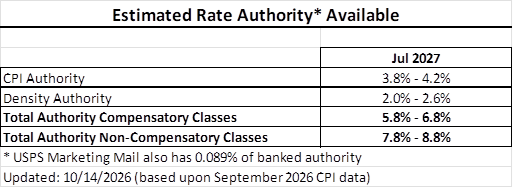
Given the substantial volatility in energy costs, these estimates are subject to heightened uncertainty and may change.
OIG’s Latest Review of USPS’ DFA Plan
The USPS Office of Inspector General (OIG) on Sept. 30, 2026, released its white paper with its latest oversight of the USPS’ Delivering for America Plan (DFA), the fourth of its white papers on the DFA. The DFA is the USPS’ 10-year strategic plan, first published in 2021, and updated in 2024.
“While the Postal Service has made progress towards some strategic initiatives, like moving toward a more integrated network,” the OIG reported, “other initiatives have moved slower or gone through multiple iterations.” “Many of these strategic initiatives require significant investment, as well, and the Postal Service’s financial condition remains dire, halfway through the ten-year plan period,” it said. The OIG said its latest report “provides perspective on the DFA plan’s evolving journey as it has moved through its recent modernization efforts.”
USPS Finances. On the financial objectives in the DFA, the OIG reported that “[d]uring the first five years of the DFA plan, the Postal Service’s financial results painted a mixed picture.” “Market Dominant revenue increased by about 9.1 percent,” the OIG said, “primarily driven by seven price adjustments that cumulatively raised rates about 50 percent.” “Conversely,” it noted, “mail volume fell about 16 percent over the same period, consistent with its years’ long downward trend.” “This dynamic indicates that revenue growth has been influenced primarily by price increases even as the volume has decreased,” the OIG said. “Furthermore,” it reported, “Competitive products exhibited a decrease in both revenue and volume, 1.3 percent and 9.8 percent, respectively, as several price hikes on shipping and packages, including temporary peak season adjustments, and the successful introduction of USPS Ground Advantage, tempered the overall revenue decline.”
“Since the PRC’s 2020 pricing authority ruling and until FY 2025, the Postal Service increased prices on Market Dominant products seven times, about 50 percent cumulatively,” the OIG reported, noting that “[b]eginning in FY 2023, the shift to semiannual price increases became a component of its revenue strategy.” It contined,
“Since the implementation of the DFA plan in FY 2021 to FY 2025, controllable costs increased 5.8 percent, primarily driven by compensation and benefits, which remained the largest expense. Despite the Postal Service’s efforts to reduce work hours — roughly 56 million from FY 2021 through FY 2025 — compensation and benefits costs continued to rise, driven by contractual wage increases and the conversion of employees from pre-career to career status. Transportation costs followed as the second largest controllable expense over this period; however, strategic changes during this timeframe — including network optimization efforts and the elimination of underutilized trips — improved efficiency. Additionally, the package delivery shift from air to surface has, among other transportation initiatives, resulted in savings of over $1 billion.”
On Service Performance. The OIG in its DFA progress report said that the USPS “has not succeeded, over the last five years, in meeting its DFA plan goal of delivering at least 95 percent of all mail and packages on time, despite changing the service standard for multiple products to allow for longer delivery times.” The OIG noted that the USPS in October 2021 “updated the service standards for First-Class Mail and Periodicals.” “The change allowed up to an additional two days for delivery of some mail within the contiguous United States by introducing 4-day and 5-day delivery time frames,” it said.
“The 2021 service standard change and the 2025 Regional Transportation Optimization (RTO) initiative succeeded in decreasing costs by reducing the number of trips between post offices and mail processing facilities,” the OIG reported, “but contributed to increases in nationwide mail delivery timeframes, with rural communities experiencing the most significant declines.” “In February 2025,” it said, “the Postal Service further updated service standards based on 5-digit ZIP Codes and their distance to the nearest processing facility.” “The changes affected First-Class Mail, Periodicals, Marketing Mail, and Package Services by adding or subtracting days to the standard, including those locations impacted by the RTO initiative,” the OIG said, noting that “[t]he 2021 and 2025 service standard changes were intended to realign service expectations with the updated network changes using ground transportation.”
“In the five years prior to the start of the DFA plan, the Postal Service failed to reach all but two of its stated targets,” the OIG reported, “and it was between 2 to 6 points below its then-target for First-Class Mail of 96 percent-on-time delivery.” “However,” it noted, “the Postal Service has had seasonal success in delivering specific types of mail timely.” “For example,” it said, “it showed improved service performance for all mail products during FY 2026 peak mailing season compared to the previous peak season.” “However,” the OIG reported, “despite their success, only Parcel Select reached 95 percent reliability during this period.” “The Postal Service also significantly exceeded timeliness targets for the processing and delivery of Election Mail during the 2024 general election,” it said.
On Network Integration. “Before the DFA plan,” the OIG reported, “the Postal Service encountered substantial challenges stemming from infrastructure that was outdated and built primarily for processing mail versus packages.” “The vision of the DFA plan was to transform the processing network into something scalable, reliable, visible, efficient, automated, and digitally integrated,” the OIG said, noting that “[i]nitiatives were developed which aimed to rationalize and modernize the way mail and packages were processed, transported, and delivered.” “These initiatives were designed to move the network toward a more resilient, customer-focused operation that could adapt to the demands of today and tomorrow,” it said. It reported,
“As of September 2024, the Postal Service committed $17.3 billion to redesign the processing network and improve facility conditions. The pursuit of the plan has resulted in establishing Regional Processing and Distribution Centers (RPDC) and Local Processing Centers (LPC), as well as updating equipment and addressing deferred maintenance at existing facilities. The network transformation also involved establishing Sorting & Distribution Centers (S&DC), which combine mail carrier operations from multiple smaller locations in certain areas into one larger facility.”
“Since implementing the DFA plan,” the OIG reported, “the Postal Service has made substantial investments in modern processing equipment to boost throughput,
reduce manual handling, and better manage larger packages.” “Since the DFA plan was implemented,” it said, “activation of RPDCs, LPCs, and S&DCs have progressed slowly based on the initial plan for each facility.” “After launching the DFA plan,” the OIG said, “the Postal Service realized the importance of consolidating cross-country volumes to increase efficiency.” “This led to the Regional Transfer Hubs (RTH) initiative to act as consolidation centers, sending full trailer loads of mail across the country to enhance transportation efficiency,” it reported, noting that the USPS “has not set specific targets or effective monitoring tools to assess if RTHs delivered the anticipated transportation savings, or if service impacts outweighed the costs.”
Product Modernization. “While network integration focused on back-end infrastructure,” the OIG reported, “post office and product modernization was intended to address customer-facing retail touchpoints.” “Before the Postal Service developed the DFA plan,” it said, “its facilities suffered from years of underinvestment, and the organization faced competition from other companies to keep its products and services modern and efficient.” “As a result of the underinvestment,” the OIG reported, “many post offices were outdated, expensive to maintain, and lacked a modern appearance.” It continued,
“In the DFA plan, the Postal Service established goals to modernize and transform its network of over 31,000 post offices and retail centers into go-to destinations to support community needs by providing a wider range of government and commercial services and better aligning those to customer demand, as well as creating postal-centric retail hubs for local business growth. Additionally, it planned on using the postal logistics network and infrastructure to connect businesses. The Postal Service’s service offerings were bundled with the goal of growing the package delivery business and expanding its ground network.”
“Even with these goals for retail modernization,” the OIG reported, “the initiatives designed to implement modernized attributes have not been implemented at most retail facilities.” “However,” it noted, “the organization has developed several new products that have made positive contributions to its financial performance.” “Since inception of the DFA plan,” it said, “the S&DCs that have been fully modernized represent less than 1 percent of total postal facilities.” “In 2024,” the OIG said, “the Postal Service established a goal of modernizing 43 S&DC facilities by FY 2027.” It noted that the USPS “has made incremental investments in pieces of equipment to enhance the retail experience, with around 2,600 locations equipped with enhanced self-service kiosks and 700 locations that offer smart lockers.”
“From the start of the DFA plan through July 2026,” the OIG reported, “the Postal Service has invested $323 million in retail modernization — around 11 percent of the costs spent on investing in the new package processing machines.” “This represents over 8 percent of the $4 billion the Postal Service committed to invest in the DFA plan for its retail modernization,” it said, noting that “Congress, the PRC, and the public have been supportive of retail modernization.” “The slow progress in modernizing customer-facing operations underscores a broader challenge: despite clear interest and stated commitments, the Postal Service has not yet articulated a cohesive strategy for how its retail network should evolve,” the OIG said.
“The DFA plan for product modernization was clear: launch innovative products that would drive revenue growth and strengthen its competitive position,” the OIG said, noting that the USPS’ “product modernization journey has been marked by significant progress and notable setbacks.” “While new products were introduced,” it said, “some initiatives simply rebranded existing offerings rather than delivering true innovations.”
In reporting on the USPS’ product innovations, the OIG noted that the USPS launched USPS Connect in 2022, “which had a goal of giving businesses the benefits of accessing the Postal Service’s vast network.” “While USPS Connect Regional has increased revenue,” it reported, “USPS Connect Local has had limited impact on the agency’s bottom line.” “Through the first two quarters of FY 2026,” the OIG reported, “USPS Connect products contributed 3 percent of the Postal Service’s total revenue.”
“In July 2023, the Postal Service launched USPS Ground Advantage, a new shipping product that consolidated three previously offered ground services (USPS Retail Ground, USPS Parcel Select Ground and USPS First-Class Package Service) into one single ground shipping option,” the OIG said, noting that “USPS Ground Advantage has become the flagship ground shipping option for packages weighing up to 70 pounds.” “The Postal Service has marketed it as an economical option that uses the organization’s vast network — providing additional convenience for its customers,” it said, noting that “USPS Ground Advantage has been well-received by customers and contributed to the Postal Service’s bottom line.” “In FYs 2023, 2024, and 2025, total revenue for Competitive products grew by about $161, $501 and $160 million, respectively, and by nearly $78 million in the first two quarters of FY 2026, partially offsetting the revenue decreases in Priority Mail Services and Parcel Services,” the OIG reported. “This new product has increased the Postal Service’s presence in the marketplace,” it said.
“To further grow its business and build on the success of USPS Ground Advantage,” the OIG said, “in January 2026, the Postal Service launched a bidding website to expand access to its last-mile delivery network.” “It changed the way last-mile service is offered by expanding the reach of retailers and others who value same-day or next-day delivery,” it said. “As of early June 2026,” it reported, “there has been less interest from customers in this service than anticipated.” “The service is still being offered but will likely evolve to better reach its intended customers,” the OIG said.
“Continuing its modernization push, in July 2026, the Postal Service launched USPS Local XChange, a service that enables customers to buy, sell, and swap items locally through USPS Smart Lockers without the need to meet in person,” the OIG reported, noting that “[i]t is designed to connect local buyers and sellers, enabling secure transactions without in-person meetups, appealing to customers’ goal of saving time, reducing risk, and adding peace of mind.” “While the use of parcel lockers is growing throughout the world,” the OIG noted, “it is too early to determine if USPS Local XChange will be a success in terms of public acceptance and revenue gains.”
“Collectively, these new product initiatives have helped broaden the Postal Service’s market presence and generate additional revenue,” the OIG concluded, but noted that “despite some early successes with some of its offerings, their long-term impact remains uncertain in a highly competitive environment.”
On Prior OIG Recommendations. The OIG noted in its report that “[s]ince the implementation of the DFA plan through July 30, 2026, the OIG has issued 80 reports directly related to the Postal Service’s financial performance, service, network integration, and post office and product modernization efforts.” “Out of these reports,” it said, “we issued 348 recommendations, and the Postal Service has worked to close 306 of them.”
USPS Response. The USPS in its response to the OIG concerning the report, said that it “appreciates that this fourth edition reinforces the need for Congressional action to address longstanding business model impediments and acknowledges the work the Postal Service has done to address over 90% of the OIG recommendations issued to date over the last five years.” It noted, however, that “[w]hile this report seeks to assess progress toward our ten-year objectives with a focus on service excellence and financial stability, we note that certain elements of the report conflate various components of our service standard changes and goals.”
The USPS specifically said it disagrees with the OIG representation that “the plan set a goal to deliver at least 95 percent of all mail and packages on time by changing its service standards to facilitate a transportation change for First-Class Mail and First-Class Package Services.” “This ultimate goal to deliver at least 95 percent of all mail and packages on time was a long-term goal,” the USPS said, “dependent upon the successful implementation of all changes outlined in the Plan.” “As a result,” the USPS told the OIG, “it was not a near-term goal, particularly during the network transition, nor was it ever a published service performance target.”
The USPS also told the OIG it disagreed with “the characterization of semi-annual price increases as a routine ‘revenue generation’ strategy without additional context.” “In reality,” the USPS said, “the twice-yearly adjustments were implemented to address inflation and correct pricing imbalances caused by the previous defective pricing model.” “This approach was especially necessary in FY2023 and FY2024, when elevated inflation required more frequent Market Dominant price changes to keep pace with costs,” the USPS said, noting that “[a]s inflation moderated in FY2025, only one price increase was made.” “Our pricing strategy is based on careful consideration of economic and market conditions,” the USPS said, not a fixed schedule.”
The USPS further said in its response to the OIG on the report that “[t]he ongoing transformation of the Postal Service is a multi-year process that naturally involves challenges in execution.” “The OIG’s reports have highlighted some of these issues,” the USPS said, “which the Postal Service continues to address as needed by adjusting our processes to support the effective implementation of our Plan initiatives.” “Through these efforts,” it said, “the Postal Service has successfully reduced costs and is improving service performance as we continue to leverage the opportunities presented by the network to increase efficiency and reliability.” “Maintaining the momentum at this stage of the Plan is essential for the survival of the Postal Service as a matter of financial and operational necessity,” the USPS responded.
The USPS said that the OIG’s report “does not fully reflect the implementation of the Plan.” “Going forward,” it said, “the Postal Service encourages future reports to offer a broader perspective on the Delivering for America Plan initiatives by including relevant context from management responses and recent related actions to provide a more comprehensive understanding of our progress over the last five years.”
OIG White Paper on USPS Retirement Model
The USPS Office of Inspector General (OIG) on October 9, 2026, issued a white paper, “Comparative Analysis of Alternative Retirement Models,” which it said is designed to “understand the potential financial impact if the Postal Service were to operate under a different retirement model. “[T]he OIG partnered with the Segal Group, an actuarial consulting firm, to project the effects of such a change on the Postal Service’s pension funding status over the next 20 years,” it said, noting that “[t]hese projections compare a current model scenario with four alternative retirement models and include a range of outcomes based on projected performance of investment assets.”
“Over the past 10 years,” the OIG said, “the Postal Service’s retirement costs have grown faster than other categories of spending.” “These expenses are a major contributor to the agency’s annual losses,” it said. “The paper analyzes the potential financial impact of selected alternative retirement models on the Postal Service’s pension funding,” the OIG said, noting that the paper “presents 20-year projections under different retirement benefit models, including the status quo and four alternative models.” “Maintaining the current retirement system would likely result in the Postal Service’s pension liabilities remaining underfunded over the next 20 years,” the OIG said. “Diversifying retirement investments could by itself address the agency’s retirement benefit funding problems without impacting employee benefits,” the OIG reported. “However,” it said, “this may expose the Postal Service’s pension funds to greater market volatility.” “The Postal Service cannot make changes to its retirement model on its own,” the OIG said, “and congressional action would be required to allow the agency to depart from its current model.”
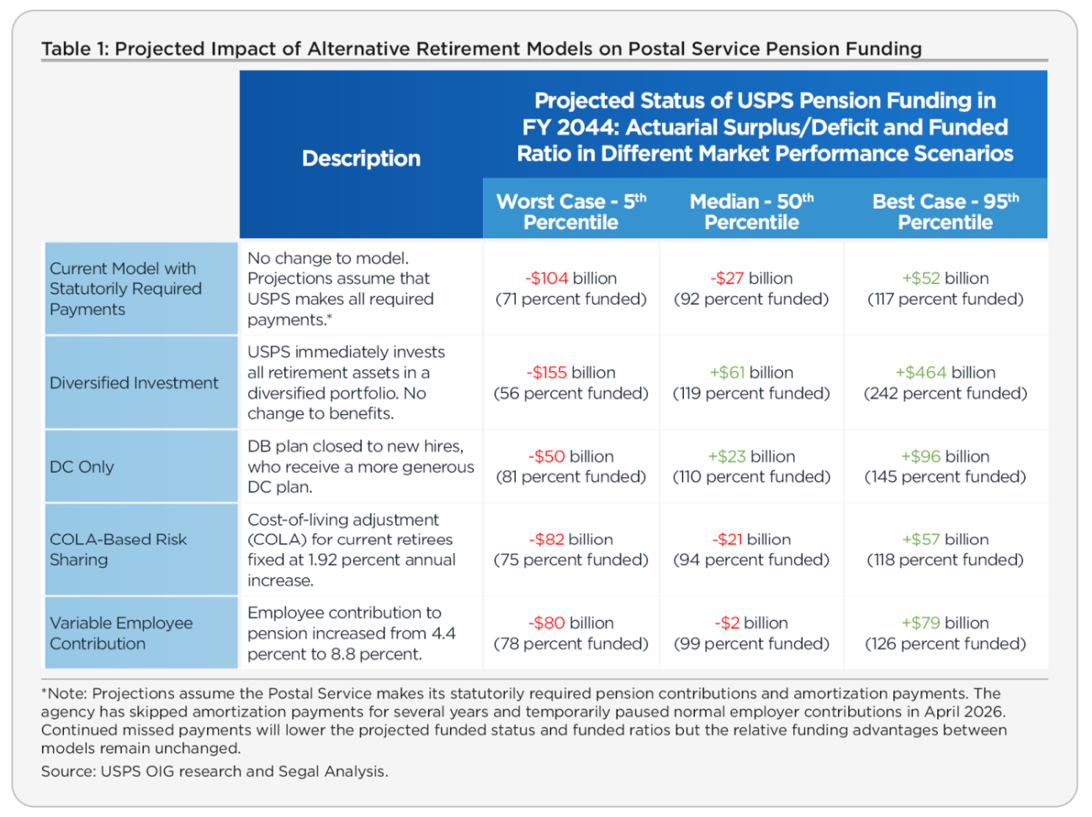
The OIG report found that “[e]ven if the Postal Service were to make all required employer contributions and amortization payments, maintaining the current retirement system would likely result in the funded status remaining below 100 percent over the next 20 years.” “As a result,” it said, “high pension costs, including billions in annual amortization payments to pay off unfunded liabilities, will persist and continue to strain the Postal Service’s finances.”
In looking at diversifying its retirement investments, the OIG concluded it could significantly improve funding within ten years but increases market risk. “In this scenario,” it said, “the Postal Service would invest all its retirement assets in a diversified investment portfolio of 60 percent equities and 40 percent fixed-income investments.” “The average (50th percentile) result of this scenario has the unfunded liability falling to $34 billion lower than the current model in FY 2034 (after 10 years),” it said. “In FY 2044 (after 20 years), the result is a significant actuarial surplus, with a balance $88 billion higher than the current model projection,” the OIG reported, noting that “[t]hese projections suggest that, over time, diversified investment of pension funds could by itself address the agency’s retirement benefit funding problems without impacting employee benefits.” “However,” the OIG noted, “this may expose the pension funds to greater market volatility.”
Enrolling New Hires in a DC-Only Plan Could Reduce Unfunded Liabilities in the Long Term While Weakening Employee Benefits: “In this scenario,” the OIG reported, “the DB plan is closed to new hires.” “There would be a new tier of employees who do not accrue pension benefits but have a more generous DC plan than the Thrift Savings Plan in which Postal Service employees are currently enrolled,” it said. “This scenario projects an actuarial surplus, with a balance of almost $50 billion higher than the current model after 20 years in the best case scenario, but leaves employees with reduced benefits,” it reported.
Establishing a Fixed Cost-of-Living Adjustment (COLA) Would Limit Postal Service Liability in a High Inflation Environment While Reducing Retiree Benefits: “To demonstrate the potential impact of limiting the COLA, the OIG projected a scenario in which the COLA is fixed at 1.92 percent,” it reported, noting that “[t]he results demonstrate that setting a fixed COLA would not be an impactful change to the Postal Service’s retirement model in lower inflation environments but could reduce the impact of high inflation rates.” “Implementing this measure, however, would result in retirees receiving lower benefits in higher inflation years than under the current COLA formula,” it said.
Doubling the Employee Contribution Rate Could Improve Long-Term Funding While Lowering Take-Home Pay: “In this scenario,” the OIG said, “we doubled the employee contribution for new hires.” “This scenario reduces the unfunded liability by $25 billion more than the current model after 20 years but reduces take-home pay for employees without providing additional retirement benefits,” it said.
“In summary,” the OIG reported, “our simulations of the potential financial impact of alternative retirement models on the Postal Service showed that diversified investment of retiree assets in stocks and bonds would produce the largest expected positive financial impact on the Postal Service’s retirement funding without altering employee compensation or retiree benefits.” “The other models projected in this paper could also positively impact retirement funding but would achieve those outcomes by reducing benefits or increasing employee contributions,” it said. “Weakening benefits or reducing overall compensation may affect the Postal Service’s ability to attract and retain employees,” the OIG said.
“Due in part to the current retirement model,” the OIG reported, “the Postal Service faces persistent budget shortfalls.” “These deficits require the Postal Service to weigh competing financial priorities,” it said, “from paying down unfunded liabilities to maintaining its operations or modernizing its network.” “Taking action to improve retirement funding can strengthen the Postal Service’s finances and help sustain its mission over the long term,” the OIG said.
USPS Expands Addressing and Geospatial Data Offerings
The USPS on Sept. 30, 2026, announced that it “is expanding its suite of addressing and geospatial data products, giving business customers new ways to use USPS operational data for planning, analysis and decision-making.” “The offerings are part of the organization’s ‘Beyond the Mail’ initiative, which draws on the Postal Service’s nationwide addressing and geospatial data assets for applications beyond mail delivery,” it said. It outlined the below “offerings.”
USPS Post Office and Collection Box Location. The USPS Post Office and Collection Box Location provide coordinates for Postal Service facilities and blue collection boxes, along with details such as services offered, hours of operation and collection times across the 31,000 USPS Post Offices and 124,000 blue collection box locations in the network.
USPS Occupancy Trends. USPS Occupancy Trends uses vacancy data collected by USPS carrier operations to provide an aggregate count of vacant addresses by ZIP Code area, USPS carrier route, county, and congressional district. Additionally, that count can be viewed by census tract, group, and block as a fraction of total possible deliveries.
USPS Population Mobility Trends. The USPS Population Mobility Trends provides a tabular dataset built upon aggregated USPS change-of-address (COA) data and 2020 Census demographics (income, age, household size). The data is aggregated to highlight the 9 highest-volume ZIP Code destinations (3 local, 3 in-state, and 3 out-of-state) people are migrating to for each source ZIP Code area, providing detail for top migration patterns.
New! USPS Emerging Roads. USPS Emerging Roads data provides key information on new and existing roads, with attributes informed by new delivery points added to the system and USPS GPS data. The data is built by aggregating USPS mobile delivery device breadcrumbs and package scans to identify newly active street segment clusters of new delivery locations.
New! USPS ZIP Code Boundaries. USPS ZIP Code Boundaries is a national 5-digit ZIP Code map that leverages the USPS’ uniquely authoritative nature regarding ZIP Codes by utilizing USPS delivery route, address, and location information to support highly accurate boundary mapping.
More information is available at Beyond the Mail on PostalPro.
Into the Postal Weeds…
For those who live in the “postal weeds,” and are looking for news on mail entry, preparation, discounts, incentives, and more, this column in the Alliance Report will be right up your alley! We won’t go all the way into the weeds…but we will offer up highlights on useful resources and mailing standard changes.
| · 2027 Promotions Webinar. The USPS has posted the slides and recording of its recent webinar with additional details on the 2027 Promotions.
Register Now for Alliance Nonprofit Direct Mail Session for NPF Delivered™ SeriesThe Alliance of Nonprofit Mailers will be presenting an education session as part of the National Postal Forum (NPF) Delivered™ webinar series. The Alliance session, Why Direct Mail Still Delivers for Nonprofits, will be held on Tuesday, November 10, 2026, from 1:00 – 2:00 pm EST and registration is open at https://www.npf.org/delivered. The session description appears below: “Direct mail remains a vital fundraising channel for nonprofits, helping organizations build donor relationships while advancing the missions and communities they serve. Join nonprofit and industry leaders for a timely look at nonprofit postage rates, emerging mail trends, and the strategies organizations use to acquire, retain, reactivate and steward donors. Explore how direct mail has evolved as a media channel, how attribution and measurement are changing, and how nonprofits can better understand what’s working. Gain practical insights for managing postage costs, demonstrating ROI and making informed fundraising decisions that strengthen campaign performance.” The webinar panel will include Alliance Board member Tracey Burgoon, Chief Development Officer, Disabled American Veterans (DAV); Alliance sponsor member Greg Fox, Chief Strategy Officer, Moore; and Kathleen Siviter, Executive Director of the Alliance. |

Leave a Reply