

Alliance Report
Oct. 28, 2026
Issue 26/22
The leading voice of nonprofits on postal issues for over 45 years.
Copyright 2025: Alliance of Nonprofit Mailers—All rights reserved.
The Alliance of Nonprofit Mailers is a 501 (c)(4) nonprofit organization established by nonprofits for nonprofits.
PRC Reopens Public Inquiry on USPS’ DFA Plan
The Postal Regulatory Commission (PRC) on October 7, 2026, issued Order No. 9761 reopening the Public Inquiry on Changes Associated with the Delivering for America Plan (DFA), which the PRC had closed in November 2025, explaining that it “would continue to monitor DFA initiatives and proactively seek information where appropriate.” The PRC now has reopened the docket, seeking information regarding the implementation of several DFA initiatives.
The PRC noted that since it closed the docket on November 7, 2025, “the Postal Service has continued to implement operational changes to its network.” “Some of the changes appear to be planned or modified DFA initiatives while others appear to be new initiatives altogether,” the PRC said, reiterating its concern “about the lack of information regarding the current status of the DFA strategic plan,” and concern “that the ongoing operational changes continue to negatively impact costs and service performance.” The PRC said that “[r]ecent media reports show on-going declines in service performance and operational efficiency in areas where DFA initiatives are being implemented.” The PRC cited numerous geographic examples and further noted that the “USPS quarterly service performance results filed with the Commission show recent declines in service that may potentially be associated with ongoing DFA operational initiatives in affected areas.”
“Currently,” the PRC said, “the Commission does not have the information and data required to determine the causes of these service performance issues observed in these areas, or whether the causes are related to transportation or processing changes due to RTO implementation, RPDC activations, or any other new DFA initiatives.” “It also appears that recently,” it said, “certain DFA initiatives have been notably modified.” “For example, the Postal Service has expanded the role of some RDPCs to include standalone Regional Transfer Hubs (RTHs),” it said, noting that a “USPS Office of Inspector General (OIG) report on RTHs stated that as of March 2025, the Postal Service activated 18 facilities with RTH operations located throughout the country, and 3 of the 18 facilities (Denver, CO, Dallas, TX, and Phoenix, AZ) performed only RTH operations, while the others were co-located with existing processing facilities.”
“The most recent Section 207 report shows that the purpose and function of RTHs differs now from the description provided in Docket No. N2024-1,” the PRC said, explaining that in its “update to the description of the modernized network, the Postal Service lists RTHs as operations or facilities, while previously it listed RPDCs, LPCs, and S&DCs only but did not include RTHs.” “This change suggests that RTHs play a different and more significant role than the Postal Service previously described,” it concluded. The PRC said that although it “is aware that the DFA Plan is subject to regular evaluations and revisions, this modification related to RTHs appears to be contributing to service declines as well.”
“The expansion of the RTHs, their modified role in the Postal Service’s network, and the observed deterioration of service performance calls for additional exploration of the RTHs’ impacts on cost and service,” the PRC said. It also noted that it has “observed other network changes, but it is unclear whether these changes are related to the DFA Plan.” The PRC gave other examples of potential changes related to the DFA Plan. “These examples highlight the need for better transparency related to the DFA Plan as it moves into its seventh year and as the Postal Service continues to face financial and service challenges,” it said, noting that a “USPS OIG report concluded that although the Postal Service has made some strides in implementing DFA Plan initiatives, further action remains outstanding and the path ahead is unclear.”
“In addition,” the PRC said, “a recent U.S. Government Accountability Office (GAO) report explained that DFA cost-cutting initiatives had led to declines in service and highlighted the importance of clear communication from the Postal Service about its ongoing and planned actions to address persistent concerns about service performance.” “The GAO noted that the ‘upcoming update to [the Postal Service’s] strategic plan, which is planned for 2027, presents an opportunity for USPS to communicate this information to Congress, the public, and relevant stakeholders,’” the PRC said. “In response to the GAO report,” it noted, “the Postal Service agreed to provide additional information in its forthcoming update to the DFA Plan.” The PRC said it “looks forward to learning more about the Postal Service’s plans in that update.” “In the meantime, this docket presents an opportunity for the Postal Service to communicate current and more detailed information to its stakeholders, particularly as it develops and implements initiatives that appear to negatively impact service and cost,” the PRC said.
“Given the varied nature of the changes,” the PRC said, “the Commission finds it appropriate to gather all of the information related to the DFA Plan at this time in one docket.” “Moreover, should the Postal Service’s 2027 DFA update describe new or modified initiatives that will impact cost, service, or otherwise implicate Commission oversight duties, this docket will be available for the Commission and other stakeholders to seek additional information regarding those initiatives at that time,” it explained. “Reopening this docket does not prejudge the effectiveness of the DFA Plan or its implementation,” the PRC said, noting that “[t]t would provide a focused means to obtain the information needed to assess whether and to what extent those initiatives affect cost, efficiency, and service.” “Information requests will identify discrete information gaps; the anticipated 2027 strategic plan update does not eliminate the need to understand changes already implemented and their current effects,” the PRC stated.
The PRC said it “intends to issue information requests to learn about proposed changes to the network as well as the possible impact of recent changes on costs, service, or certain customers.” “Interested parties may also propose questions by filing motions seeking information requests,” it said.
OIG White Paper on Last Mile Delivery in the U.S.
The USPS Office of Inspector General (OIG) on October 19, 2026, issued a white paper, “Evolving Last Mile Delivery in the United States,” which “explores the characteristics and comparative advantages of emerging alternative carriers.” “It highlights their technologies, labor and pricing models, and external investments, and seeks to understand the impacts of the evolving last-mile market on the Postal Service,” the OIG said. “The U.S. last-mile delivery landscape is undergoing a shift away from traditional carriers, including the U.S. Postal Service,” the OIG said, noting that “[f]or the first time in 2025, the Postal Service was not the nation’s largest parcel carrier by volume.”
“In addition,” the OIG said, “’alternative’ carriers captured almost 11 percent of parcel volume, nearly tripling their market share over the last five years.” “Alternative carriers can offer flexible services at aggressive rates by utilizing asset-light business models powered by crowdsourced gig labor, automated sorting, and dynamic routing platforms powered by AI,” it said, noting that “[a]t the same time, these low-cost operating models bring significant operational trade-offs and risks that have increasingly drawn legal and regulatory scrutiny.”
As the USPS “navigates these evolving dynamics,” the OIG said, it “is working to strengthen its market position by expanding its commercial partnerships, seeking higher-margin parcels, and modernizing its operational infrastructure.” “The Postal Service also maintains key structural advantages, including its extensive geographic reach, universal service, and a vetted career workforce, which alternative providers cannot replicate,” the OIG noted.
The OIG observed in its report that the “last-mile delivery market is undergoing substantial disruption.” “Historically dominated by the U.S. Postal Service (USPS), the United Parcel Service (UPS) and Federal Express (FedEx), in recent years, the last-mile ecosystem has quickly evolved to include many new players, offering a variety of services and utilizing innovative business models,” the OIG reported, noting that “[n]otably, Amazon surpassed the Postal Service as the largest parcel carrier by volume in 2025.” “As a result,” it said, “the combined market share of the three legacy carriers dropped from 85 percent of volume in 2019 to just over 60 percent in 2025.”
“A perfect storm of surging ecommerce volumes, major regulatory and trade policy changes, and the emergence of on-demand (gig) labor models created a market opportunity for alternative carriers,” the OIG said, noting that “[t]hese alternative providers include physical and online retailers expanding their own delivery networks such as Walmart’s Spark and Target’s Shipt; crossborder ecommerce specialists handling international ecommerce shipments mostly from China such as GOFO, UniUni, and SpeedX; and regional, tech-driven logistics providers such as OnTrac, Veho, and Better Trucks.” “These alternative providers nearly tripled their collective volume market share between 2022 and 2025,” it said.
The OIG report noted that the USPS’ “response strategy to the fast-changing last-mile market has centered on expanding its customer base by pursuing long-term, higher-margin partnerships and strengthening its technological capabilities to improve efficiency and delivery visibility.” “Interviews we conducted with industry experts, stakeholders and the Postal Service highlighted key areas that make USPS’s value proposition stronger as it develops its competitive strategy: its unmatched nationwide reach and price parity, a stable and vetted career workforce and a law enforcement infrastructure, and ongoing efforts to modernize its last-mile delivery through technological innovation and operational enhancements,” it said. “Pairing operational modernization and efficiency efforts with a focus on supply chain trust and compliance can help preserve the Postal Service’s position as a competitive and dependable player amidst significant industry change,” it concluded.
USPS to Implement Fuel Surcharge in January 2027
The USPS has published an FAQ document on its plan to implement a new fuel surcharge for Competitive Services products effective January 2027. The USPS notes in its FAQs that the surcharge will apply to Priority Mail Express (jet fuel), Priority Mail Express Return (jet fuel), Priority Mail (jet fuel), Priority Mail Return (jet fuel), Ground Advantage (diesel fuel), Ground Advantage Return (diesel fuel), and Parcel Select (diesel fuel). “The surcharge will be updated weekly, based on the prices of diesel and jet fuel, as described on the eia.gov website,” the USPS states.
The fuel charge percentage will be added to the base postage, and shippers will receive electronic updates for current/upcoming percentages to be applied, along with effective dates. The USPS plans to publish the jet fuel surcharge percentages 3-4 days in advance and the diesel fuel surcharge percentages 3-5 days in advance. Additional information is available in the USPS’ FAQ document.
USPS Shares Lates Price Change Forecast at MTAC
The USPS at last week’s meeting of the Mailers Technical Advisory Committee (MTAC) shared the below chart with its current price change forecast. For the next price change, slated to occur in July 2027, the USPS currently is forecasting a 6.6% increase (8.6% for “underwater” categories if the current rules remain in effect).
The USPS stressed that there are still some unknowns which could cause “tweaks” to the percentage increase for July 2027, including CPI and the final calculations for the Density additional rate authority (if the current rules remain in effect) as well as impact from promotions/incentives. Upon questioning, the USPS said so far there is little impact from promotions/incentives for First-Class Mail but there may be a greater impact for Marketing Mail. The USPS stressed that it is too early to have a good estimate for the promotions/incentives impacts on July 2027 rates.

USPS Chief Solutions & Strategy Officer Matthew Connelly Shares Vision with MTAC
Sharing his goals and vision for the USPS Solutions & Strategy Office (SSO), Matthew Connelly, Chief Solutions & Strategy Officer and Executive Vice President, said he is excited about his role and the opportunity to transform the USPS’ legacy network. Connelly spent 16 years working for UPS, including working as the VP of Network Operations. Since leaving UPS in 2019, he served on the Board and later as CEO of Good360, then as founder, chair and strategic adviser to logistics solutions provider Vesta Freight.
Connelly told the MTAC group that his goals at USPS include leading service improvement, control and oversight throughout the organization; achieving strong alignment with the Sales, Revenue Management and Product Strategy groups; streamlining and enhancing Network Planning decision making and execution; creating a structure to identify and analyze strategic opportunities for middle mile cost reductions; and expanding cost and investment analytics for retail, delivery and collection operations. He noted the recently announced partnership between the USPS and DHL, and said the USPS will continue to work with industry partners.
The USPS CSSO said his group has expanded its capabilities to create a more holistic look at the USPS network, looking not just at reducing transportation costs, but also processing costs, capital expenditures and revenue growth. In talking about the USPS peak season and the likelihood of high transportation costs due to tight capacity and fuel costs, Connelly said the USPS would attempt to minimize increases in transportation costs during peak by avoiding use of the spot market and freight auction as much as possible, by better planning and scheduling to avoid urgent transportation needs. He noted that the USPS is working closely with transportation providers and shipping customers to get volume forecasts as early as possible to guide transportation needs.
Reblin on New USPS Commercial Organization Focus
Gary Reblin, newly assigned USPS Chief Commercial Officer and Executive Vice President, last week addressed the Mailers Technical Advisory Committee (MTAC) group on his new role in the newly created Commercial organization at USPS. He said the group is primarily focused on the end consumer, looking at delivery and retail. The USPS wants to be the returns leader, Reblin said, and wants to improve tracking and notification services for end users from a visibility standpoint.
The group is also tasked with driving revenue to the USPS by meeting or exceeding the value proposition for the customer. Reblin told the MTAC audience that he has a goal of growing revenue by $3 billion in FY2027. He shared his focus areas for the first 90 days, which include developing and enacting a Platform strategy that enables growth in that segment; retail technology and returns partnering to enable a network that competes, enabling growth; developing a strategy that emphasizes Marketing Mail share growth; rollout of new visibility technology that will provide passive scanning to improve customer confidence in USPS’ products; looking at opportunities to differentiate the USPS’ package security; automating a win-back approach for churned volume; and creating pathways to “yes.” Reblin said that bringing back channel partners is one of the first things the group will work on.
One initiative the group is focusing on in the near term is enabling world-class product visibility. Reblin said the USPS is testing use of passive Bluetooth on labels for live plant-to-plant exchange of pieces. The USPS is also looking at adding a notification of pending delivery when the carrier is a certain amount of stops away, giving customers a minimum of a 1-2 hour in advance delivery window notification, which Reblin said only happens today for about 20% of pieces. The USPS also is expanding its self-service returns network, with reportedly about 66% of the U.S. population currently located within 15 minutes of a self-service location.
“You will see a ton of new things over the next year,” Reblin told the MTAC group. He noted another potential initiative using Informed Delivery and offering business senders a reminder to be sent out after the initial piece went through Informed Delivery (e.g., a reminder sent out right before a sale or other event the mailpiece is tied to).
EMA Releases 2025 Mailing Industry Jobs Study
The Envelope Manufacturers Association (EMA) at last week’s meeting of the Mailers Technical Advisory Committee (MTAC) released preliminary data from its 2025 Mailing Industry Jobs Study, completed by the EMA Foundation for Postal Studies. According to the study, which is prepared using the Bureau of Labor Statistics (BLS) publicly available data, the mailing industry represents 7.4 million jobs in the U.S. (4.5% of the nation’s jobs), and $2.0 trillion in sales revenue (3.8% of the U.S. total output).
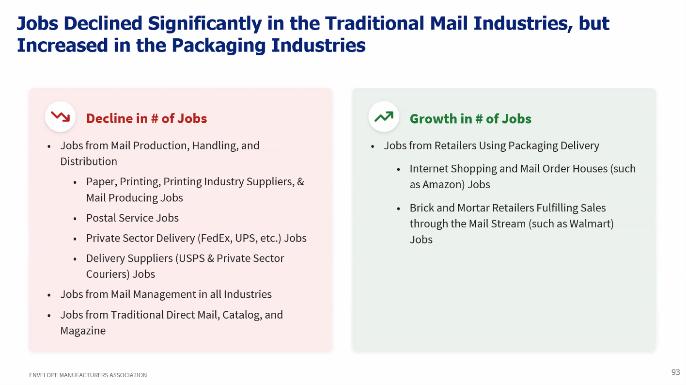
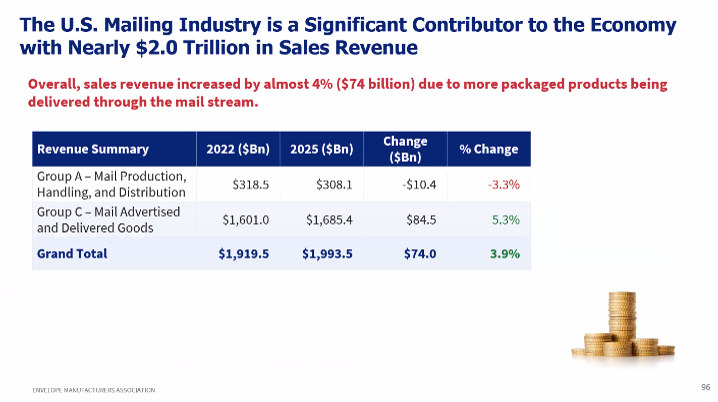
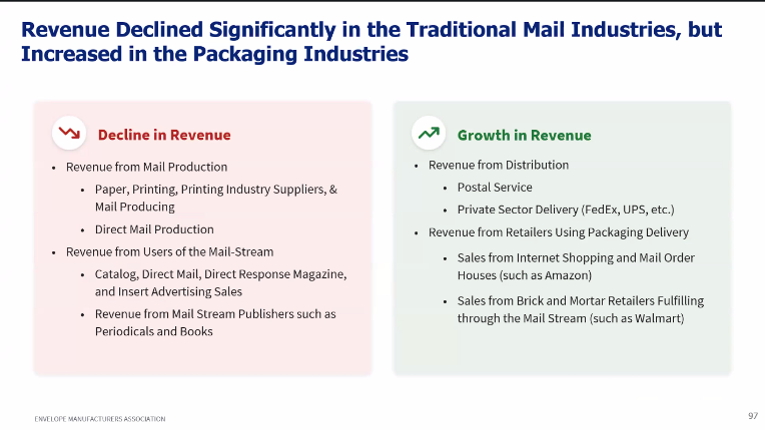
Compared to the 2022 study, the number of mailing industry jobs declined by 6% (down from 7.9 million in 2022), but revenue grew by 4% due to package delivery. The study breaks data down by mailing industry job types and groups (see below)
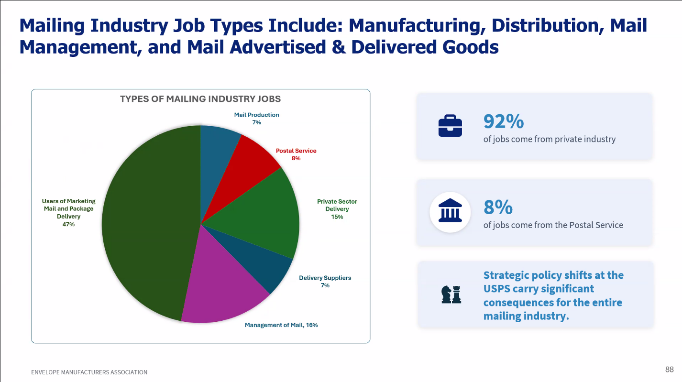
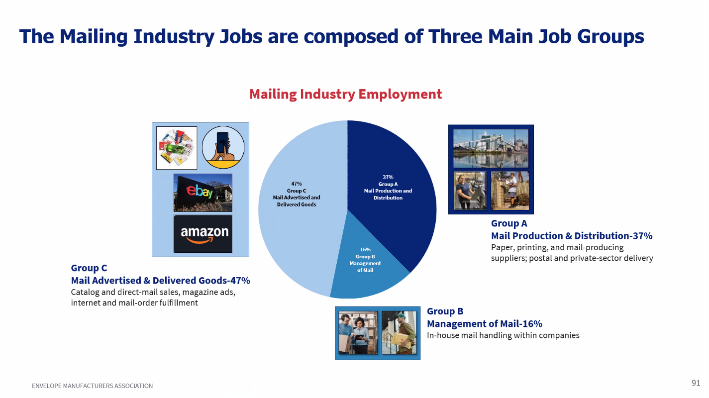
The group reported that while jobs in the traditional mail industries declined, jobs in the packaging industry increased.
Similarly, sales revenue increased by almost 4% due to more packaged products being delivered through the mail stream (see below).
Access to the EMA Jobs Study presentation, job cards by geographic segmentation, and other key information can be found at https://www.envelope.org/emaf/institute-for-postal-studies/ or by scanning the below QR code.
MTAC and the Alliance Recognize Steve Smith on his Retirement
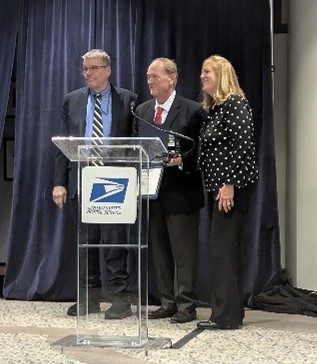 The Mailers Technical Advisory Committee (MTAC) last week presented a recognition certificate to Alliance MTAC representative Steve Smith, who will be retiring at the end of this month. Pictured above are Steve Monteith, USPS x, Deb Damore, GrayHair Software/MTAC Industry Chair; and Steve Smith, outgoing MTAC representative for the Alliance. Smith has served as an MTAC representative for the Alliance for over 30 years.
The Alliance separately recognized Steve on his many contributions to the Alliance of Nonprofit Mailers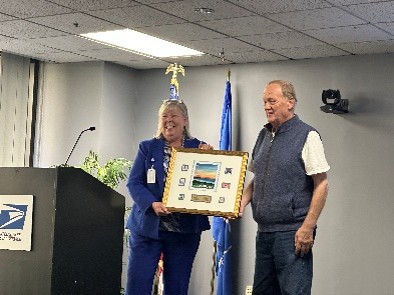 where he has been a member for nearly 40 years. In the past, Smith served on the Alliance Board of Directors, first as a Board member and later as Vice President, then President of the association. When he served as association President, Smith organized a tour and meeting with then-Chair of the Postal Rate Commission (now the Postal Regulatory Commission) Dan Blair. Smith also played an integral role in the search committee for past Alliance Executive Director Tony Conway, who replaced Neal Denton.
Steve has been a valuable asset to the Alliance, with strong experience in both Periodicals and Nonprofit. He has always made himself available to Alliance members and leadership to help the association and its members, and provide education on complex Periodicals and Nonprofit rules. Kathleen Siviter, Alliance Executive Director presented Smith with a framed stamp art piece representing his interests and career (shown above). Many attendees from both the USPS and the industry shared personal experiences they have had with Steve over the years he has been involved in our industry. The Alliance wishes Steve the best in his retirement!
USPS Recent Organizational Changes
The USPS recently announced several significant organizational changes, highlights below.
- Executive Detail – Sara Bambrough as Vice President, Strategic Sales
- New Commercial Organization – creation of a new organizational group led by Gary C. Reblin as Chief Commercial Officer. Groups reporting to Gary in his new role include National Sales, Regional Sales, Strategic Sales, Sales Transformation, Revenue Operations and Applied Engineering.
- Chief Processing & Distribution Office Reorganization – USPS is realigning Engineering Systems under the Chief Processing & Distribution organization. In addition to the functions that currently report to Engineering Systems, some teams will be moving from under the Chief Technology Officer team to now report to Engineering Systems, including Maintenance Operations, Plant Modernization, and Plant Design Methods & Standards.
Into the Postal Weeds…
For those who live in the “postal weeds,” and are looking for news on mail entry, preparation, discounts, incentives, and more, this column in the Alliance Report will be right up your alley! We won’t go all the way into the weeds…but we will offer up highlights on useful resources and mailing standard changes.
· USPS Peak Season Network Updates. The USPS on October 19, 2026, announced it will begin its peak season network update calls on November 10, 2026, with calls schedule 2-3 times per week through January 6, 2027. The calls are designed for the USPS to communicate peak conditions related to processing, delivery, logistics, mail transport equipment and weather-related impacts during peak season. Anyone can participate on the calls, however the format is that industry attendees are muted but can submit questions during the call using the Q&A feature.
Register Now for Nov. 10th Alliance Nonprofit Direct Mail Session for NPF Delivered™ SeriesThe Alliance of Nonprofit Mailers will be presenting an education session as part of the National Postal Forum (NPF) Delivered™ webinar series. The Alliance session, Why Direct Mail Still Delivers for Nonprofits, will be held on Tuesday, November 10, 2026, from 1:00 – 2:00 pm EST and registration is open at https://www.npf.org/delivered. The session description appears below: “Direct mail remains a vital fundraising channel for nonprofits, helping organizations build donor relationships while advancing the missions and communities they serve. Join nonprofit and industry leaders for a timely look at nonprofit postage rates, emerging mail trends, and the strategies organizations use to acquire, retain, reactivate and steward donors. Explore how direct mail has evolved as a media channel, how attribution and measurement are changing, and how nonprofits can better understand what’s working. Gain practical insights for managing postage costs, demonstrating ROI and making informed fundraising decisions that strengthen campaign performance.” The webinar panel will include Alliance Board member Tracey Burgoon, Chief Development Officer, Disabled American Veterans (DAV); Alliance sponsor member Greg Fox, Chief Strategy Officer, Moore; and Kathleen Siviter, Executive Director of the Alliance. |
Leave a Reply